
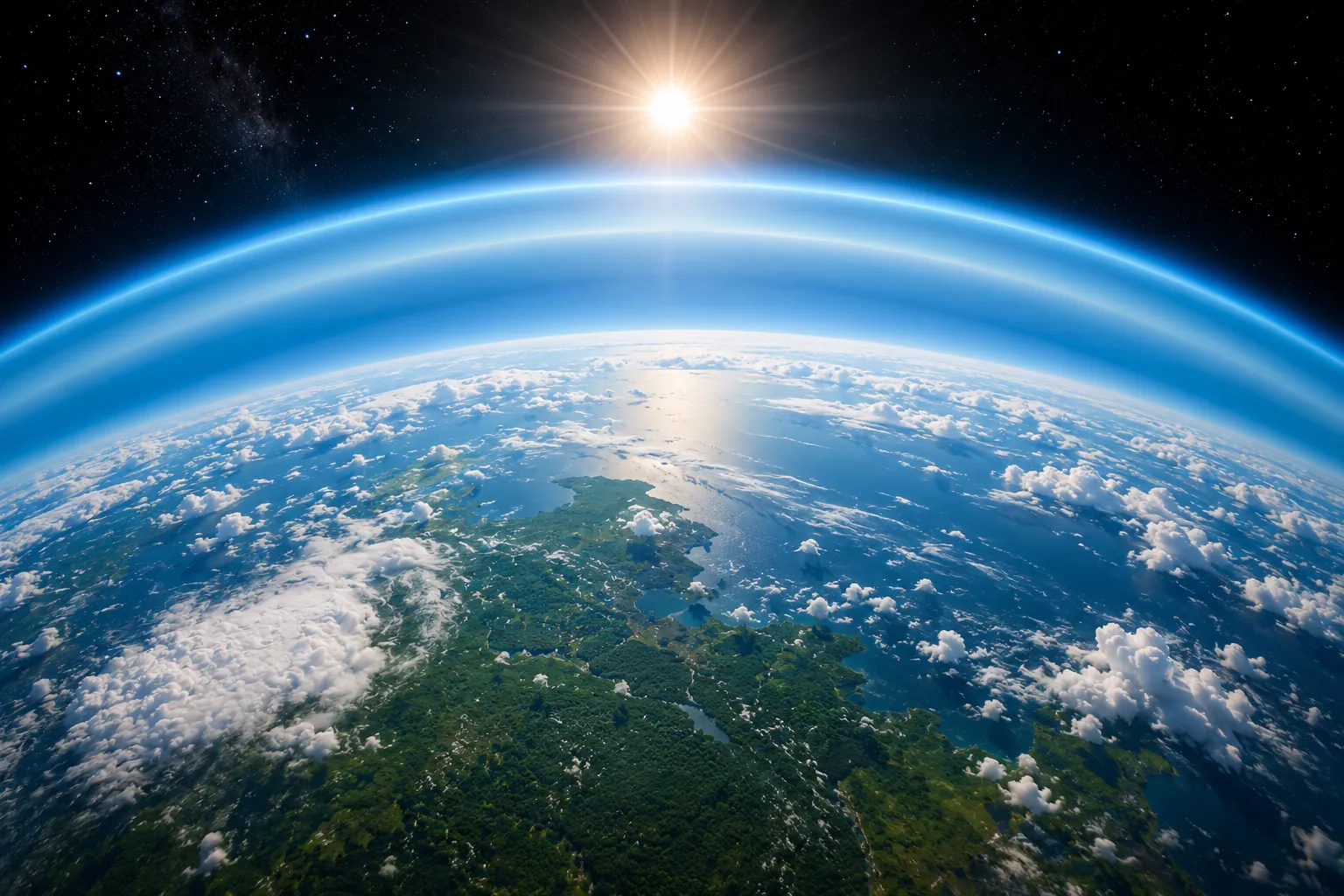
The ozone layer story is, in a meaningful sense, one of the most encouraging environmental stories of the 20th century: a genuine global threat, identified by science, addressed through international cooperation, and measurably improving as a result. It is also a story that is widely misunderstood, sometimes confused with climate change, sometimes assumed to have been either fully solved or permanently irreparably damaged.
The reality is more nuanced and more interesting than either extreme. Here is a clear account of what the ozone layer is, what went wrong with it, what the world did about it, and what the latest scientific data shows about its current state.
What Is the Ozone Layer?
Ozone is a molecule made of three oxygen atoms (O3), as distinct from the oxygen we breathe, which is made of two atoms (O2). Most ozone in the atmosphere is found in the stratosphere, a layer of the atmosphere between roughly 15 and 35 kilometres above Earth's surface. Within the stratosphere, ozone is concentrated in what is called the ozone layer, though it is not a solid layer so much as a region of higher-than-average ozone concentration.
The ozone layer plays a critical protective function. It absorbs the majority of the Sun's ultraviolet-B (UVB) radiation before it reaches Earth's surface. UVB radiation is the component of sunlight responsible for sunburn, and it is also the radiation that, with sufficient exposure, causes skin cancer and cataracts and damages DNA in plants and marine organisms. Without the ozone layer's protection, UVB levels at the surface would be dramatically higher, with severe consequences for most life on land and in the upper ocean.
What Caused the Ozone Hole?
The ozone layer began to be damaged on a significant scale from roughly the mid-20th century onwards, through the widespread industrial production and use of a class of chemicals called chlorofluorocarbons, or CFCs. CFCs were invented in the 1920s by American chemists Thomas Midgley Jr. and Charles Kettering as a supposedly safe alternative to the toxic refrigerants then in use. They are stable, non-toxic, non-flammable, and highly effective as refrigerants, propellants in aerosol sprays, blowing agents for foam, and cleaning solvents. Through the middle decades of the 20th century, they were used in virtually every refrigerator, air conditioner, aerosol can, and fire extinguisher on the planet.
The problem with CFCs is precisely their stability. Because they do not react easily with other chemicals, they survive in the lower atmosphere for decades and eventually drift upward into the stratosphere. Once there, they are broken apart by the intense ultraviolet radiation at that altitude. The chlorine atoms released in this breakdown are the problem. Each chlorine atom can catalytically destroy thousands of ozone molecules in a chain reaction before eventually being removed from the stratosphere. The net effect is a depletion of the ozone layer.
The depletion is most dramatic over Antarctica because of specific polar atmospheric conditions. During the Antarctic winter, a pattern of atmospheric circulation called the polar vortex isolates the air over the continent. Polar stratospheric clouds form in the extremely cold temperatures, and chemical reactions on the surface of these cloud particles convert chlorine compounds into forms that are highly reactive against ozone when sunlight returns in spring. The result is a rapid, severe seasonal depletion of ozone over Antarctica, the "ozone hole."
The ozone hole was first identified by scientists from the British Antarctic Survey (Jonathan Farman, Brian Gardiner, and Jon Shanklin) in 1985, using ground-based measurements collected since 1956. Their paper, published in the journal Nature, showed that ozone levels above Antarctica had been falling dramatically since the late 1970s. The same year, NASA satellite data confirmed the findings from space. The data showed that by the mid-1980s, ozone levels over Antarctica in spring were reduced by 30 to 40% compared to pre-industrial levels, with a near-total absence of ozone in some altitude bands.
The Montreal Protocol: The World Acts
The scientific evidence produced rapid political action at a speed that has rarely been matched on global environmental issues before or since. In 1987, just two years after the scientific community had formally established the ozone hole and its cause, the Montreal Protocol on Substances that Deplete the Ozone Layer was signed in Montreal, Canada, by 46 nations. The agreement established binding schedules to phase out the production and consumption of CFCs and other ozone-depleting substances.
The Montreal Protocol has since been ratified by every country on Earth, making it the first treaty in UN history to achieve universal ratification. Subsequent amendments have strengthened and accelerated its requirements. The London Amendment (1990) added more substances and brought forward phase-out timelines. The Copenhagen Amendment (1992) accelerated the CFC phase-out further. The Kigali Amendment (2016) added hydrofluorocarbons (HFCs), which had been introduced as replacements for CFCs but turned out to be powerful greenhouse gases, though HFCs do not damage the ozone layer.
Global production of CFCs, which had peaked at over one million tonnes per year in the late 1980s, was largely eliminated by the early 2000s under the Protocol's schedules. The UN Environment Programme has described the Montreal Protocol as "the most successful environmental agreement in history."
Is the Ozone Layer Recovering?
Yes, the scientific evidence clearly shows that the ozone layer is recovering, though the process is slow and not yet complete. Ozone-depleting substances have long atmospheric lifetimes, meaning that even though production has largely stopped, molecules released decades ago are still present in the stratosphere and still causing some depletion. Full recovery to pre-1980 levels will take time.
According to the 2022 Scientific Assessment of Ozone Depletion, published by the World Meteorological Organization (WMO) and the UN Environment Programme every four years, ozone levels outside the polar regions have recovered to approximately 1980 baseline levels. In the Northern Hemisphere mid-latitudes, ozone is back to pre-depletion levels. In the Southern Hemisphere mid-latitudes, recovery is somewhat slower but clearly progressing.
The Antarctic ozone hole is still present each spring, but it is showing clear signs of recovery. The average size and depth of the hole has declined since its peak in the late 1990s and early 2000s. The 2022 scientific assessment projected that the Antarctic ozone hole would return to 1980 values by approximately 2066, while ozone over the Arctic should return to pre-depletion levels by around 2045.
However, the recovery is not completely smooth. The 2023 Antarctic ozone hole was exceptionally large and deep, partly attributed to the eruption of the Hunga Tonga-Hunga Ha'apai submarine volcano in January 2022, which injected an unusual amount of water vapour into the stratosphere (stratospheric water vapour enhances ozone-destroying reactions). Scientists emphasised that this was a temporary setback to the long-term recovery trend, not a reversal of the overall progress.
Is the Ozone Problem the Same as Climate Change?
These two issues are frequently confused with each other, but they are distinct problems with different causes, mechanisms, and timescales, though they do interact in important ways.
Ozone depletion is caused by specific manufactured chemicals (primarily CFCs and related halogen compounds) destroying ozone molecules in the stratosphere. Climate change is caused primarily by increased concentrations of carbon dioxide, methane, and other greenhouse gases trapping heat in the lower atmosphere. The two share the same space (the atmosphere) but operate through different chemistry at different altitudes.
The interactions between them are real but complex. A depleted ozone layer allows more UVB to reach the surface, which has a modest cooling effect on the planet (because UVB reflects some energy back to space). A warming climate affects stratospheric temperatures in ways that can influence ozone chemistry. The HFCs that replaced CFCs, while ozone-friendly, turned out to be potent greenhouse gases, which is why the Kigali Amendment to the Montreal Protocol was needed to phase them out.
What Does This Tell Us?
The ozone layer story stands as proof that coordinated global action on an environmental problem can produce measurable positive results. When scientists identified the problem, when policy makers accepted the evidence, when industry found alternatives, and when every nation signed and implemented the same agreement, the result was a genuine, measurable reversal of a dangerous global trend.
The chemicals responsible for ozone depletion were not minor industrial substances. CFCs were central to refrigeration, air conditioning, and dozens of consumer products. Phasing them out required investment, innovation, and cooperation from both wealthy and developing nations. It was not easy. But it worked.
Forty years after the discovery of the ozone hole and nearly forty years since the world's governments decided to act on it, the ozone layer is genuinely recovering. Skin cancer rates from UV exposure, which would have been catastrophically higher in a world without the Montreal Protocol, are lower than they would otherwise have been. The recovery is slow, measured in decades, not years. But it is real, it is ongoing, and it is one of the clearer examples in modern history of what global scientific and political cooperation can actually accomplish.
Related Posts
Blue Moon vs Red Moon Explained: What They Actually Are
What is a blue moon, and does it actually look blue? What makes a moon turn red? A clear, science-based explanation of two of the most misunderstood events in the night sky.
Why Is the Ocean Salty? The Real Scientific Answer
Rivers flow into the ocean every day and they are not salty. So why is the ocean? The answer involves billions of years of geology and a water cycle that never stops.

What Is a Leap Year and Why Do We Have It?
Every four years, February gets an extra day. The answer involves the fractional maths of Earth's orbit, Julius Caesar, and a calendar rule with three exceptions.
Comments
Loading comments…