
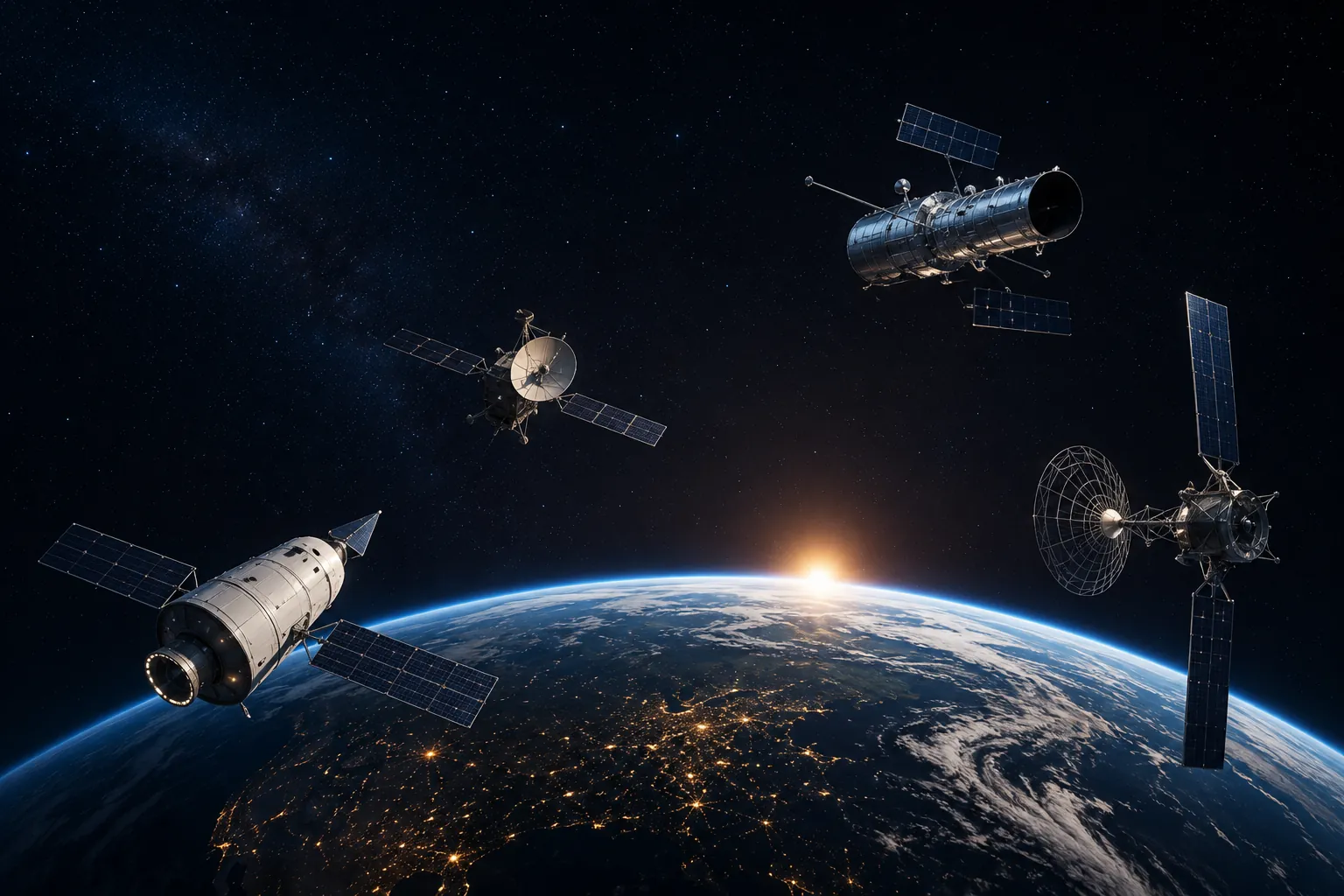
Most people interact with space technology dozens of times a day without knowing it. The GPS signal that routes your delivery driver. The satellite imagery that powers Google Maps. The weather forecast that tells you to bring an umbrella. The financial transaction that clears instantly because two satellites confirmed the timestamp. Space is not an abstraction, it is infrastructure that underpins the global economy, and it has been since the 1970s.
What has changed in the last decade, and what will change much more dramatically in the next, is the cost of accessing space. SpaceX's Falcon 9 rocket reduced the cost of launching a kilogram of payload to orbit from approximately $54,000 in 2000 to under $2,700 today. Starship, SpaceX's fully reusable heavy-lift vehicle, is designed to reduce that cost to under $100 per kilogram. When the cost of reaching orbit falls by two orders of magnitude, the range of economically viable space activities expands enormously.
The satellite internet revolution
The most immediately impactful development is already underway. SpaceX's Starlink network, now numbering over 6,000 satellites in low Earth orbit, provides broadband internet access to over 4 million subscribers in 100 countries, with coverage available even in remote regions far beyond the reach of terrestrial infrastructure. Amazon's Kuiper constellation, OneWeb (now Eutelsat OneWeb), and China's Guowang network are deploying competing systems.
The implications for global equity are significant. Approximately 2.6 billion people currently lack reliable internet access. Satellite internet cannot replace fibre optics in urban centres, but it can provide viable connectivity to rural communities, island nations, disaster zones, and the 40% of the world's population that currently operates without reliable broadband. Healthcare, education, financial services, and economic participation, all of which increasingly require connectivity, become accessible in places where they previously were not.
"The first industrial revolution was about steam. The second was about electricity. The next one will be about space, but most people will not notice until it has already happened."
Earth observation: watching the planet in real time
The second major transformation is in Earth observation. There are now over 1,000 Earth observation satellites in orbit, operated by government agencies, commercial companies, and research institutions. They monitor deforestation in the Amazon to a resolution of a few metres. They track ships crossing oceans, including dark vessels that have turned off their transponders. They measure air quality over individual cities, soil moisture across continents, and ice extent at both poles with a frequency and precision that was impossible a decade ago.
The commercial applications are expanding rapidly. Precision agriculture, using satellite data to tell farmers exactly which fields need water, fertiliser, or treatment, rather than treating everything uniformly, could reduce agricultural water use by 30% and chemical inputs by 20% if adopted at scale. Insurance companies are using satellite imagery to assess crop damage, wildfire risk, and flood exposure in real time. Commodity traders are using it to estimate harvest sizes before official government statistics are released.
Manufacturing in orbit: the long game
The most speculative but potentially most big development is orbital manufacturing. The vacuum, microgravity, and extreme temperature differentials of space enable manufacturing processes that are physically impossible on Earth. Certain optical fibres, semiconductors, and pharmaceutical compounds can only be produced with the purity and structure that space conditions allow.
Varda Space Industries launched its first manufacturing capsule in 2023 and returned ritonavir, a critical HIV/AIDS medication, manufactured in space. The drug crystals produced showed superior structure to Earth-produced equivalents, with implications for drug efficacy. This is a proof of concept, not a commercial supply chain. But as launch costs fall and orbital platforms become more capable, in-space manufacturing for high-value products will become economically viable over the coming decade.
The risks: debris, regulation, and the race for resources
The expansion of space activity brings serious risks that are not yet adequately governed. Low Earth orbit is increasingly congested with active satellites and debris from decades of launches. The Kessler Syndrome, a theoretical cascade of collisions that could make certain orbital zones unusable, is no longer purely theoretical. Several close approaches and actual collisions have already occurred. International frameworks for orbital debris management lag far behind the pace of commercial deployment.
The legal framework for space resources is similarly underdeveloped. The 1967 Outer Space Treaty prohibits national appropriation of celestial bodies but is ambiguous about resource extraction. The United States, Luxembourg, Japan, and UAE have passed national legislation asserting the right of their companies to extract and own space resources. China has not. Russia has not. A coherent international framework does not exist. As asteroid mining and lunar resource extraction move from concept to commercial planning, this regulatory gap will become increasingly consequential.
None of this stops the expansion. The economic incentives are too large, the technology is advancing too fast, and the geopolitical competition is too intense for any single actor to slow the pace. What it means is that the governance of humanity's expansion into space, who benefits, who bears the risks, and who sets the rules, is one of the defining policy challenges of the next generation.
Related Posts

Why is there liquid inside a coconut? The answer is stranger than you think
You crack open a coconut and liquid pours out. The real answer involves biology, evolution, and a survival trick millions of years in the making.
Blue Moon vs Red Moon Explained: What They Actually Are
What is a blue moon, and does it actually look blue? What makes a moon turn red? A clear, science-based explanation of two of the most misunderstood events in the night sky.

Why Is the Ocean Salty? The Real Scientific Answer
Rivers flow into the ocean every day and they are not salty. So why is the ocean? The answer involves billions of years of geology and a water cycle that never stops.
Comments
Loading comments…