
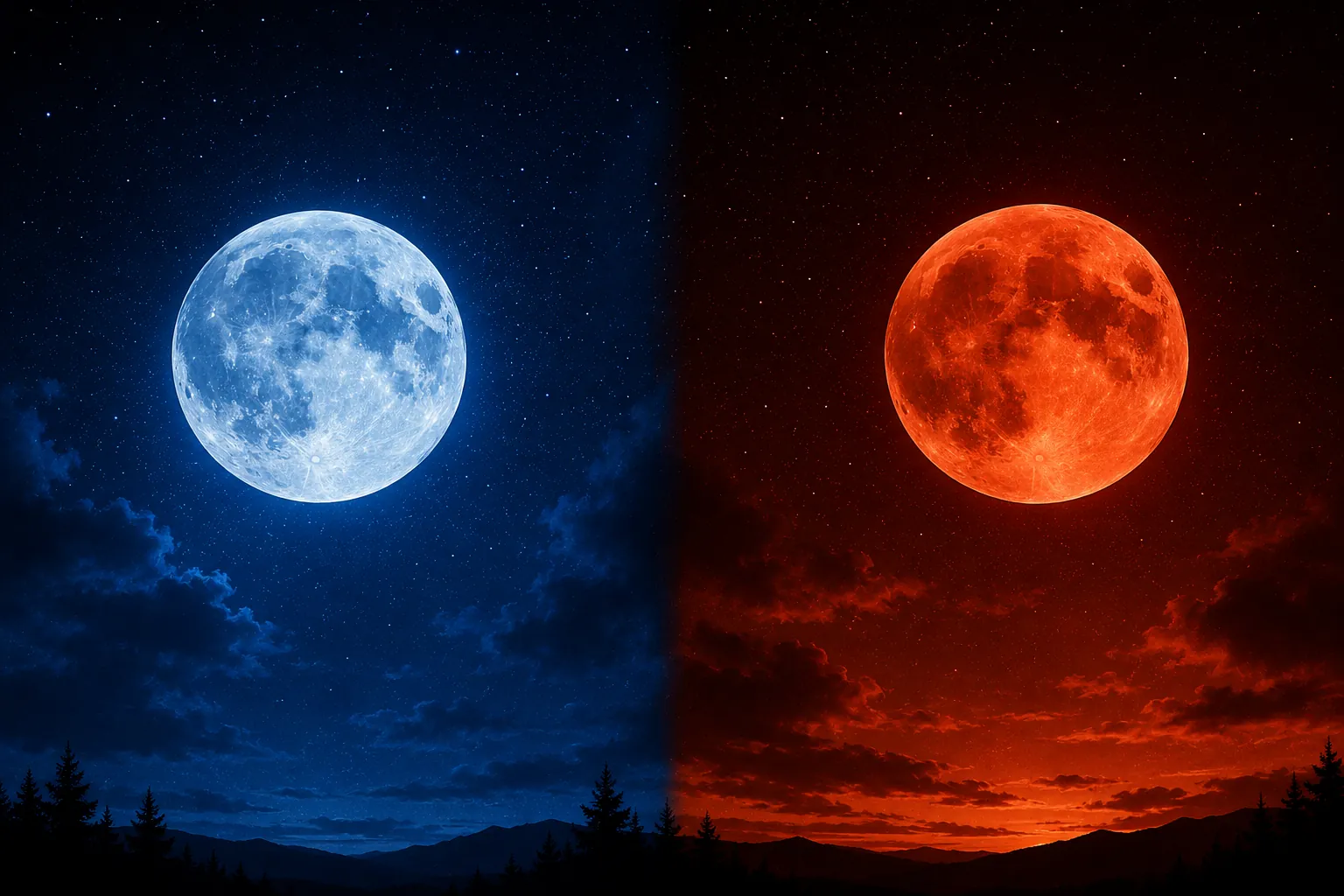
You have almost certainly heard the phrase "once in a blue moon." You may have also seen photographs of a vivid red or orange moon glowing in the night sky and wondered what was happening. These two phenomena, the blue moon and the red moon, are among the most frequently mentioned but least accurately understood events in popular astronomy.
Neither is as mysterious as the phrases suggest. Both have clear scientific explanations. And perhaps most surprisingly, a blue moon almost never looks blue, while a red moon genuinely does look red, just for entirely different reasons than most people assume. Here is what the science actually says.
What Is a Blue Moon?
The term "blue moon" has two separate and distinct definitions that are both in common use today, and the confusion between them is itself part of the story.
Definition one: the calendar blue moon. This is the most widely recognised modern definition. A blue moon is the second full moon to occur within a single calendar month. Because the lunar cycle is approximately 29.5 days long, most months contain only one full moon. But because some months are 30 or 31 days long, occasionally a month will begin with a full moon and end with another one. That second full moon is called a blue moon.
A calendar blue moon occurs roughly every two to three years. More precisely, it happens about 7 times every 19 years, a cycle known as the Metonic cycle, named after the ancient Greek astronomer Meton of Athens who identified it around 432 BCE. The next calendar blue moons after 2026 will fall in 2028 (two in that year, in January and March) and again in 2031.
Definition two: the seasonal blue moon. This is actually the older and more technically precise definition, used by professional astronomers and trackers of the traditional farming almanac. In this definition, a blue moon is the third full moon in an astronomical season that contains four full moons. A season (spring, summer, autumn, winter) normally contains three full moons. When a season contains four, the third one is called the blue moon.
The seasonal definition pre-dates the calendar definition by centuries. It was used in the Maine Farmer's Almanac from at least the early 20th century. The calendar definition became dominant after a 1946 article in Sky and Telescope magazine misidentified the seasonal blue moon as the second full moon in a calendar month. That misinterpretation became so widely repeated that it eventually became the standard popular definition. Both definitions are now considered legitimate.
Does a Blue Moon Actually Look Blue?
Almost never. Under normal conditions, the second full moon in a month looks exactly like any other full moon, white or pale yellow, depending on its position in the sky and atmospheric conditions. The name is not a description of colour.
There is one rare scenario in which the moon can genuinely appear blue or blue-grey. When large quantities of particles of a specific size, between 0.5 and 1 micrometre in diameter, are present high in the atmosphere, they scatter red light and allow blue light to pass through, causing the moon to appear faintly blue. This has been observed following major volcanic eruptions. After the eruption of Krakatoa in 1883, observers around the world reported seeing the moon appear blue or green for months, due to ash and sulphur dioxide particles suspended in the upper atmosphere. Similar reports followed the eruptions of El Chichón in Mexico in 1982 and Mount Pinatubo in the Philippines in 1991. Large wildfires can also create the effect temporarily when smoke particles of the right size drift over a large area.
But these are rare coincidences of atmospheric chemistry, not a property of blue moons themselves. The phrase "once in a blue moon" meaning "very rarely" likely derives from the rarity of genuinely blue-tinted moons, rather than from any standard lunar calendar event.
What Is a Red Moon?
A red moon, often called a blood moon, has a completely different cause. It is the result of a total lunar eclipse, and unlike the blue moon, it genuinely does look red, sometimes a deep orange-red, sometimes a brighter copper colour, and occasionally closer to brown depending on atmospheric conditions at the time.
A total lunar eclipse occurs when the Earth passes directly between the Sun and the Moon, and the Moon moves fully into Earth's shadow. This shadow has two parts: the penumbra (the outer, lighter shadow) and the umbra (the inner, darker shadow). A total lunar eclipse happens when the Moon is entirely within the umbra.
During a total lunar eclipse, the Moon is not completely dark because Earth's atmosphere bends (refracts) sunlight around the edges of the planet. As sunlight passes through the Earth's atmosphere, shorter-wavelength light, the blue and violet end of the spectrum, is scattered away by air molecules in all directions. This is the same process that makes the sky appear blue during the day. What remains is longer-wavelength light: reds and oranges. This filtered, reddish light is what reaches the Moon during a total eclipse and is reflected back toward Earth, giving the Moon its characteristic blood-red appearance.
The exact shade of red depends heavily on the current state of Earth's atmosphere at the time of the eclipse. More volcanic ash or dust in the atmosphere means deeper, darker reds. Clearer air produces a brighter copper or orange colour. The Danjon scale, developed by French astronomer André-Louis Danjon in the 1920s, rates total lunar eclipses on a scale from 0 (very dark, the Moon nearly invisible) to 4 (very bright, coppery orange with a blue-grey edge), based on the expected colour intensity.
How Often Does a Total Lunar Eclipse Happen?
Total lunar eclipses are more common than many people realise. They occur roughly every 1.5 years on average, though they can be visible only from certain parts of the Earth at any given event. Unlike a solar eclipse, which is only visible along a narrow corridor, a total lunar eclipse can be seen by anyone on the night-facing side of the Earth when it occurs, covering roughly half the globe.
Unlike solar eclipses, which require special eye protection to observe safely, a lunar eclipse requires no special equipment at all. It is completely safe to watch with the naked eye, binoculars, or a telescope. The entire process from the Moon first entering the penumbra to the end of totality and its exit can last several hours. The period of full totality, when the Moon is completely within the umbra and at its reddest, typically lasts between a few minutes and about 100 minutes depending on the geometry of the particular eclipse.
What About a Supermoon?
You may also have heard the term supermoon, which is often mentioned alongside blood moons and blue moons in news headlines. A supermoon occurs when a full moon (or new moon) coincides with the Moon being at or near its closest point to Earth in its slightly elliptical orbit. This closest point is called perigee.
Because the Moon's orbit is not a perfect circle, its distance from Earth varies between approximately 356,500 kilometres at its closest (perigee) and about 406,700 kilometres at its farthest (apogee). When a full moon occurs near perigee, it appears roughly 14% larger and about 30% brighter than a full moon at apogee. The term "supermoon" was coined by astrologer Richard Nolle in 1979, and while it is not an official astronomical term, it has been widely adopted by scientists and the media to describe a full moon within 90% of its closest approach to Earth.
A supermoon total lunar eclipse, a combination sometimes called a super blood moon, is a rarer event. The most recent widely observed super blood moon visible from large parts of the world occurred in May 2021.
A Common Confusion: The Harvest Moon
A harvest moon is neither blue nor red. It is simply the full moon that falls closest to the autumn equinox, typically in September or occasionally early October in the Northern Hemisphere. It is called the harvest moon because historically, farmers used its light to continue harvesting crops into the night after sunset.
The harvest moon often appears larger and more orange than usual when it rises near the horizon. This is due to the moon illusion, a well-documented perceptual effect in which the Moon appears larger when near the horizon compared to when it is high in the sky, even though its actual size and distance have not changed. The orange colour when near the horizon results from the same atmospheric scattering as a sunset: when the Moon is low, its light passes through a much thicker slice of atmosphere, scattering blue light and leaving warm reds and oranges.
Key Differences at a Glance
A blue moon is a calendrical or seasonal event: a full moon occurring an extra time in a month or season. It almost never actually looks blue. A red moon, or blood moon, is an optical phenomenon caused by a total lunar eclipse, where Earth's atmosphere filters sunlight and casts a red glow on the Moon. It genuinely looks red. A supermoon is a full moon at its closest approach to Earth, appearing slightly larger and brighter. A harvest moon is the full moon nearest to the autumn equinox, which often appears orange when rising for atmospheric reasons.
These events can overlap. A super blood moon combines a supermoon with a total lunar eclipse. A blue moon total lunar eclipse, while theoretically possible, is rare because the two phenomena are determined by entirely different mechanisms.
Why Do These Events Fascinate Us?
The Moon has been a reference point for human timekeeping, agriculture, navigation, and storytelling for as long as our species has existed. Nearly every major ancient civilisation used lunar calendars. The word "month" itself derives from the Moon. Blue moons and blood moons are moments when ordinary observers, without any special equipment, can look up and see something different in the sky, and feel connected to both the physical reality of the solar system and the long chain of humans who looked up at the same sky throughout history.
The science behind these events is entirely understood. But understanding how something works does not make it less worth watching. A total lunar eclipse, with the Moon turning a deep copper-red in a dark sky, is genuinely one of the most beautiful free spectacles that nature offers. No special equipment required. You just need a clear night and an unobstructed view of the sky.
Related Posts
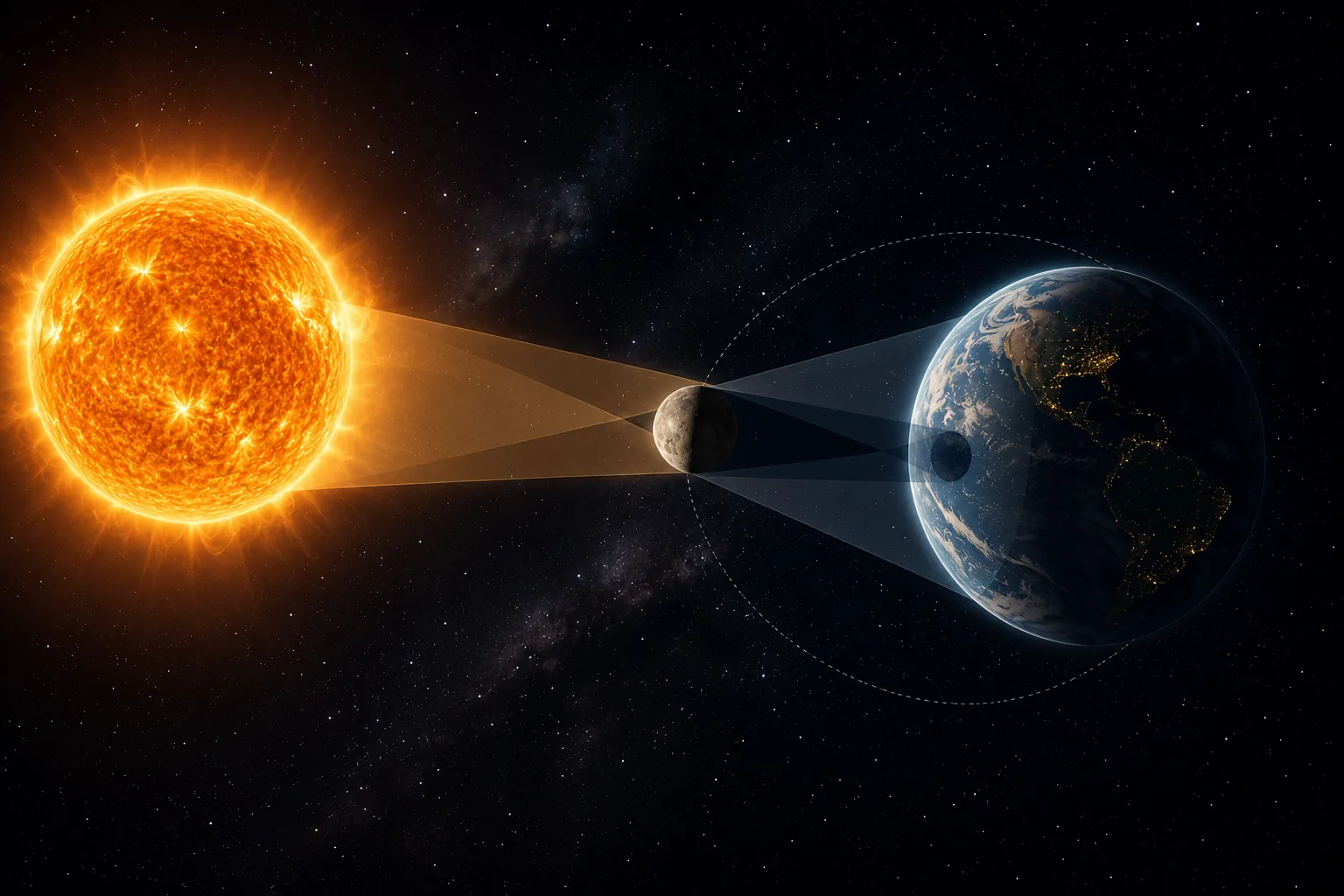
What Causes a Solar Eclipse and Is It Safe to Look?
A solar eclipse is one of nature's most dramatic events. Here is exactly what causes it, why total eclipses are rare, and the real truth about eye safety.
What Is a Leap Year and Why Do We Have It?
Every four years, February gets an extra day. The answer involves the fractional maths of Earth's orbit, Julius Caesar, and a calendar rule with three exceptions.
Northern Lights Explained: What Causes the Aurora Borealis?
Curtains of green, purple, and red light dancing across the sky. Here is the real science behind the aurora borealis and why 2024 and 2025 produced record displays.
Comments
Loading comments…