
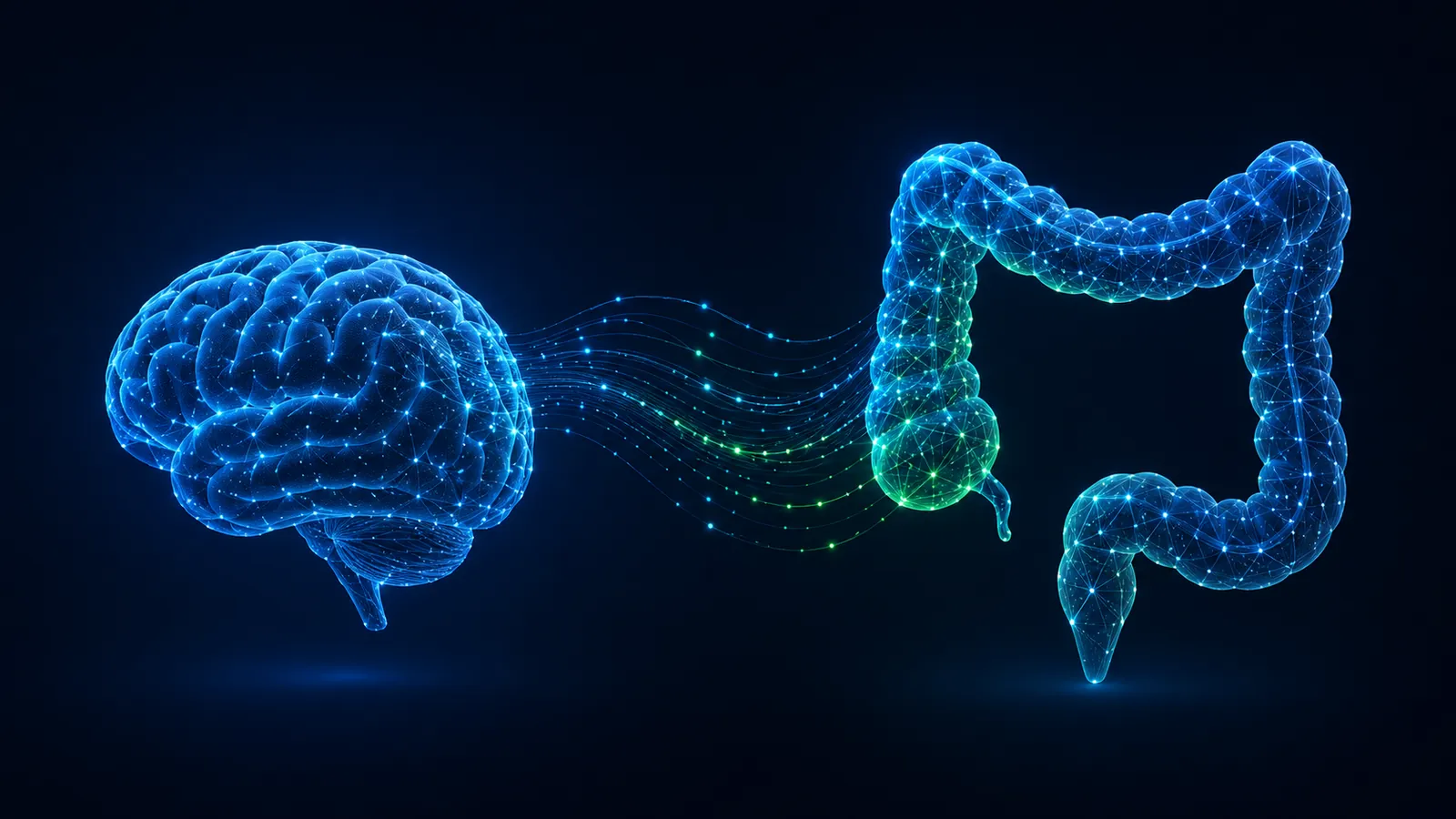
The idea that the gut and brain communicate is not new. The phrase "gut feeling" exists in virtually every language. Before an exam or a difficult conversation, most people experience the sensation in their stomach that accompanies anxiety. What is new, dramatically new, and still being absorbed by medicine as a whole, is the mechanistic understanding of how this communication works, how pervasive it is, and what it means for treating some of the most challenging diseases in human health.
The gut contains what scientists call the enteric nervous system, a network of approximately 100 million neurons embedded in the lining of the gastrointestinal tract. This is more neurons than the spinal cord contains, which is why researchers sometimes refer to the gut as "the second brain." The enteric nervous system communicates bidirectionally with the brain via the vagus nerve, through hormonal signals, and through the immune system. It does so constantly, and the influence runs in both directions.
The microbiome: the overlooked organ
Living in and on this enteric nervous system is the gut microbiome, a community of approximately 38 trillion microorganisms, primarily bacteria, that collectively weigh about 1.5 kilograms and contain around 150 times more genes than the human genome. Until relatively recently, these microorganisms were considered passengers, tolerated residents performing some basic digestive functions. Research over the past two decades has overturned this view entirely.
The gut microbiome produces neurotransmitters including serotonin, dopamine, and GABA, the same chemicals that regulate mood, motivation, and anxiety in the brain. Approximately 90% of the body's serotonin is produced not in the brain but in the gut. The microbiome regulates the immune system, influences inflammation throughout the body, and, through mechanisms still being fully mapped, affects cognitive function, behaviour, and mental health in ways that have surprised even the researchers who discovered them.
"We used to think the brain ran the body. Now we understand the gut is running a significant part of the brain."
Mental health: the evidence accumulating fast
The link between gut microbiome composition and mental health has moved from speculative to evidence-based at an accelerating pace. Studies in mice have demonstrated that transplanting gut bacteria from anxious mice into calm ones induces anxiety-like behaviour in the recipients, a striking result that prompted serious investigation in humans. A 2022 large-scale study in Nature Microbiology, involving over 1,000 participants, found significant associations between specific gut bacteria and depression, with participants who had lower levels of two bacteria, Coprococcus and Dialister, showing consistently higher rates of depressive symptoms, independent of antidepressant use.
Fermented foods, which increase the diversity and abundance of beneficial gut bacteria, have now been shown in randomised controlled trials to reduce markers of inflammation and improve reported mental wellbeing. A 2021 Stanford study found that a high-fermented-food diet increased microbiome diversity and decreased 19 inflammatory proteins, including interleukin-17a, which has been implicated in rheumatoid arthritis, inflammatory bowel disease, and depression.
Parkinson's and Alzheimer's: the gut as origin
Some of the most extraordinary research in the gut-brain field concerns neurodegenerative disease. Evidence has been accumulating that Parkinson's disease may not begin in the brain at all, it may begin in the gut. Misfolded alpha-synuclein proteins, the hallmark of Parkinson's pathology, have been detected in the enteric nervous system of Parkinson's patients up to 20 years before brain pathology appears. The vagus nerve appears to act as a conduit along which these proteins travel from the gut to the brain.
A landmark study in Denmark followed 9,400 people who had undergone vagotomy, surgical severing of the vagus nerve, and compared their Parkinson's incidence to matched controls. Those with complete vagotomy had a 40% lower risk of developing Parkinson's disease. The implication, that cutting the gut-brain communication pathway reduces the pathway by which Parkinson's pathology travels, is striking.
For Alzheimer's, similar patterns are emerging. The gut microbiome appears to influence the production and clearance of amyloid beta, the protein that accumulates in Alzheimer's brains. Specific gut bacteria produce short-chain fatty acids that regulate the brain's immune cells and may slow or accelerate neuroinflammation. This does not mean gut interventions will prevent Alzheimer's, the research is not there yet. But it opens a route of investigation that was not previously on the map.
What this means for how we eat
The gut-brain research provides a new mechanistic framework for understanding why diet affects mental health and cognitive function, not just physical health. High-fibre diets rich in diverse plant foods increase microbiome diversity, which is consistently associated with better health outcomes across multiple systems. Ultra-processed foods reduce microbiome diversity and increase gut permeability (sometimes called "leaky gut"), allowing bacterial products to enter the bloodstream and trigger systemic inflammation.
The Mediterranean diet, associated with reduced risk of depression, dementia, and cardiovascular disease across dozens of large studies, appears to achieve many of its benefits through microbiome mechanisms. This is not a reason to follow any particular branded diet, but it does reinforce a principle that emerges consistently from nutritional science: variety, plants, and minimally processed food support the biological systems that underpin both physical and mental health in ways that are now mechanistically understood.
This article is for general information only and is not medical advice. Talk to a qualified health professional about your own situation.
Related Posts

Japan is testing a drug that grows back your teeth. Human trials started in 2026
A Japanese biotech company has started human trials for a drug that can grow back lost teeth from the root up.
Scientists in Germany just created a gel that grows back your joint cartilage, and no surgery is needed
Millions of people live with painful, damaged joints and are told there is no fix. German scientists just proved that wrong with a gel that restores cartilage naturally.
Comments
Loading comments…