
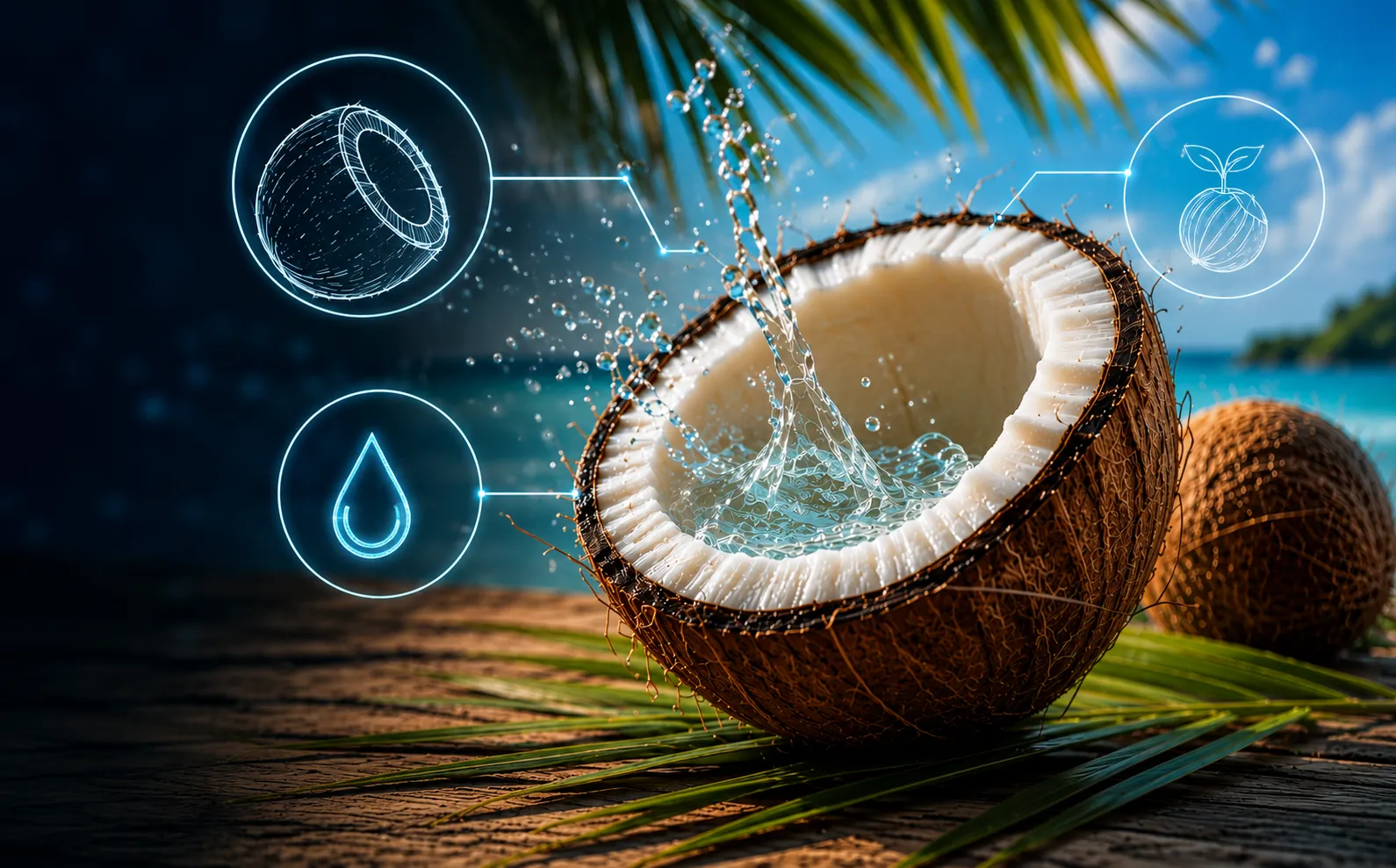
Most people who drink coconut water have never stopped to wonder what it actually is or where it comes from. It just seems like a natural thing that happens to be inside a coconut, the way juice is inside an orange. But coconut water is not juice. It is not the same kind of liquid at all. And the story of how it gets inside the coconut, and why it is there in the first place, is genuinely surprising once you understand it.
Let us start with the most basic question: what exactly is the liquid inside a coconut?
Coconut water is not juice
When you squeeze an orange, the liquid that comes out is the result of crushing the cells of the fruit's flesh. That is juice in the traditional sense: the broken-down contents of plant cells. Coconut water is completely different. It is not extracted from any flesh. It is not made by crushing anything. It is a liquid that the coconut produces and stores inside itself as it grows.
Scientifically, coconut water is classified as a liquid endosperm. The endosperm is the nutritional tissue inside a seed that feeds the developing plant embryo before it can photosynthesize and feed itself. In most seeds, the endosperm is solid or semi-solid, like the white part of a grain of corn. In a coconut, the endosperm exists in two forms: the liquid water inside the hollow centre, and the white flesh on the inner wall of the shell.
As the coconut matures on the tree, the liquid gradually gets absorbed by the flesh, which is why young green coconuts have more water inside than older brown ones. The water is essentially the food supply for the coconut's embryo, stored in liquid form to be used during germination.
Where does the liquid come from originally?
This is the part that surprises most people. The liquid inside a coconut does not come from rain. It does not seep in through the shell. It is produced by the coconut palm tree itself and pumped directly into the developing coconut through the stalk that connects the nut to the tree.
The coconut palm draws water up from the ground through its roots, the way all plants do. As this water travels through the tree and into the developing coconut, it picks up minerals, sugars, vitamins, and electrolytes along the way. The coconut's outer husk and hard shell are watertight, so once this liquid is inside, it stays inside. The coconut essentially fills up with this nutrient-rich fluid over the course of several months as it grows.
A young coconut that is about five to seven months old contains the most water, sometimes as much as one full litre inside a single nut. As the coconut continues to mature over the next several months, specialised cells on the inner wall of the shell absorb more and more of this liquid and convert it into the solid white flesh we call coconut meat. By the time the coconut is fully mature at around twelve months, much of the water has been converted into flesh, and the remaining liquid has become richer and slightly thicker than it was when the coconut was young.
Why did the coconut evolve to store liquid this way?
The coconut is one of the most remarkable seeds in the plant kingdom when it comes to survival strategy. Most seeds are small and light, designed to be carried by wind or animals to a new location where they can germinate. A coconut is the opposite: it is enormous, heavy, and built like a fortress.
The reason for this is that the coconut palm evolved in coastal tropical environments where the primary method of seed dispersal was the ocean. A coconut that falls from a tree near the coast can float in the sea for months or even years, carried by ocean currents across vast distances, and still be capable of germinating when it finally washes ashore somewhere new.
That liquid inside the coconut is the key to this strategy. It is the food and water supply that keeps the embryo alive during its long ocean journey. The embryo does not need soil or rain or sunlight while it is floating. It just needs the nutrients stored inside its own shell to survive until it reaches land. The liquid endosperm, full of sugars, amino acids, and minerals, provides exactly that.
The thick outer husk of the coconut, which most people discard without thinking much about it, is not just padding. It is a sophisticated flotation device made of buoyant fibres that keeps the coconut floating with the right side up and protects the embryo from saltwater damage. The hard inner shell adds another layer of protection. The whole structure is an extraordinarily well-designed survival capsule, refined by millions of years of evolution.
Why is coconut water so good for you?
The nutritional profile of coconut water makes more sense when you understand what it is designed to do. It is not designed to be a health drink for humans. It is designed to be a complete survival package for a plant embryo that might spend months at sea before germinating.
That means it needs to contain everything the embryo could possibly need: water for hydration, sugars for energy, minerals for cellular function, and electrolytes to maintain the right chemical balance inside the embryo's cells. The result is a liquid that happens to be remarkably well-suited for human hydration as well, because plants and animals share many of the same basic nutritional needs at the cellular level.
Coconut water contains potassium, sodium, magnesium, calcium, and phosphorus, the same electrolytes that are lost through sweat during exercise. It is low in calories, has a natural sweetness from its sugars, and is easy to digest. During World War Two, coconut water was reportedly used as an emergency intravenous fluid for wounded soldiers when medical supplies ran low, because its electrolyte composition is close enough to human blood plasma to serve as a substitute in emergencies.
Whether modern coconut water sold in shops retains all the nutritional benefits of fresh coconut water from a young green coconut is a more complicated question. Processing, pasteurisation, and storage all affect the nutritional content. Fresh coconut water from a young coconut cracked open on the spot is the most nutritious version. Packaged coconut water varies considerably depending on how it was produced.
What about the white flesh? Where does that come from?
The white flesh of a mature coconut is the solid endosperm, the same nutritional tissue as the water, just in a different form. As the coconut matures, the cells lining the inner shell absorb the liquid endosperm and convert it into fat-rich solid tissue. This is why coconut flesh is high in fat, particularly saturated fat, while coconut water is low in fat. The same basic material has been chemically transformed into a completely different substance.
Coconut milk, which is different from coconut water, is made by grating and squeezing the white flesh. It is rich and creamy because of the high fat content of the flesh. Coconut cream is an even more concentrated version. None of these are the naturally occurring liquid inside the nut. They are all produced by processing the flesh after the coconut has been opened.
Does the coconut know you are drinking its food supply?
In a sense, yes, though not in any conscious way. When you drink coconut water from a young green coconut, you are consuming the food that the coconut intended to use to grow a new palm tree. You have essentially intercepted the embryo's lunch.
The coconut palm does not care, of course. It produces thousands of coconuts in its lifetime, most of which never germinate successfully. From the tree's perspective, this is just one more coconut that did not become a palm tree, the same as all the others that fell, rotted, or got eaten by animals. The coconut's survival strategy is built around the idea that only a small fraction of seeds need to succeed for the species to survive.
Humans have been drinking coconut water for thousands of years across tropical regions of Asia, the Pacific, the Caribbean, and parts of Africa. In many of these cultures, the young green coconut was not just a drink but a survival tool, providing both hydration and nutrition in hot climates where fresh water could be scarce. The same evolutionary trick that helped coconuts survive ocean voyages also made them one of the most valuable food sources in the tropical world for much of human history.
One more thing that will change how you look at a coconut
Next time you hold a coconut, consider this: the liquid sloshing around inside it was pumped in by a tree that may be twenty metres tall, travelling up through the trunk and into the nut over a period of months, collecting minerals from deep in the soil along the way. That liquid has been sealed inside a watertight shell, protected by a thick husk, ready to feed a tiny embryo on a potential journey of thousands of kilometres across open ocean.
It is one of the most sophisticated survival systems in the natural world, refined by millions of years of evolution, and it fits in the palm of your hand. The fact that it also tastes good and happens to be excellent for human hydration is just a happy coincidence of biology.
Related Posts

Blue Moon vs Red Moon Explained: What They Actually Are
What is a blue moon, and does it actually look blue? What makes a moon turn red? A clear, science-based explanation of two of the most misunderstood events in the night sky.

The space economy: how space is about to affect your daily life
Satellites, asteroid mining, and orbital manufacturing are no longer science fiction. They are business plans.

Why Is the Ocean Salty? The Real Scientific Answer
Rivers flow into the ocean every day and they are not salty. So why is the ocean? The answer involves billions of years of geology and a water cycle that never stops.
Comments
Loading comments…