
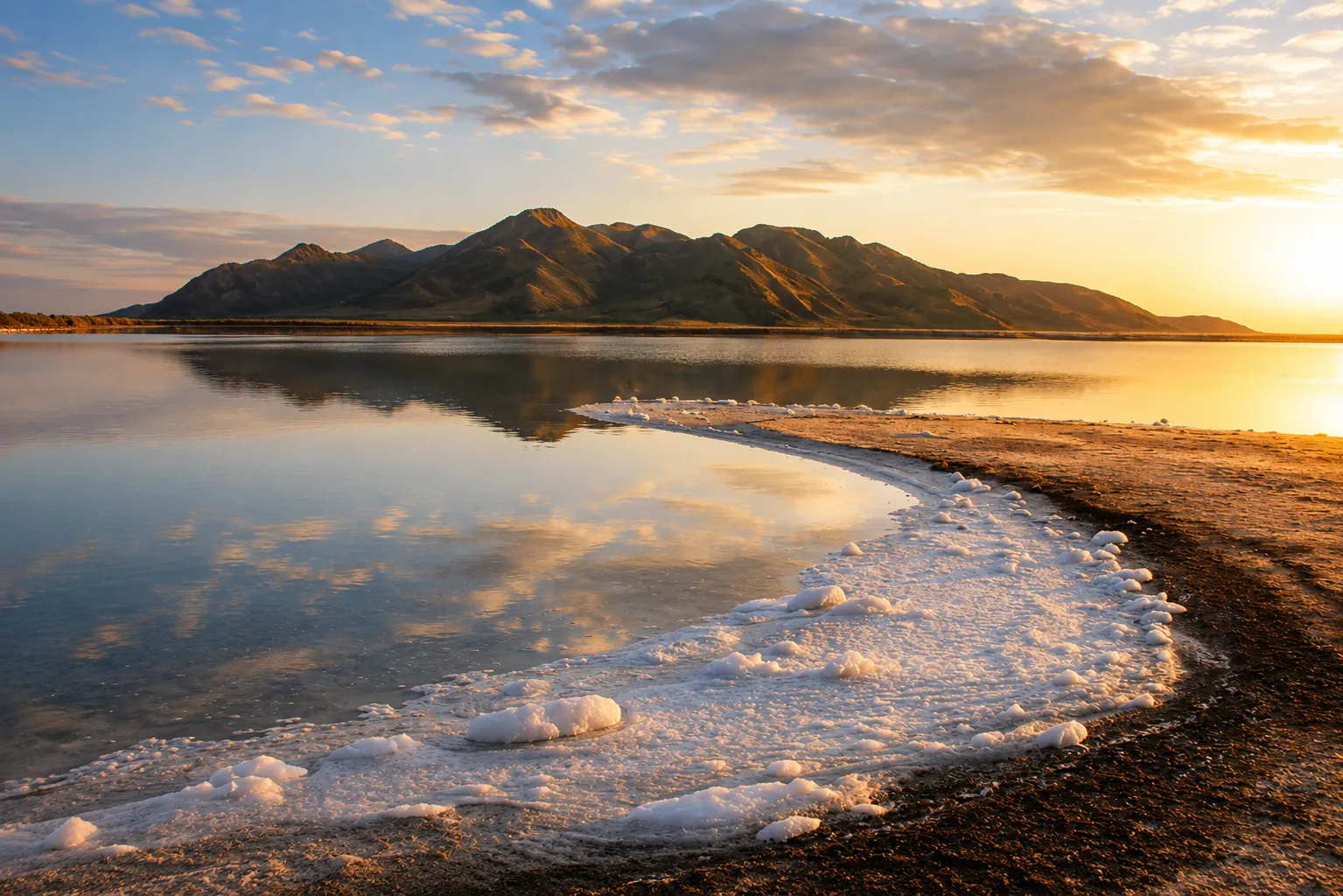
The ocean covers about 71% of Earth's surface and contains approximately 1.335 billion cubic kilometres of water. That water is salty, with an average salinity of about 35 grams of dissolved salt per kilogram of seawater (usually written as 35 parts per thousand, or 35 ppt). Every litre of ocean water you scoop up contains roughly 35 grams of dissolved mineral salts.
This raises an obvious question. The rivers that flow into the ocean every day are carrying fresh water from rainfall and snowmelt. Rain is fresh water. Snowmelt is fresh water. Groundwater seeping into rivers is mostly fresh water. So how does the ocean stay salty? And why was it salty to begin with?
The answer involves two separate processes, one that built up the ocean's saltiness over billions of years, and one that keeps it in a stable equilibrium today.
Where Did the Salt Come From? Process One: Rivers and Weathering
The most important source of salt in the ocean is rock. The continents are made of rock, and rock contains minerals, including the sodium and chlorine ions that make up common table salt (sodium chloride, NaCl), as well as magnesium, potassium, calcium, and dozens of other dissolved minerals.
When rain falls, the water is very slightly acidic because it dissolves a small amount of carbon dioxide from the atmosphere to form weak carbonic acid. This mildly acidic water, over time, dissolves minerals from rocks in a process called chemical weathering. As water travels across and through rock formations, picking up dissolved minerals, it becomes rivers and streams that eventually flow into the ocean, carrying those dissolved minerals with them.
This process has been running for essentially the entire time liquid water has existed on Earth, roughly 3.8 to 4 billion years. Over that immense timescale, rivers have delivered an almost unimaginable quantity of dissolved minerals to the ocean. According to NOAA (the US National Oceanic and Atmospheric Administration), rivers and streams deliver approximately 4 billion tonnes of dissolved salts to the ocean each year, even today.
But here is where the logical question arises: if rivers are constantly delivering salt to the ocean, why is the ocean not getting saltier every year? And if rivers are not salty, why is the ocean?
Why Rivers Are Not Salty
Rivers do contain dissolved minerals, including sodium and chloride. The concentration is simply much lower than in the ocean, typically around 0.01 to 0.1 parts per thousand, hundreds of times less than seawater. The minerals are there; they are just diluted by the sheer volume of water.
When river water reaches the ocean, the water itself eventually evaporates back into the atmosphere as part of the global water cycle. But the dissolved minerals cannot evaporate with it. Water molecules escape from the ocean's surface as water vapour, leaving all their dissolved mineral cargo behind. That water vapour forms clouds, falls as fresh rain or snow, and the whole cycle repeats. Each cycle leaves a tiny additional fraction of mineral content in the ocean.
Over billions of years, this differential evaporation has concentrated the minerals in the ocean to the levels we see today. The ocean is, in this sense, a long-term accumulation point for minerals that are continuously delivered from land but can never leave with the evaporating water.
Process Two: Hydrothermal Vents and the Seafloor
A second, equally important source of ocean saltiness comes from below the ocean floor rather than from above it. Along the mid-ocean ridges, where the tectonic plates that make up the ocean floor are pulling apart, seawater seeps down through cracks in the rock, is heated by the molten rock below, and then erupts back into the ocean through hydrothermal vents.
During this process, the superheated water dissolves minerals from the surrounding rock, adding additional dissolved material to the ocean. But the process also removes some ions from the ocean, as the hot water reacts with minerals and leaves some compounds behind in the rock. Hydrothermal vents are therefore both a source and a sink for certain ocean minerals, depending on the specific chemistry involved.
Hydrothermal vents were only discovered in 1977, when scientists aboard the research submersible Alvin explored the Galapagos Rift in the Pacific Ocean. Before this discovery, the full picture of ocean chemistry was incomplete. We now know that the hydrothermal vent system is a major part of the global cycling of elements between the ocean, the seafloor, and the mantle beneath it.
Why Is the Ocean Not Getting Saltier?
If salt is continuously being added to the ocean through rivers and hydrothermal vents, it seems like the ocean should be getting saltier over time. The reason it is not, and has apparently maintained roughly stable salinity for hundreds of millions of years, is that there are processes that remove salt from the ocean at roughly the same rate it is being added.
The most important removal processes are geological. When seawater evaporates in shallow coastal areas and enclosed basins, it leaves salt deposits behind. These evaporite deposits (which include the rock salt formations found in many parts of the world, from the Sahara to the American Midwest) effectively remove salt from the ocean and lock it into rock. Over geological timescales, tectonic processes can bury these deposits beneath the seafloor, where the salt is eventually recycled back through volcanoes or subduction zones.
Additionally, marine organisms use calcium and other minerals from seawater to build shells and skeletons. When these organisms die, their shells sink to the seafloor and become part of the sedimentary rock record, another pathway for removing dissolved minerals from the ocean.
The result of all these inputs and outputs is what oceanographers call a "steady state" or chemical equilibrium: the major ions in seawater are at roughly stable concentrations because they are being added and removed at approximately equal rates. The ocean is not a static bowl of salt water. It is a dynamic chemical system in constant, slow exchange with the atmosphere, the seafloor, and the continents.
Which Salts Are in the Ocean?
When people say the ocean is "salty," they tend to think purely of sodium chloride, the salt you use in cooking. Sodium chloride is indeed the dominant dissolved salt in seawater, making up about 77.7% of all dissolved salts. But seawater contains a complex mixture of ions.
By concentration, the major components of seawater salinity are sodium (about 30.6% of all dissolved ions by weight), chloride (about 55.1%), sulfate (7.7%), magnesium (3.7%), calcium (1.2%), and potassium (1.1%), plus smaller amounts of bicarbonate, bromide, boron, strontium, and many trace elements. The exact proportions are remarkably consistent across all of the world's open oceans, a fact first established by the Challenger Expedition of 1872 to 1876, the pioneering oceanographic survey that made the first systematic measurements of seawater chemistry around the globe.
Why Are Some Bodies of Water Saltier Than Others?
Salinity varies significantly between different parts of the ocean and between different bodies of water. In general, enclosed or semi-enclosed seas in hot, dry climates have higher salinity because water evaporates faster than rivers and rain can replenish it. The Red Sea, for example, has a salinity of about 40 to 42 ppt, significantly above the ocean average, because it is almost entirely enclosed, has very little rainfall, receives only a small amount of river input, and loses substantial water to evaporation in its hot, dry climate.
The Dead Sea, which is actually a lake and not connected to the ocean, has a salinity of roughly 300 to 340 ppt, about ten times the average ocean salinity. It is fed by the Jordan River but has no outlet, and extreme evaporation in the hot desert climate concentrates its mineral content dramatically. The high salinity is what makes floating in the Dead Sea effortless, the dense salt water provides much greater buoyancy than regular water.
By contrast, the Baltic Sea, in northern Europe, has a salinity of only about 10 ppt in its central portions, and near-fresh-water conditions in its northernmost reaches. The Baltic is almost entirely enclosed, receives large amounts of fresh water from rivers draining large parts of northern Europe, and has relatively limited exchange with the open North Atlantic. The result is a much more dilute body of water than the open ocean.
The Ocean as a Chemical Record of Earth's History
The chemistry of seawater is not just an interesting fact about the ocean. It is a record of the entire geological history of the planet. The specific combination of ions in seawater reflects billions of years of weathering, volcanic activity, biological activity, and tectonic cycling. Changes in ocean chemistry over geological time, preserved in the fossil record and in sedimentary rocks, allow geochemists to reconstruct ancient climates, the evolution of the atmosphere, and the history of life itself.
The saltiness of the ocean, which seems like it should have a simple answer, turns out to be the product of a planet-scale chemical system that has been operating for nearly four billion years. Every grain of dissolved salt in the ocean has its own geological journey, from ancient rock formation to chemical weathering to river transport to oceanic accumulation. The ocean is salty because the Earth has been actively processing its own chemistry, through water, rock, and volcanic heat, for most of its existence.
Related Posts
Blue Moon vs Red Moon Explained: What They Actually Are
What is a blue moon, and does it actually look blue? What makes a moon turn red? A clear, science-based explanation of two of the most misunderstood events in the night sky.

What Is a Leap Year and Why Do We Have It?
Every four years, February gets an extra day. The answer involves the fractional maths of Earth's orbit, Julius Caesar, and a calendar rule with three exceptions.
What Causes a Solar Eclipse and Is It Safe to Look?
A solar eclipse is one of nature's most dramatic events. Here is exactly what causes it, why total eclipses are rare, and the real truth about eye safety.
Comments
Loading comments…