
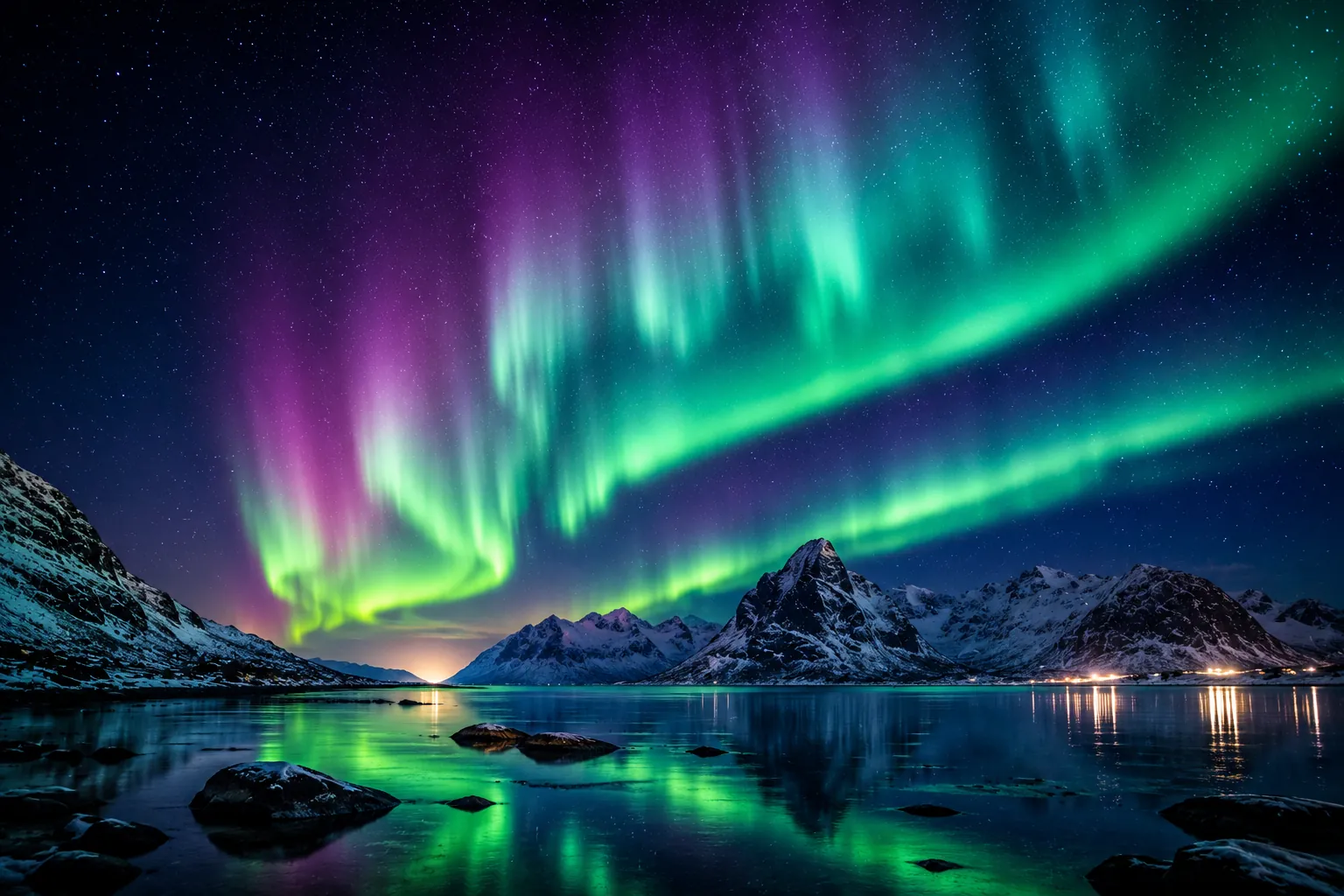
Few natural events on Earth are as immediately breathtaking as the aurora borealis. Ribbons of green, purple, pink, and red light ripple and dance across a dark Arctic sky, sometimes filling the entire horizon, sometimes concentrated in specific arcs or curtains that shift and pulse over minutes and hours. People travel thousands of kilometres specifically to stand in the cold and watch it.
For most of human history, the aurora was explained through myth and legend. Norse mythology described it as the shimmer of the shields of the Valkyries riding across the sky. Indigenous peoples of northern Canada and Alaska saw it as the spirits of animals. In medieval Europe, a red aurora was often interpreted as an omen of war or disaster, not unreasonably, since red auroras are associated with stronger solar activity that has, on rare occasions, disrupted navigation and communications.
The actual cause is both more prosaic and more fascinating than any myth.
It All Starts With the Sun
The Sun is not a quiet, stable object. It is a violently active star that continuously ejects streams of charged particles (mostly electrons and protons) outward through the solar system. This constant outpouring of particles is called the solar wind. At Earth's distance from the Sun, the solar wind travels at speeds of roughly 400 to 800 kilometres per second.
Earth is largely protected from this particle stream by its magnetic field, called the magnetosphere. The magnetosphere is generated by the flow of molten iron in the Earth's outer core and extends tens of thousands of kilometres into space, forming a protective bubble around the planet. Most solar wind particles are deflected around the Earth by this magnetic shield.
But at the poles, the geometry is different. Earth's magnetic field lines converge at the magnetic poles and dip downward into the atmosphere. This creates two zones, one at each pole, where solar wind particles can follow the magnetic field lines and funnel down into the upper atmosphere. These zones, called the auroral ovals, are roughly ring-shaped bands at high latitudes surrounding each magnetic pole.
What Actually Produces the Light?
When solar wind particles (primarily electrons) follow the magnetic field lines downward and enter the upper atmosphere, they collide with gas molecules and atoms, primarily oxygen and nitrogen, at altitudes between approximately 100 and 300 kilometres above the surface. These collisions transfer energy to the gas atoms, exciting their electrons to higher energy states. When those electrons drop back down to their normal energy levels, they release the excess energy as photons of light.
The colour of that light depends on which gas is being excited and at what altitude the collision occurs.
Green is the most common aurora colour and is produced by oxygen atoms at altitudes between roughly 100 and 150 kilometres. It is the colour that appears most vivid to human eyes under low-light conditions, which is why it tends to dominate visual observations and photographs.
Red is produced by oxygen at higher altitudes, above about 200 kilometres. It requires more energetic solar activity and is less commonly seen. When a red aurora appears at unusually low latitudes (as happened in May 2024 and May 2025, when aurora was visible across much of the United Kingdom, France, Germany, and even parts of the United States as far south as Florida and Texas), it signals an exceptionally powerful geomagnetic storm.
Blue and purple colours are produced by nitrogen molecules at lower altitudes, below about 100 kilometres. These often appear at the edges or lower fringes of auroral displays.
Pink and mixed colours result from combinations of nitrogen and oxygen emissions at different altitudes blending together in the same section of sky.
What Is Solar Maximum, and Why Did 2024 Produce Such Spectacular Auroras?
The Sun's activity level follows an approximately 11-year cycle, called the solar cycle, between periods of relative quiet (solar minimum) and peak activity (solar maximum). At solar maximum, the Sun's magnetic field is more complex and unstable, producing more sunspots, solar flares, and coronal mass ejections (CMEs). A CME is a massive burst of magnetised plasma from the Sun's corona, ejected into space at millions of kilometres per hour.
When a CME strikes Earth's magnetosphere, it compresses and distorts the magnetic field in a geomagnetic storm. The stronger the storm, the further south (or north, in the Southern Hemisphere) the auroral oval expands, allowing aurora to be seen at much lower latitudes than usual.
Solar Cycle 25 reached its predicted maximum in late 2024 and early 2025, and it turned out to be more active than most forecasts had predicted. The May 2024 geomagnetic storm, rated G5 (the highest level on the five-point scale used by NOAA, the US National Oceanic and Atmospheric Administration), was the strongest geomagnetic storm in over 20 years. Aurora was reported as far south as Mexico, the Canary Islands, and southern Australia. In the UK, the aurora was visible from every county in England for the first time in decades. A second major storm in May 2025 produced similar results.
These events were exceptional. For most years, strong aurora is reliably visible only from Alaska, northern Canada, Iceland, Norway, Sweden, Finland, and the Russian Arctic.
Where and When Can You See the Aurora?
The best places to see the aurora borealis consistently are within the auroral zone, the band that runs roughly 65 to 72 degrees north latitude. This includes northern Norway (Tromsø is one of the most popular aurora tourism destinations in the world), northern Sweden, northern Finland, Iceland, Alaska, and northern Canada (particularly Yukon, Northwest Territories, and northern Manitoba and Saskatchewan).
The ideal conditions are dark skies (away from city light pollution), clear weather, and a geomagnetically active period. The aurora is present overhead far more often than it is visually dramatic. On many nights within the auroral zone, the aurora may be faintly visible but appear as little more than a greenish glow on the horizon. The dramatic, curtain-like displays require active solar wind conditions.
Aurora season runs from late August through April in the Northern Hemisphere, when nights are long and dark enough at high latitudes to see the display. The period around the spring and autumn equinoxes (roughly March and September) tends to produce more aurora activity than other times of year, for reasons related to the angle of Earth's magnetic field relative to the incoming solar wind.
Is There a Southern Lights Too?
Yes. The southern equivalent is called the aurora australis, and it follows the same physical process at the southern magnetic pole. The auroral oval in the Southern Hemisphere falls mostly over Antarctica and the Southern Ocean, making it far less accessible to most observers. Occasionally, during strong geomagnetic storms, the aurora australis is visible from the southern tips of New Zealand, Australia, and South America. Residents of Invercargill in New Zealand and Ushuaia in Argentina occasionally witness displays during major storm events.
Can the Aurora Affect Technology?
Yes, significantly. Strong geomagnetic storms, the same events that produce visible aurora at low latitudes, can cause substantial disruption to technology and infrastructure. The mechanisms are complex but real.
Power grids are vulnerable because rapidly fluctuating magnetic fields induce electrical currents in long transmission lines. The Carrington Event of September 1859, the most powerful geomagnetic storm in recorded history, generated currents so strong that telegraph operators reported receiving electrical shocks and telegraph paper catching fire even with equipment disconnected. If a comparable event struck today's interconnected power infrastructure, the potential for widespread blackouts would be significant.
The May 2024 storm caused disruptions to high-frequency radio communications used by aviation and emergency services. GPS accuracy was temporarily degraded in some regions because the ionospheric disturbances caused by the storm affected satellite signal propagation. Satellites in low Earth orbit experience increased atmospheric drag during major storms because the heating of the upper atmosphere causes it to expand, increasing resistance on orbital paths.
Space agencies and power grid operators monitor solar activity continuously through instruments like NASA's Solar Dynamics Observatory and NOAA's space weather prediction centre, specifically to provide advance warning of major geomagnetic events.
The Mythology Was Not So Far Off
Ancient peoples who watched the aurora and saw in it the movement of spirits, the shimmer of divine shields, or the breath of celestial animals were, in their own way, recognising something true: this is not an ordinary earthly phenomenon. The aurora is, in a real sense, a visible manifestation of the relationship between the Earth and the Sun, of the continuous outpouring of energy from our star and our planet's magnetic defence against it. It is a light show powered by a star 150 million kilometres away, filtered through a magnetic field generated in the molten iron miles beneath your feet.
The mythology captured the wonder correctly, even if the mechanism was beyond what any ancient observer could know. That seems like a reasonable approach to something this beautiful.
Related Posts
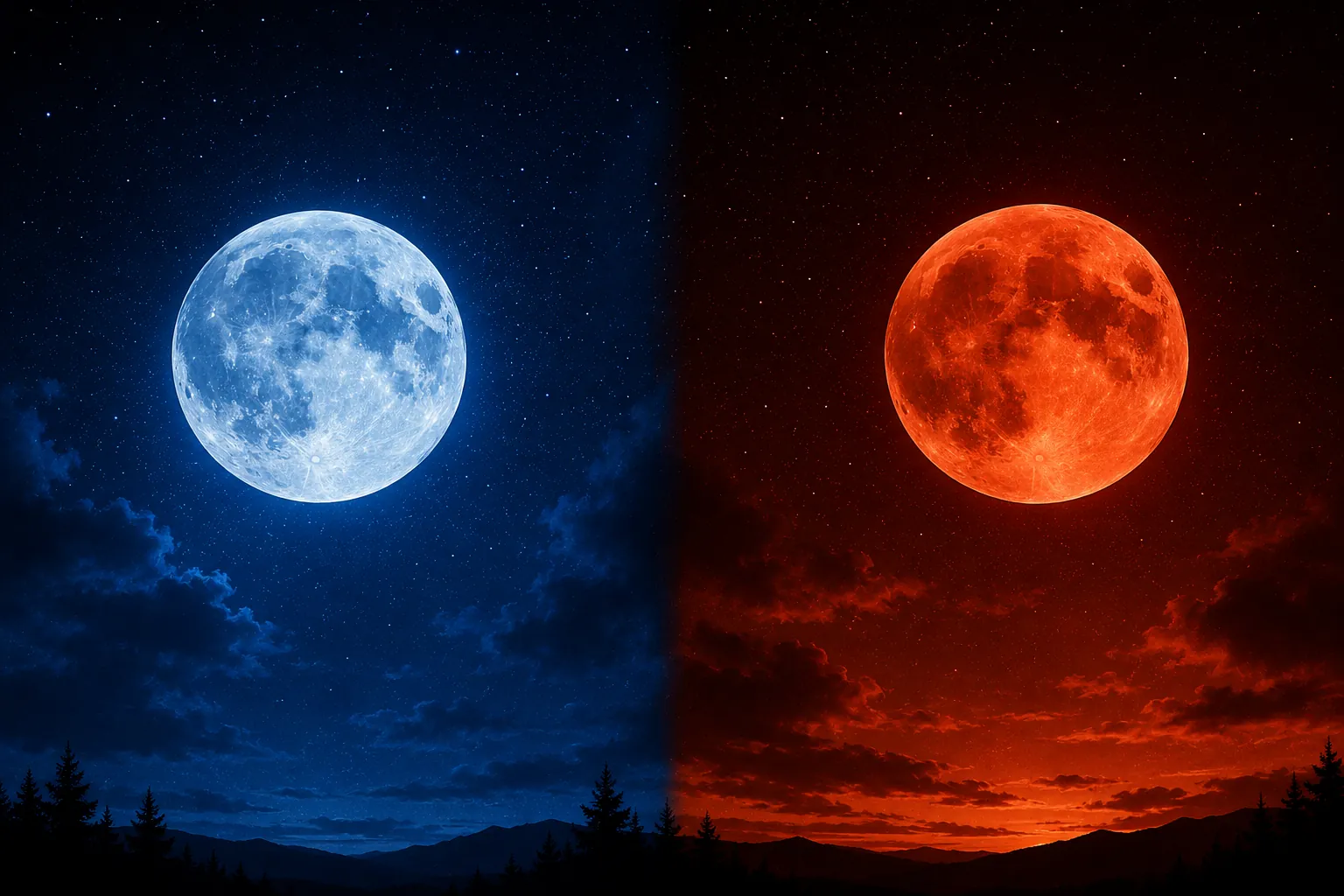
Blue Moon vs Red Moon Explained: What They Actually Are
What is a blue moon, and does it actually look blue? What makes a moon turn red? A clear, science-based explanation of two of the most misunderstood events in the night sky.
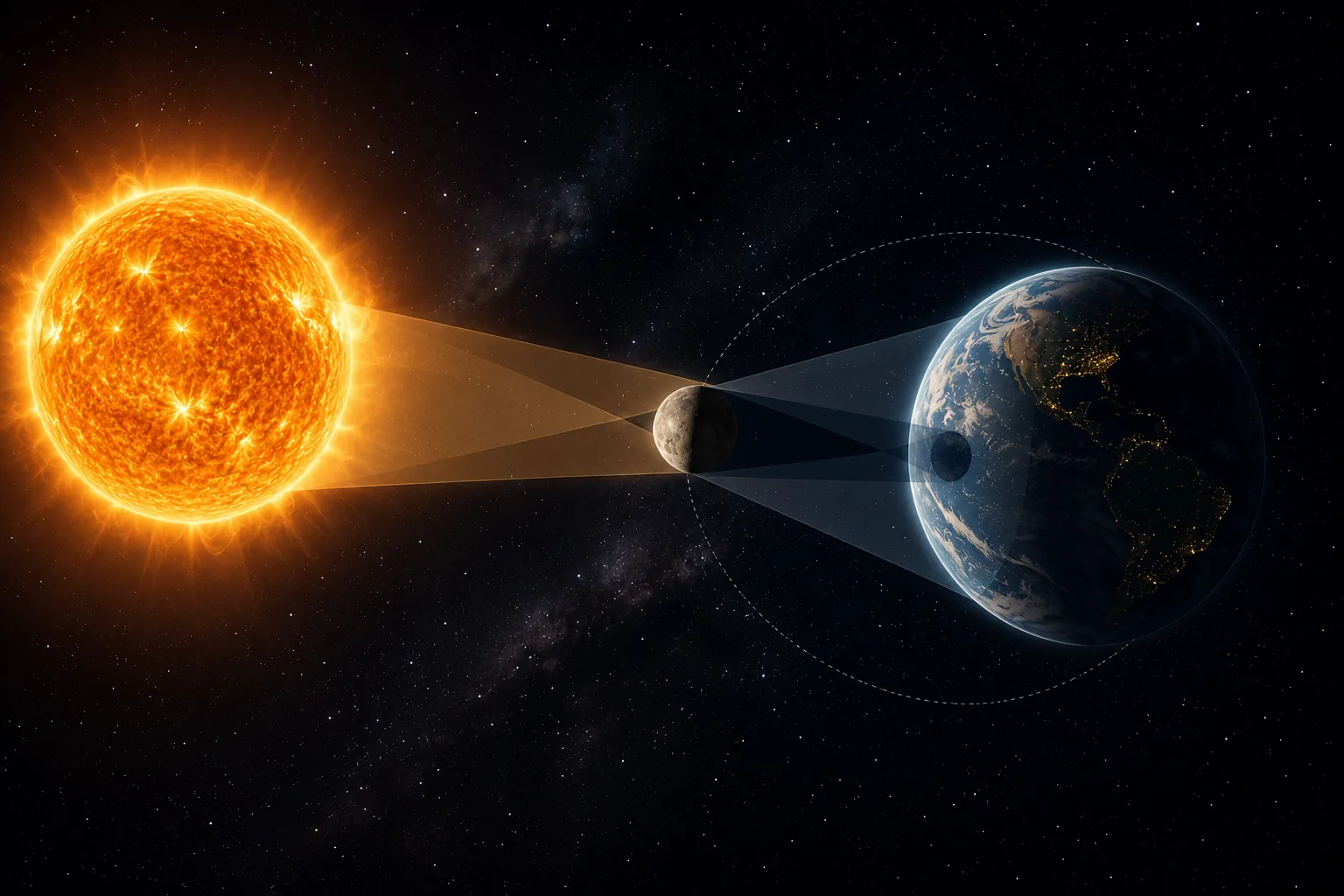
What Causes a Solar Eclipse and Is It Safe to Look?
A solar eclipse is one of nature's most dramatic events. Here is exactly what causes it, why total eclipses are rare, and the real truth about eye safety.
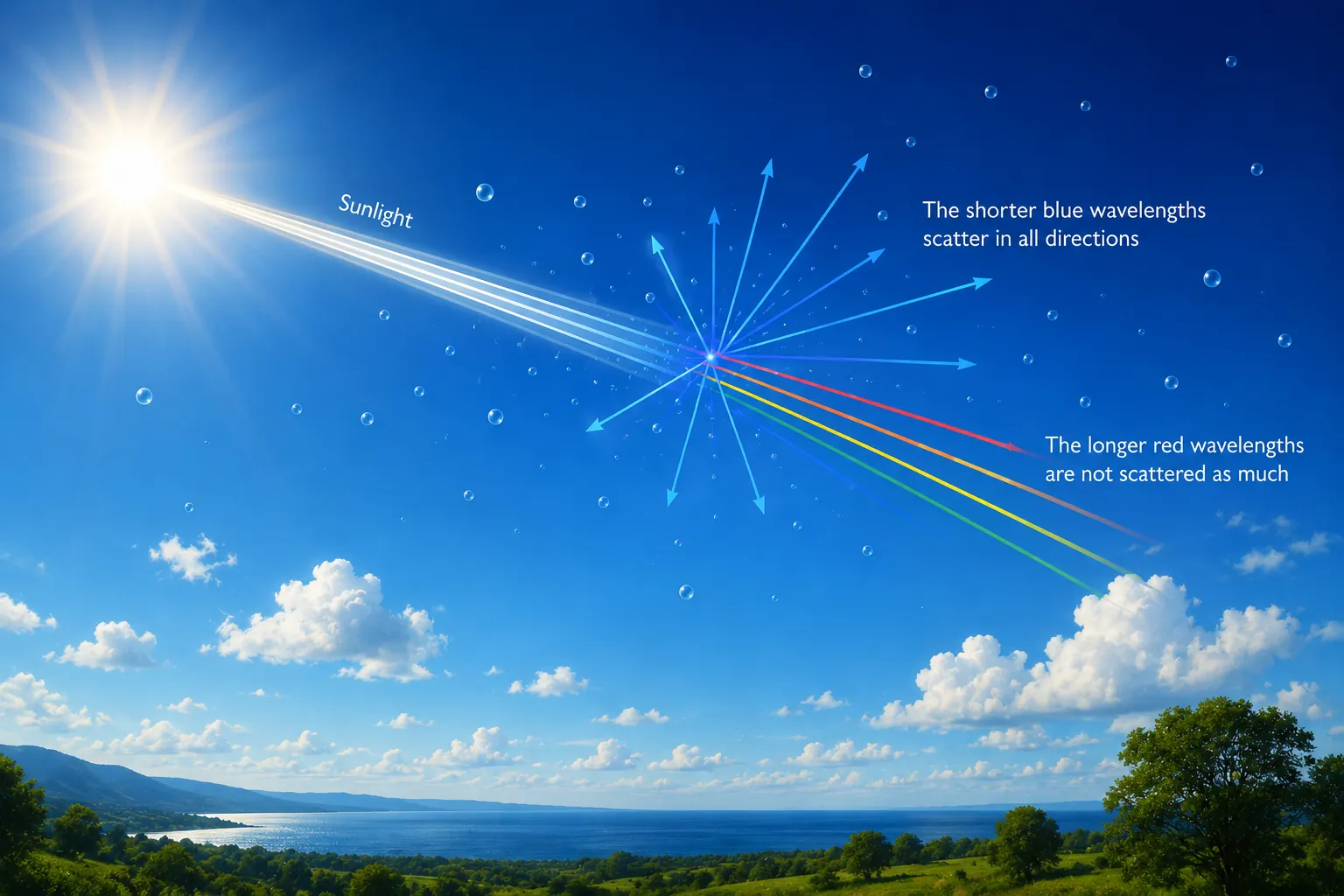
Why Is the Sky Blue? The Real Explanation
It is one of the first questions children ask and one many adults cannot fully answer. Here is the real, clear science behind the colour of the sky.
Comments
Loading comments…