
Look up on a clear day, and the sky appears a vivid, deep blue. Look at the same sky from the International Space Station, and it is completely black. Look at the horizon at sunset, and the sky shifts through orange, pink, and red. The colour of the sky is not a fixed property of the atmosphere. It is a dynamic optical effect, and understanding why it happens tells you something genuinely interesting about the nature of light.
The explanation involves a concept called Rayleigh scattering, named after the British physicist Lord Rayleigh (John William Strutt), who worked out the mathematics behind it in 1871. The core idea is not complicated, and once you understand it, you will see the sky, sunsets, and the Moon in a completely different way.
First: What Is Light?
Sunlight looks white or pale yellow, but it is actually a mixture of all the colours of the visible spectrum combined: red, orange, yellow, green, blue, indigo, and violet. You can see this whenever white light passes through a glass prism or a raindrop and splits into a rainbow. Each colour corresponds to a different wavelength of electromagnetic radiation. Red light has a longer wavelength (around 700 nanometres). Violet and blue light have shorter wavelengths (around 380 to 450 nanometres). All of these travel through the vacuum of space at the same speed, about 300,000 kilometres per second.
What Happens When Sunlight Enters the Atmosphere?
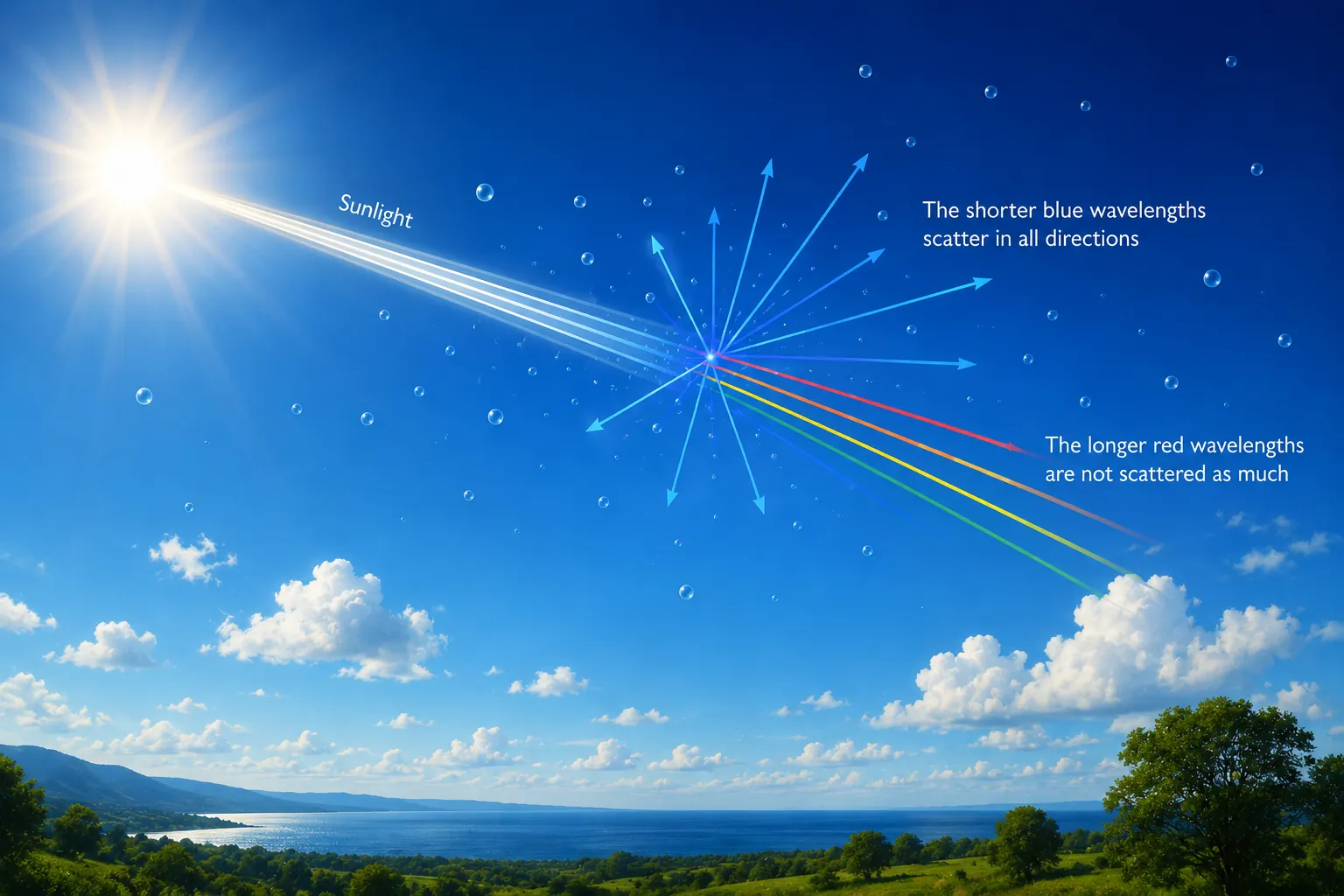
The Earth's atmosphere is made up primarily of nitrogen (about 78%) and oxygen (about 21%), along with small amounts of other gases. These gas molecules are tiny, far smaller than the wavelengths of visible light. When sunlight enters the atmosphere and hits these tiny molecules, the light does not simply pass straight through. The molecules absorb and then re-emit the light in all directions. This process is called scattering.
Here is the crucial part: the amount of scattering that occurs is not the same for all colours of light. Lord Rayleigh's mathematics showed that shorter-wavelength light is scattered much more intensely than longer-wavelength light. Specifically, the scattering intensity is inversely proportional to the fourth power of the wavelength. This means that blue light (short wavelength) is scattered approximately 5.5 times more intensely than red light (long wavelength).
So what happens in practice? Sunlight enters the atmosphere. The red, orange, and yellow light (longer wavelengths) mostly passes straight through with relatively little disruption. The blue light (shorter wavelength) gets scattered in every direction by the gas molecules. It bounces around the atmosphere, changing direction repeatedly. When you look up at the sky from any direction, what you see is this scattered blue light arriving at your eyes from across the entire sky.
This is why the sky appears blue, not just in the direction of the Sun, but everywhere overhead. The blue light has been scattered so thoroughly that it fills the entire sky.
Why Not Violet, Since Violet Has an Even Shorter Wavelength?
This is a very reasonable question. Violet light has an even shorter wavelength than blue, which means it should be scattered even more strongly. So why does the sky look blue and not violet?
There are two reasons. First, sunlight contains less violet light than blue light to begin with, so there is less of it to scatter. Second, and more importantly, the human eye is significantly less sensitive to violet wavelengths than to blue ones. Our eyes contain three types of cone cells (the receptors responsible for colour vision), sensitive to red, green, and blue light. The sensitivity of our blue cones peaks at around 450 nanometres, well within the blue range. Violet, at around 380 to 420 nanometres, is near the edge of our visible range, and our eyes respond to it weakly.
So even though violet is scattered more than blue, our eyes pick up the scattered blue light far more readily, and the sky appears blue to us. An animal with different colour vision receptors, one more sensitive to ultraviolet wavelengths, might perceive the sky as violet or even ultraviolet. Bees, which can see into the ultraviolet range, almost certainly experience the sky very differently from us.
Why Are Sunsets Orange and Red?
At sunset or sunrise, the Sun is near the horizon. This means its light has to travel through a much thicker slice of the atmosphere to reach your eyes compared to when the Sun is directly overhead. The path through the atmosphere may be 10 to 40 times longer at the horizon than at zenith.
Over this very long path, almost all of the blue and violet light gets scattered away to the sides, long before it reaches your eyes. What is left by the time the light reaches you is mostly the longer-wavelength colours that were not scattered: reds, oranges, and yellows. This is why sunsets appear warm-coloured.
The exact colours of a sunset depend on what is in the atmosphere at the time. Dust particles, smoke, and especially volcanic ash create particularly vivid sunsets. After the 1883 eruption of Krakatoa in Indonesia, observers around the world reported unusually vivid red and orange sunsets for almost two years, because fine ash particles remained in the upper atmosphere and scattered light in new ways. The painting "The Scream" by Edvard Munch, created in 1893, is thought by some art historians to depict the unusual sky colours that were still being observed in Scandinavia a decade after the Krakatoa eruption.
Why Is the Sky Black in Space?
If you were standing on the surface of the Moon or looking out from the International Space Station, the sky would appear completely black even with the Sun blazing nearby. This is because there is no atmosphere. With no gas molecules to scatter the light, sunlight travels in straight lines without being dispersed in all directions. The only way to see light in space is to look directly at the source or at a surface that is reflecting it. Everything else is darkness.
This is also why stars are visible from the Moon even when the Sun is above the horizon. On Earth, the scattered blue light during the day is bright enough to overwhelm the faint light of the stars. On the airless Moon, no such scattering occurs, and the contrast between the brilliant Sun and the black sky is absolute and dramatic.
Why Is the Sky Sometimes White Near the Horizon?
On a clear day, the sky directly overhead appears a deeper, more saturated blue than the sky near the horizon, which often looks pale blue or even whitish. This is because when you look toward the horizon, you are looking through a much thicker layer of atmosphere. Over that longer path, light of all wavelengths, not just blue, gets scattered and mixed together. The more complete mixing of all colours produces a paler, more washed-out appearance. Directly overhead, you are looking through the minimum amount of atmosphere, so the scattering is dominated by blue, and the colour is richest.
What About Other Planets?
The colour of a planet's sky depends entirely on the composition of its atmosphere. Mars has a very thin atmosphere made mostly of carbon dioxide, with fine dust particles that scatter red and orange wavelengths more effectively than blue. The Martian sky appears pinkish-tan during the day and turns blue near the sunset point, the exact opposite of Earth. NASA's Mars rovers have photographed this striking blue-edged sunset many times since the Spirit and Opportunity rovers landed in 2004.
On Venus, which has an extremely thick atmosphere of carbon dioxide and sulphuric acid clouds, the sky is a yellowish-orange. On Titan, Saturn's largest moon, the thick nitrogen and methane atmosphere creates an orange haze. Jupiter, with its bands of different gas compositions, has multiple sky colours across different latitudes.
Why Does This Knowledge Matter?
Understanding Rayleigh scattering is not just a piece of interesting trivia. It has real practical applications. Astronomers must account for atmospheric scattering when calculating the true brightness and colour of stars observed from Earth. Satellite and remote sensing engineers design instruments around the scattering properties of Earth's atmosphere. Pilots and navigators use the predictable colour gradients of the sky to orient themselves. And understanding how light interacts with molecules is foundational to fields ranging from climate science to the design of optical instruments.
But beyond the practical applications, there is something worth appreciating about the simple fact that the sky is blue. Every time you step outside on a clear day, you are witnessing one of the most elegant and continuously operating physics demonstrations in nature. Every photon of blue light reaching your eyes has bounced through the atmosphere, scattered by countless gas molecules, finally arriving at your eye from every direction at once. The blue sky is not a backdrop. It is a process, happening at the speed of light, all day long.
Related Posts
Blue Moon vs Red Moon Explained: What They Actually Are
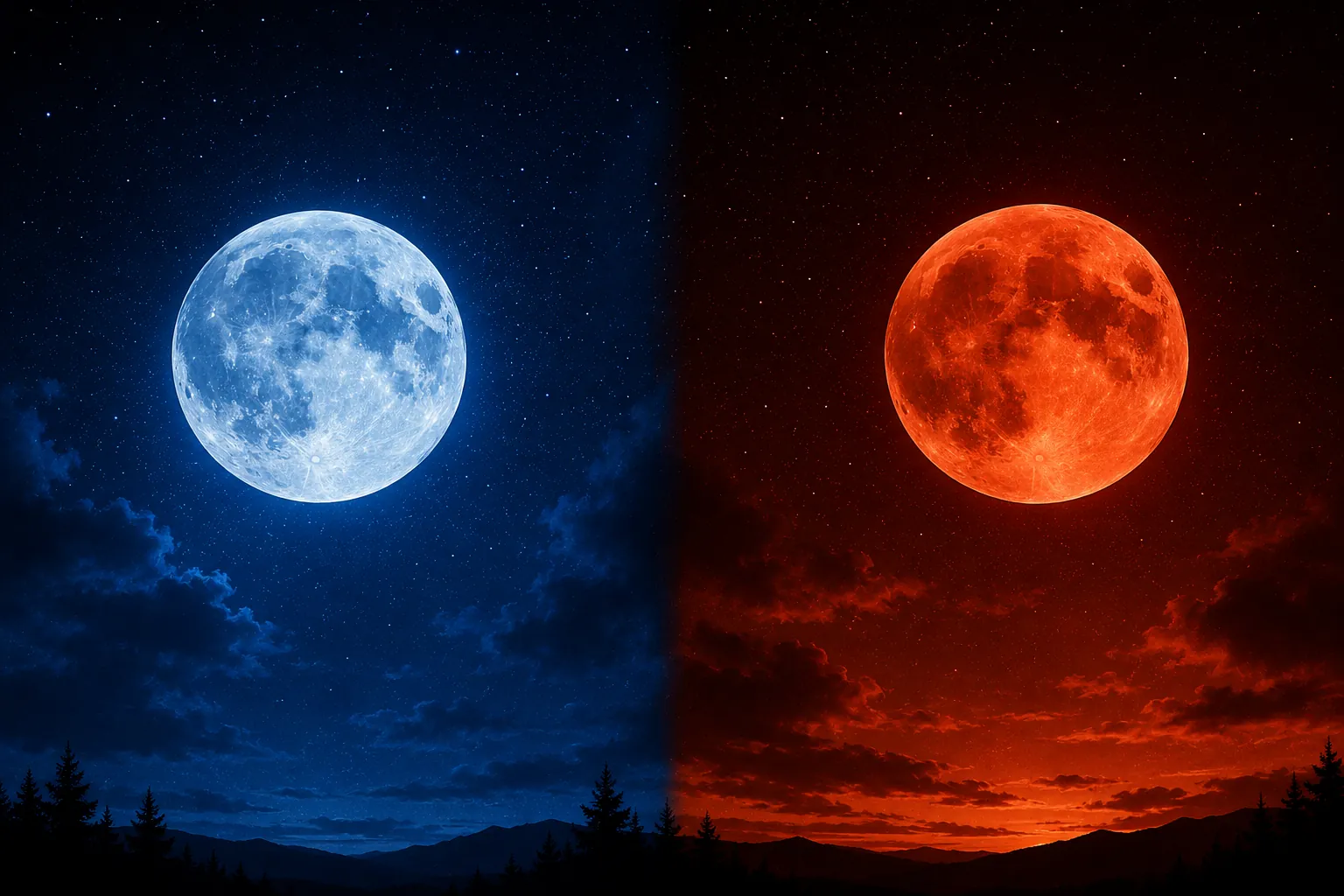
What is a blue moon, and does it actually look blue? What makes a moon turn red? A clear, science-based explanation of two of the most misunderstood events in the night sky.
What Causes a Solar Eclipse and Is It Safe to Look?
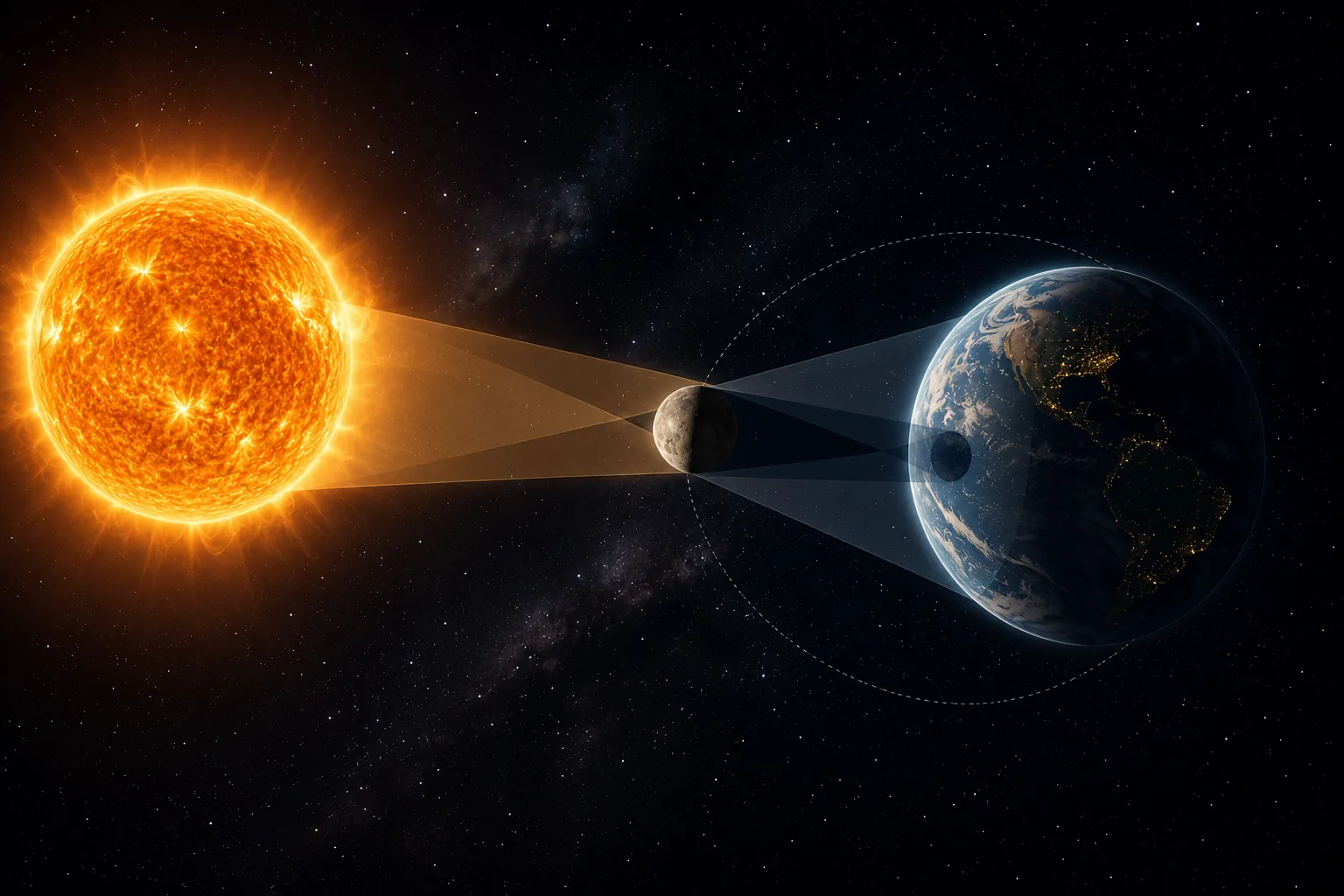
A solar eclipse is one of nature's most dramatic events. Here is exactly what causes it, why total eclipses are rare, and the real truth about eye safety.
Northern Lights Explained: What Causes the Aurora Borealis?
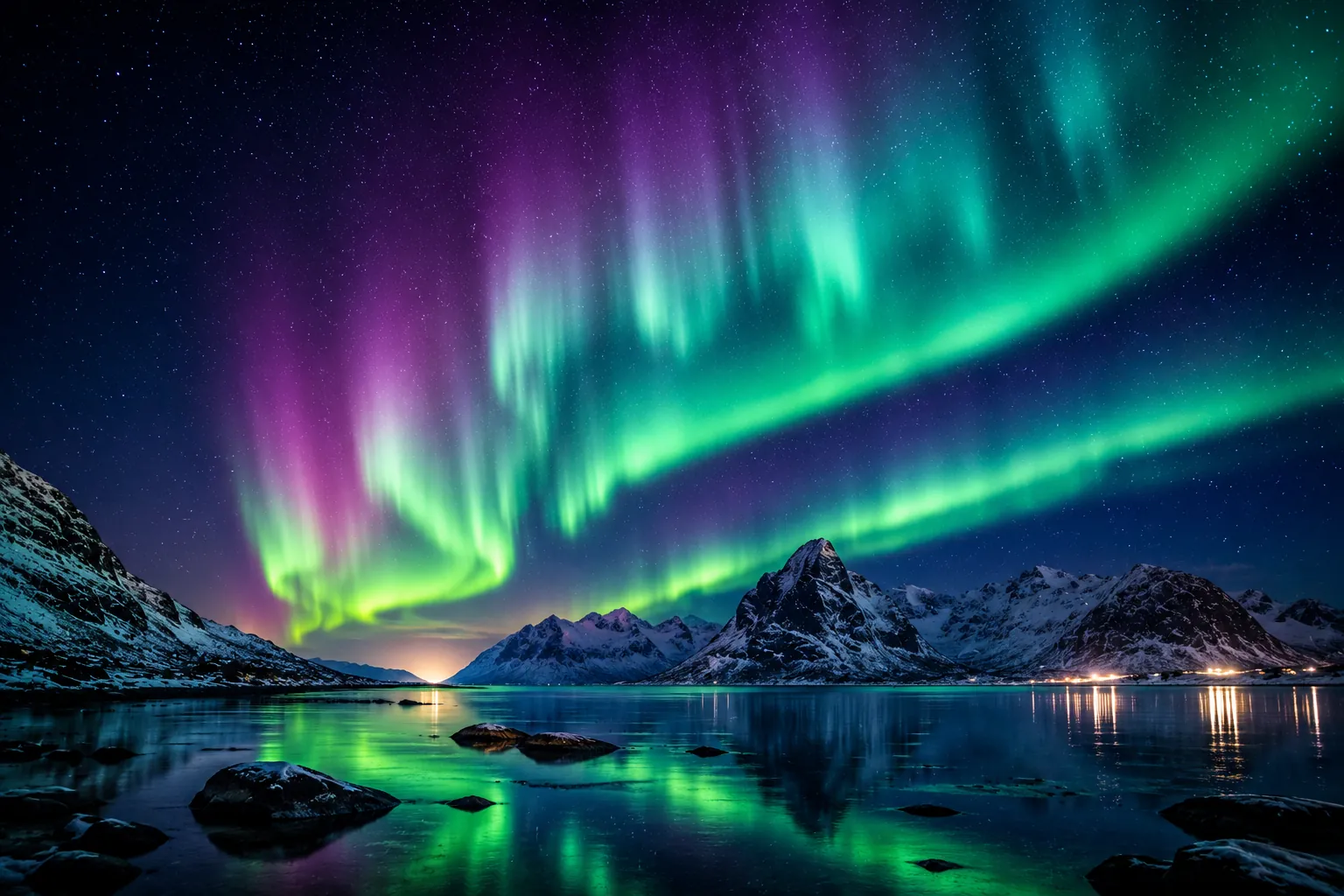
Curtains of green, purple, and red light dancing across the sky. Here is the real science behind the aurora borealis and why 2024 and 2025 produced record displays.
Comments
Loading comments…