
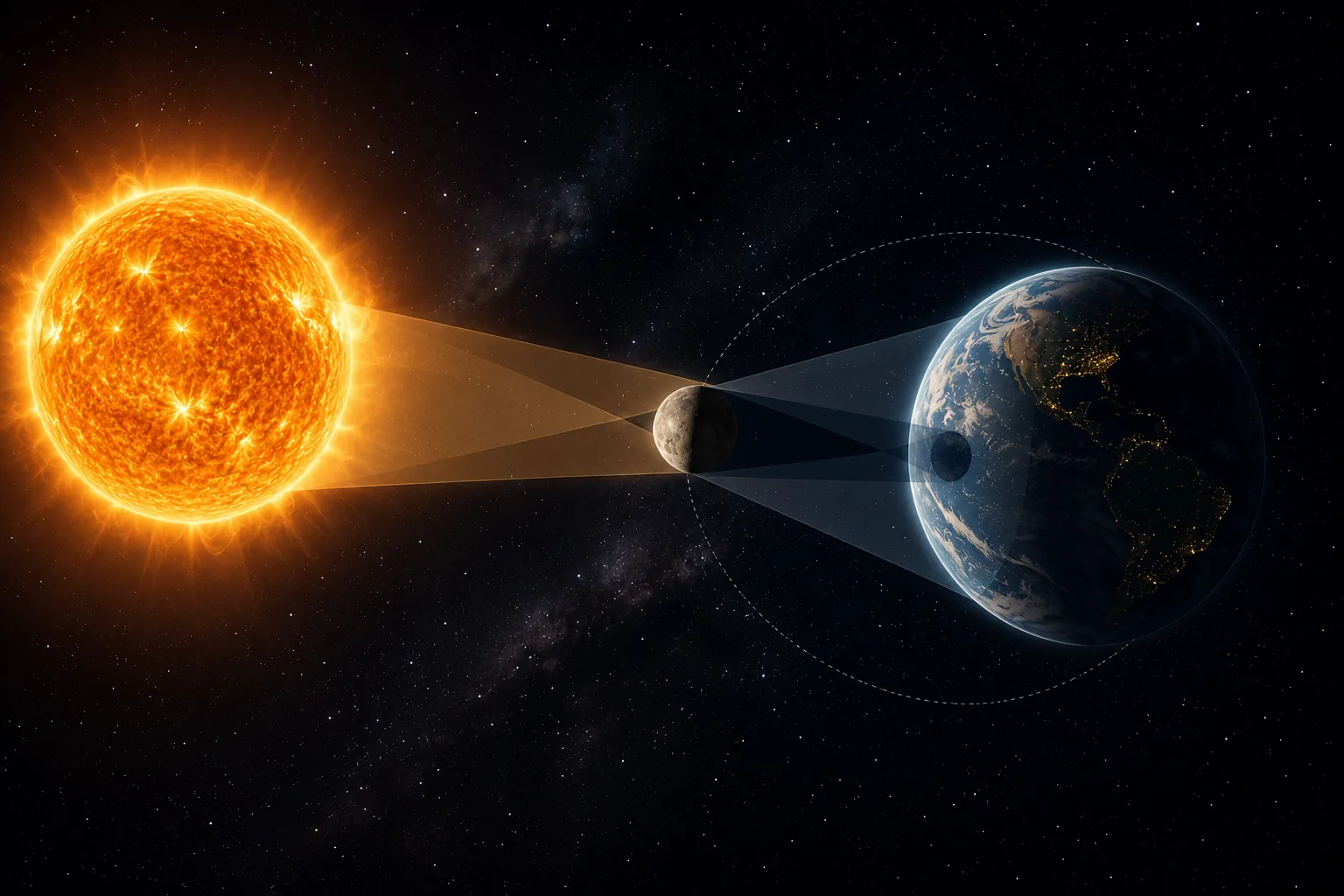
In ancient China, solar eclipses were believed to be caused by a celestial dragon devouring the Sun. In ancient India, the demon Rahu was blamed. Viking mythology had two sky wolves chasing the Sun and occasionally catching it. Across every major civilisation in history, the sudden disappearance of the Sun in the middle of the day triggered fear, rituals, and religious interpretation, because nobody knew what was actually happening.
Today, we understand solar eclipses with complete precision. Astronomers can predict the exact path, timing, and duration of every solar eclipse centuries in advance. And yet, even with full scientific understanding, standing in the path of a total solar eclipse and watching the Sun disappear behind the Moon, with the corona blazing into view and the sky turning dark at midday, remains one of the most striking experiences a human being can have.
Here is exactly how it works.
The Basic Geometry: Sun, Moon, and Earth
A solar eclipse occurs when the Moon passes directly between the Earth and the Sun, blocking some or all of the Sun's light from reaching parts of Earth's surface. This alignment is called a syzygy, from the Greek word for "yoked together."
The Moon orbits the Earth roughly every 27.3 days (the sidereal month), completing its full cycle of phases every 29.5 days (the synoptic or lunar month). A solar eclipse can only happen during a new moon, when the Moon is positioned between the Earth and Sun. But not every new moon produces an eclipse. Why not?
The answer is that the Moon's orbit is tilted by about 5.1 degrees relative to Earth's orbital plane around the Sun (called the ecliptic). Most of the time, the new moon passes slightly above or slightly below the Sun from our perspective, missing the direct alignment required for an eclipse. Only when the new moon occurs near one of the two "nodes" where the Moon's orbital plane crosses the ecliptic can a proper alignment happen. These windows, called eclipse seasons, occur roughly every six months. Because the alignment must be extremely precise for a total eclipse, total solar eclipses at any given point on Earth's surface are genuinely rare events.
Three Types of Solar Eclipse
There are three distinct types of solar eclipse: total, partial, and annular. Which type you see depends on where you are on Earth and the exact geometry of the Sun-Moon-Earth alignment at that moment.
A total solar eclipse occurs when the Moon completely covers the Sun's visible disc. This is the most dramatic type. The sky darkens dramatically, temperatures drop, birds often stop singing and return to their roosts, and the Sun's corona, its outer atmospheric halo, becomes visible to the naked eye. Totality, the period of complete coverage, typically lasts between a few seconds and about 7.5 minutes, with most totalities lasting between 2 and 4 minutes.
A partial solar eclipse occurs when the Moon covers only part of the Sun's disc. This is more common than a total eclipse and covers a much wider geographic area. The Sun appears as a crescent shape. Without proper eye protection, a partial eclipse can be easily missed by casual observers who notice only a slight dimming of sunlight.
An annular solar eclipse occurs when the Moon is at or near its farthest point from Earth in its elliptical orbit (called apogee) and appears slightly smaller than the Sun's disc. The Moon covers the centre of the Sun but leaves a ring of sunlight visible around the edges. This ring is called the annulus, from the Latin word for ring. An annular eclipse does not produce true totality, and the sky does not darken as dramatically. The ring of fire effect is visually striking but requires eye protection throughout.
Why Is a Total Solar Eclipse Such a Coincidence?
The fact that total solar eclipses are possible at all on Earth is a remarkable cosmic coincidence. The Sun is approximately 400 times wider than the Moon. But the Sun is also approximately 400 times farther away from Earth than the Moon. These two facts nearly cancel each other out, meaning the Sun and Moon appear almost exactly the same size in Earth's sky: both roughly 0.5 degrees of arc in diameter.
This ratio is not fixed. The Moon is gradually moving away from Earth at a rate of about 3.8 centimetres per year. In the distant past, the Moon was much closer and appeared larger, producing total eclipses with longer totalities. In the distant future, the Moon will be too small in the sky to completely cover the Sun, and total solar eclipses will no longer be possible from Earth. We happen to live in the cosmological window during which the geometry allows total eclipses, a window that will close in approximately 600 million years.
What Happens During a Total Solar Eclipse?
The sequence of events during a total solar eclipse is predictable and striking. It begins with the partial phase, when the Moon starts to move across the Sun's disc. Over roughly an hour, the Moon slowly covers more and more of the Sun. The light changes quality before it dims significantly, becoming sharper and more directional, with an unusual clarity that experienced eclipse watchers describe as distinctly different from normal daylight.
As totality approaches, the temperature drops noticeably, sometimes by 5 to 10 degrees Celsius within a few minutes. Animals respond. Birds fall silent. Nocturnal insects may begin to call. Shadows develop a crispness and multiple edge effect caused by the Sun becoming a thin crescent rather than a full disc.
Just before totality, a phenomenon called Baily's Beads appears, individual points of sunlight shining through the valleys and craters on the Moon's irregular surface just before the disc is fully covered. This lasts only a few seconds and is followed by the Diamond Ring effect, a single brilliant point of light at the edge of the darkened Moon.
Then totality. The sky darkens to twilight or deeper. The brightest planets and stars become visible. The corona, the Sun's outer atmosphere, blazes into view as a pearly white halo of delicate streamers and plumes extending millions of kilometres into space. This is the only time the corona is visible to the naked eye from Earth. Total solar eclipse observers consistently describe this moment as one of the most affecting experiences of their lives.
Totality ends as abruptly as it began. The Diamond Ring appears on the opposite side, Baily's Beads flash briefly, and daylight floods back. The entire event from first contact to last contact typically lasts two to three hours, with totality itself measured in minutes.
How Often Do Total Solar Eclipses Happen?
On average, a total solar eclipse occurs somewhere on Earth roughly every 18 months. However, the path of totality, the narrow strip of Earth's surface that falls within the Moon's full shadow (called the umbra), is typically only about 100 to 160 kilometres wide. This means that any specific location on Earth experiences a total solar eclipse on average only once every 375 years.
Well-known recent total solar eclipses visible from large populated areas include the August 21, 2017 eclipse across the continental United States, the April 8, 2024 eclipse across Mexico, the central United States, and eastern Canada, and the August 12, 2026 eclipse that will sweep across Greenland, Iceland, Spain, and northern Africa.
Is It Safe to Look at a Solar Eclipse?
This question has a precise, important answer. Looking directly at the Sun at any time, eclipse or not, can cause permanent retinal damage. The retina has no pain receptors, so the damage can occur without you feeling it. The condition is called solar retinopathy, and it can range from temporary visual disturbance to permanent blind spots.
During a partial or annular eclipse, and during the partial phases of a total eclipse, the Sun must never be viewed without certified eclipse glasses or a solar filter that meets the ISO 12312-2 safety standard. Standard sunglasses, no matter how dark, do not provide adequate protection. Camera lenses, binoculars, and telescopes concentrate sunlight and are dangerous without proper solar filters.
There is one and only one exception: the brief period of totality during a total solar eclipse, when the Sun's disc is completely blocked by the Moon. During totality only, it is safe to look directly with the naked eye. This is the only time you can see the corona without a filter, because the blinding photosphere (the bright visible surface of the Sun) is fully covered. The moment totality ends, even a sliver of the Sun's photosphere reappearing requires you to immediately look away or replace eye protection.
The safest approach for casual observers is to use certified eclipse glasses throughout the entire event, removing them only during totality if you are within the path of totality. If you are outside the path of totality (which most people will be for any given eclipse), you are only experiencing a partial eclipse, and certified glasses must be worn at all times.
What Did Ancient People Think Was Happening?
The range of eclipse mythology across cultures is remarkable for both its creativity and its underlying anxiety. In ancient China, the beating of drums and making of loud noise during an eclipse was a widespread practice, designed to frighten away the dragon believed to be eating the Sun. Official court astronomers were expected to predict eclipses so that the emperor could be prepared, and in one famous account from around 2300 BCE, two royal astronomers named Hi and Ho were reportedly executed for failing to predict an eclipse.
In many Mesopotamian traditions, a solar eclipse was interpreted as an omen of disaster for the king. Astronomers who had refined eclipse prediction to a useful level of accuracy were valuable members of the royal court, and their knowledge was treated as a state secret. The Babylonians had identified the Saros cycle (an 18-year, 11-day period after which eclipse patterns roughly repeat) by at least 700 BCE, giving them reliable predictive ability centuries before the underlying geometry was understood.
Christopher Columbus used his foreknowledge of a lunar eclipse (predicted from an almanac) in 1504 to convince the indigenous people of Jamaica to provide food to his crew, by threatening to "take away" the Moon if they refused. The eclipse occurred exactly as predicted, and the supplies were provided.
The Bottom Line
A solar eclipse is the result of a precise three-way alignment of the Sun, Moon, and Earth, made visually dramatic by the extraordinary coincidence that the Sun and Moon appear almost identical in size from Earth's surface. Total solar eclipses are rare at any given location, and if one ever passes over your part of the world, it is genuinely worth travelling to see. With certified eclipse glasses in hand, there is nothing to fear and everything to gain from watching one of the most spectacular events that nature offers to any observer standing on this planet.
Related Posts
Blue Moon vs Red Moon Explained: What They Actually Are
What is a blue moon, and does it actually look blue? What makes a moon turn red? A clear, science-based explanation of two of the most misunderstood events in the night sky.
What Is a Leap Year and Why Do We Have It?
Every four years, February gets an extra day. The answer involves the fractional maths of Earth's orbit, Julius Caesar, and a calendar rule with three exceptions.

Northern Lights Explained: What Causes the Aurora Borealis?
Curtains of green, purple, and red light dancing across the sky. Here is the real science behind the aurora borealis and why 2024 and 2025 produced record displays.
Comments
Loading comments…