

2024 was a leap year. So was 2020, 2016, and 2012. The next one will be 2028. You probably know that a leap year happens every four years and gives February 29 days instead of the usual 28. But do you know why? And do you know about the exception to the every-four-years rule? And the exception to that exception? And the exception to the exception to the exception?
The leap year is one of those things that seems simple on the surface but quickly reveals a genuinely interesting piece of mathematics, astronomy, and historical problem-solving. Here is the full story.
The Core Problem: Earth Does Not Orbit in a Neat Number of Days
A year, by the most useful astronomical definition, is the time it takes Earth to complete one full orbit around the Sun and return to the same position relative to the stars and seasons. This is called a tropical year, or solar year. It is the definition that matters for the calendar because it keeps the seasons aligned with the same months year after year.
The problem is that the tropical year is not exactly 365 days long. It is approximately 365.2422 days. That fraction, about 0.2422 of a day left over after every 365-day year, is the source of all the trouble.
If you simply run a 365-day calendar every year without any correction, those fractional leftovers accumulate. After 4 years, you are behind by about 0.97 days. After 100 years, you are behind by about 24 days. After a few centuries, the calendar has drifted so far from the actual seasons that what your calendar calls "spring" is actually happening in winter. This is not just an abstract inconvenience. It matters enormously for agriculture, religious festivals tied to seasonal events, and navigation.
Julius Caesar's Solution: The Julian Calendar
The Romans, before Julius Caesar's calendar reform of 46 BCE, used a messy system of intercalary months (extra months inserted irregularly by the pontiffs, the priests responsible for the calendar). This system had become so corrupted and politically manipulated that the Roman calendar was wildly out of alignment with the actual seasons by the first century BCE.
Caesar, advised by the Alexandrian astronomer Sosigenes, introduced a radical reform in 46 BCE that established a simple rule: every year has 365 days, but every fourth year has 366 days. The extra day was added to February, the shortest month. This system, the Julian calendar, went into use on 1 January 45 BCE and remained the standard calendar of the Western world for more than 1,600 years.
The Julian calendar's average year length is 365.25 days (three 365-day years followed by one 366-day year, averaged out). This is close to the tropical year of 365.2422 days, but not exact. The Julian calendar runs 365.25 minutes 365.2422 = 0.0078 days too long per year. That may sound tiny, but it adds up: about 0.78 days per century, or almost 8 days per thousand years. Over the 1,600 years the Julian calendar was in use, this meant the calendar had drifted about 10 days out of alignment with the solar year.
The practical consequence was that the spring equinox (21 March in the Julian calendar, a date important for calculating the date of Easter in the Christian church) was actually occurring around 11 March by the 16th century. The seasons and the calendar were out of step by 10 days.
Pope Gregory XIII and the Gregorian Calendar
In 1582, Pope Gregory XIII commissioned a further calendar reform to correct the accumulated drift and prevent future drift. The Gregorian calendar, designed by a team led by physician and astronomer Aloysius Lilius and mathematician Christopher Clavius, introduced a refined leap year rule that is still in use today worldwide.
The Gregorian leap year rule works as follows:
A year is a leap year if it is divisible by 4. This is the basic rule: 2024, 2028, 2032 are all leap years.
Exception: a year divisible by 100 is NOT a leap year. So 1900 was not a leap year, even though it is divisible by 4. This removes 3 of the extra days added over 400 years, bringing the average closer to the true tropical year.
Exception to the exception: a year divisible by 400 IS a leap year. So 2000 was a leap year (divisible by 400), even though it is divisible by 100. 1900 was not (divisible by 100 but not 400). 2100, 2200, and 2300 will not be leap years, but 2400 will be.
This three-level rule gives the Gregorian calendar an average year length of 365.2425 days. The true tropical year is 365.2422 days. The difference is only 0.0003 days per year, which means the Gregorian calendar will drift by one day relative to the solar year in approximately 3,333 years. This is considered good enough for practical purposes, and no further correction is currently planned or particularly urgent.
The 10-Day Jump of 1582
To implement the Gregorian reform, the 10 days of accumulated Julian calendar drift had to be removed all at once. In Catholic countries that adopted the reform immediately (Spain, Portugal, Poland, Italy, and others), Thursday 4 October 1582 was followed immediately by Friday 15 October 1582. Ten days simply vanished from the calendar.
Not everyone adopted the Gregorian calendar at the same time. Protestant and Eastern Orthodox countries resisted what they saw as a Catholic imposition. Britain and its colonies (including what would become the United States) did not switch until 1752, at which point 11 days had to be dropped (the drift had continued). In 1752, Wednesday 2 September was followed by Thursday 14 September. This caused genuine confusion and resentment among some of the population, with reports (possibly exaggerated) of riots and demands to "give us our 11 days back."
Russia did not adopt the Gregorian calendar until after the 1917 revolution, in 1918. The Russian Orthodox Church still uses the Julian calendar for its liturgical calendar, which is why Russian Christmas falls on 7 January in the Gregorian calendar rather than 25 December.
Why February? Why the Shortest Month?
February is the shortest month for historical reasons rooted in the Roman calendar, not in any astronomical logic. In the original Roman calendar (traditionally attributed to the mythical founder Romulus), the year had only 10 months, beginning in March, and winter was simply an uncounted period between December and March. February and January were added by King Numa Pompilius around 713 BCE to give the calendar a full 12-month year.
February was placed at the end of the year (the Roman year originally began in March) and received only 28 days, considered in Roman numerological tradition to be an inauspicious even number. When Julius Caesar later reformed the calendar and needed to add a day in leap years, the shortest month was the natural choice for the addition. This is why February 29 exists in leap years, a decision made partly for astronomical reasons and partly due to ancient Roman numerological preferences.
What About People Born on February 29?
People born on February 29 are called "leaplings" or "leap year babies." In most countries, their official birthday is celebrated on 28 February or 1 March in non-leap years, depending on local convention and personal preference. There is no international standard. In the UK and Hong Kong, a person born on 29 February is legally considered to turn a year older on 1 March in non-leap years. In New Zealand, it is 28 February.
The odds of being born on 29 February are approximately 1 in 1,461 (one in four years, roughly). There are an estimated 5 million people worldwide with February 29 birthdays.
Other Calendar Systems and Their Solutions
The Gregorian calendar is the globally adopted civil calendar, but many other calendar systems are in active use for religious, cultural, and agricultural purposes, and they approach the solar-year alignment problem in different ways.
The Islamic calendar is a purely lunar calendar of 354 or 355 days, making no attempt to stay aligned with the solar year. As a result, Islamic festivals (Ramadan, Eid, Hajj) move through the Gregorian calendar by about 11 days per year, cycling through all seasons over approximately 33 years.
The Hebrew calendar is a lunisolar calendar that adds an entire extra month (Adar I) in 7 out of every 19 years (the Metonic cycle), keeping major Jewish holidays aligned with the same seasons while maintaining a lunar structure for months. The Chinese calendar is also lunisolar, using a similar intercalation system.
The Ethiopian calendar has 12 months of 30 days each, plus a 13th short month of 5 days (6 in Ethiopian leap years). This is why Ethiopia celebrates New Year in September by the Gregorian calendar, and why the Ethiopian Orthodox Church calculated the year 2000 CE as falling in 2007 or 2008 depending on the specific calculation method used.
The Underlying Truth
The leap year exists because of a fundamental incompatibility between the way human societies count time and the way the solar system actually works. Earth does not orbit the Sun in a neat whole number of days. The 365.2422-day reality of the tropical year is not designed for human convenience. Every calendar system ever devised has had to grapple with this inconvenient fraction.
The Gregorian calendar's three-level rule (divisible by 4, except 100, except 400) is an elegant engineering solution to a mathematical awkwardness written into the orbital mechanics of our solar system. It is not perfect: a one-day correction will eventually be needed thousands of years from now. But for all practical human purposes, it is precise enough that the calendar will stay aligned with the seasons for longer than any current civilisation will exist in its present form.
The next time February 29 comes around in 2028, you will be observing something that Julius Caesar's astronomers first figured out 2,070 years ago and that Pope Gregory's mathematicians refined in 1582: a human solution to the fact that the planet we live on does not care about making our calendars tidy.
Related Posts

Blue Moon vs Red Moon Explained: What They Actually Are
What is a blue moon, and does it actually look blue? What makes a moon turn red? A clear, science-based explanation of two of the most misunderstood events in the night sky.
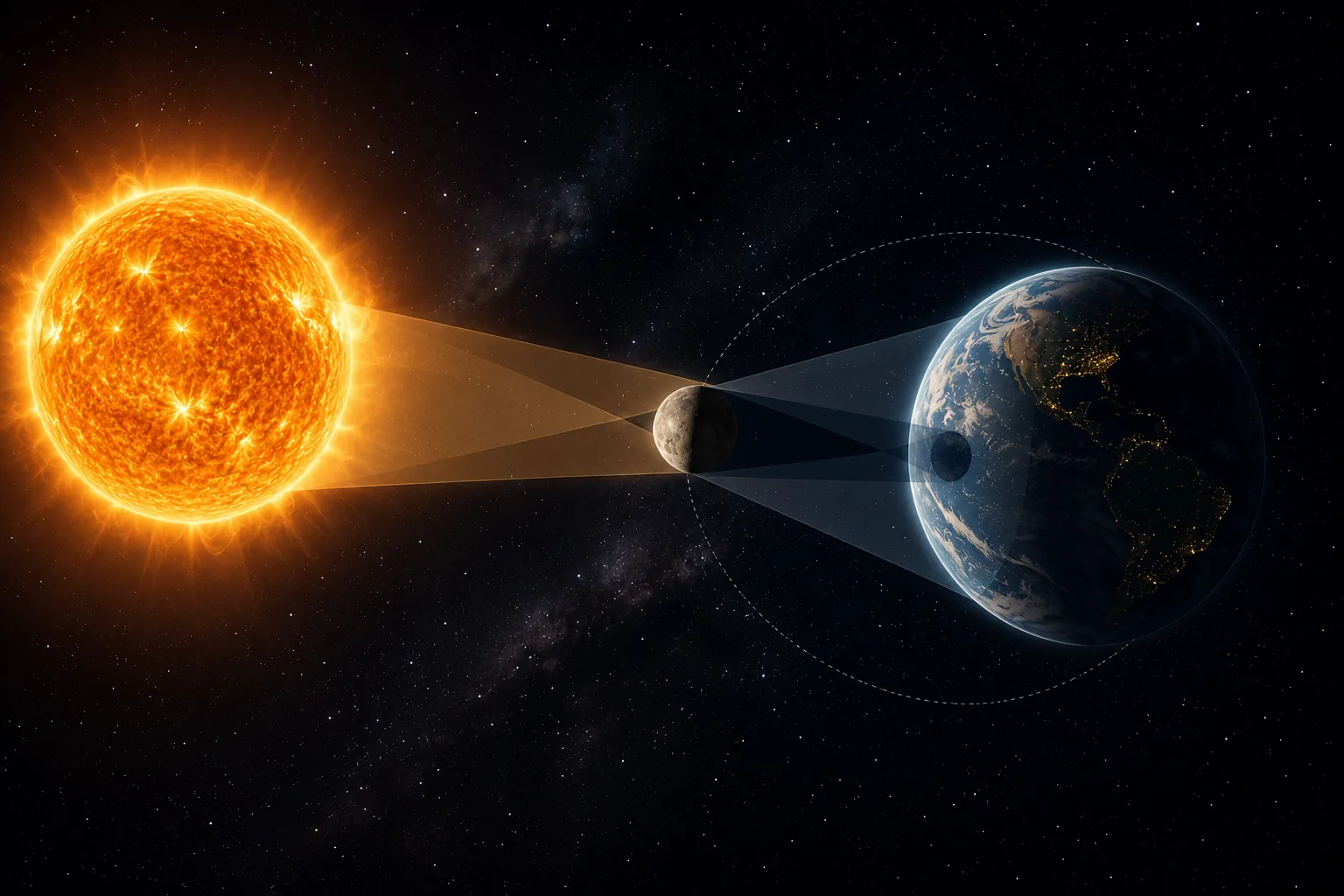
What Causes a Solar Eclipse and Is It Safe to Look?
A solar eclipse is one of nature's most dramatic events. Here is exactly what causes it, why total eclipses are rare, and the real truth about eye safety.

Why Is the Ocean Salty? The Real Scientific Answer
Rivers flow into the ocean every day and they are not salty. So why is the ocean? The answer involves billions of years of geology and a water cycle that never stops.
Comments
Loading comments…