
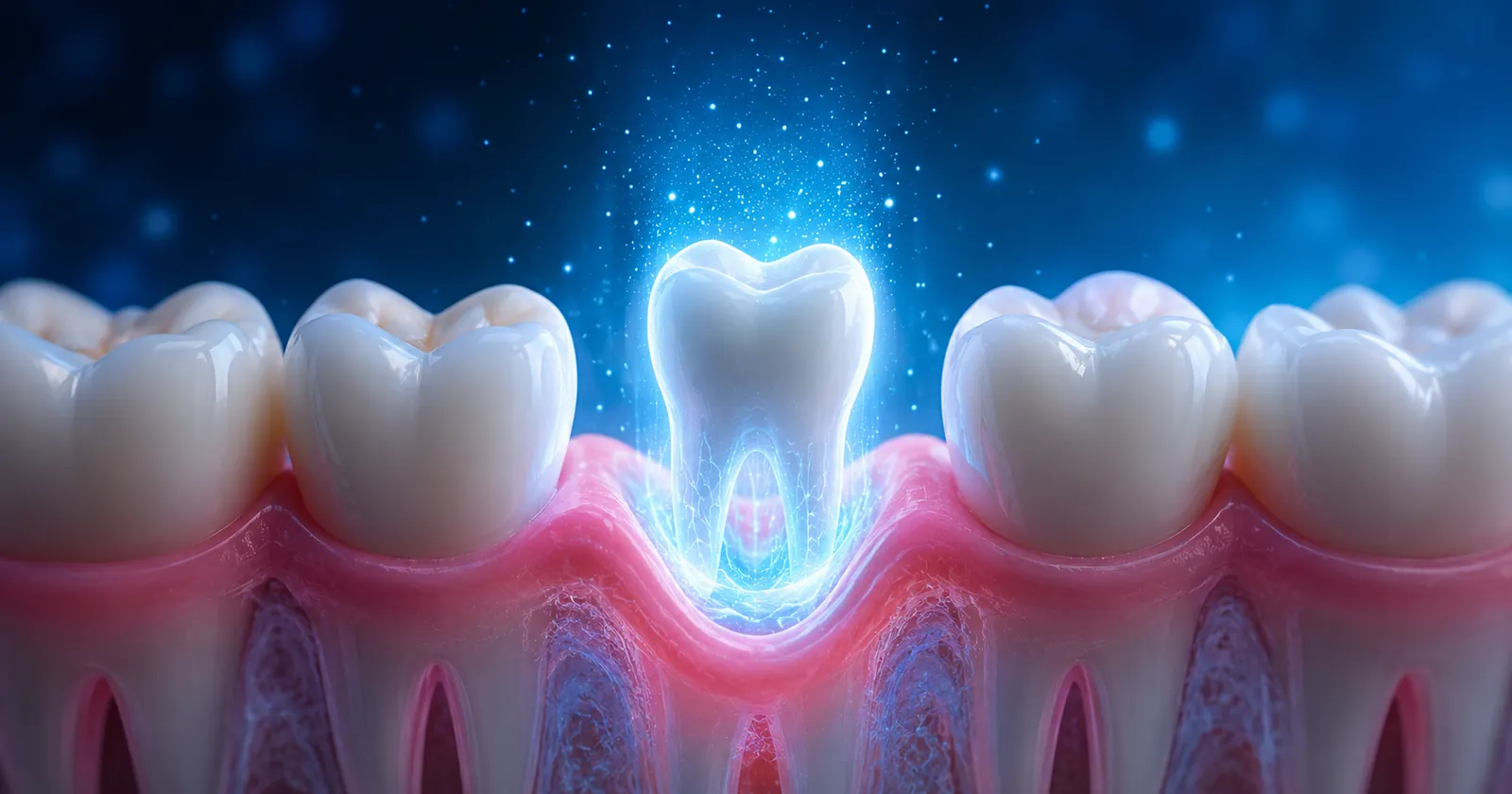
Most people accept it as one of life's simple facts: you get two sets of teeth in your lifetime. Your baby teeth fall out, your adult teeth come in, and that is it. If you lose an adult tooth to decay, injury, or gum disease, the tooth is gone. You replace it with a denture, a bridge, or an implant. None of those options are as good as a real tooth, but they have been the only options available for the whole of human history.
A Japanese company called Toregem Biopharma is working to change that. In 2024, they began the first human clinical trials for a drug that is designed to make the human body grow a brand new tooth from scratch. Not a fake tooth. Not an implant. A real, biological tooth that grows from a root, just like your natural teeth did when you were a child. The trials are now moving into a wider phase in 2026, and the early results are being watched closely by dentists and researchers around the world.
How is it even possible to grow a tooth back?
To understand why this drug might work, it helps to understand a little about how teeth form in the first place. When you are a baby, your body grows teeth because of something called tooth buds. These are small groups of cells that contain all the instructions needed to build a complete tooth, from the root to the enamel on the surface. In most people, those tooth buds are activated twice in a lifetime: once for baby teeth, and once for adult teeth.
But here is something most people do not know: many adults actually have a third set of tooth buds sitting dormant in their gums. These are tiny, undeveloped tooth germs that never got activated. The body simply never received the signal to use them. They just sit there, quietly, for a person's entire life.
The drug developed by Toregem Biopharma works by targeting a protein called USAG-1. This protein normally acts like a biological brake. It stops those dormant tooth buds from activating. By blocking USAG-1 with a specially designed antibody drug, the researchers found that they could essentially release the brake and allow the dormant tooth buds to start growing.
In experiments on mice and ferrets, the results were remarkable. Animals that had their USAG-1 protein blocked grew new, complete teeth. The teeth had proper roots, proper enamel, and proper structure. They were biologically identical to natural teeth, because they were natural teeth, just ones that the body had been prevented from growing before.
What happened in the first human trials?
Toregem Biopharma began their first human clinical trial in September 2024 at Kyoto University Hospital in Japan. The initial trial was primarily a safety trial, which is standard practice for any new drug. The goal at this stage was not to prove that the drug grows teeth in humans, but to establish that it is safe to give to people and does not cause harmful side effects.
The first phase of the trial recruited adult men between the ages of 30 and 64 who were missing at least one molar tooth due to a condition called tooth agenesis, which means the tooth never developed in the first place. This group was chosen because people with tooth agenesis are known to have dormant tooth buds that were never activated, making them the most likely candidates to respond to the treatment.
The trial ran through 2025 and into 2026. While the company has not yet published full results, early reports indicate that the drug was well tolerated with no serious safety concerns identified. This is a significant first step. The next phases of the trial will involve more patients and will begin to measure whether the drug actually causes teeth to grow in humans, not just whether it is safe.
Who could this treatment help?
If the drug works as hoped in humans, the number of people who could benefit is staggering. Tooth loss is one of the most common health conditions in the world. According to the World Health Organization, severe tooth loss affects around 1 billion people globally. In older adults, the figures are even more striking: nearly a third of people over 65 have no natural teeth remaining at all.
People with tooth agenesis, a condition where one or more adult teeth simply never develop, are the first target group for this treatment. This condition affects roughly 1 in 50 people worldwide and currently has no biological solution. Implants and bridges are the best available options, and while they work reasonably well, they do not last forever and require ongoing maintenance.
Beyond tooth agenesis, the researchers hope that the drug could eventually be used for people who have lost teeth due to decay, trauma, or gum disease. This is a much larger population, but it also presents a more complex biological challenge, since in those cases the original tooth was lost rather than never developing. Whether the dormant tooth buds can be activated in those patients, and whether the drug can guide a new tooth to grow in the right position, is something the later stages of clinical trials will need to answer.
How is this different from dental implants?
Dental implants are currently the gold standard for tooth replacement. A titanium post is screwed into the jawbone, where it fuses with the bone over several months, and a porcelain crown is attached on top. They look good and function well, but they come with significant drawbacks.
They are expensive. A single implant can cost between 1,000 and 3,000 US dollars in most countries, and more in some. Insurance rarely covers the full cost. They require surgery under local anaesthesia. The healing process takes months. They can fail, especially in patients with bone loss, gum disease, or diabetes. And they do not feel exactly like a real tooth, because they are not connected to the nervous system the way natural teeth are.
A grown tooth would be fundamentally different. It would have a real root embedded in the jawbone. It would have the same nerve connections as a natural tooth, which means you would actually feel sensation through it, something no implant can provide. It would not require titanium hardware or a surgical procedure. And because it is biological, it would integrate with the rest of your oral health in a way that no synthetic replacement can match.
What about children who lose baby teeth early?
One interesting potential application of this research is for children who lose baby teeth early due to injury or disease before their adult teeth are ready to come through. In those cases, the gap can cause the surrounding teeth to shift, leading to alignment problems that require years of orthodontic treatment. If a drug could stimulate an adult tooth to grow earlier or more reliably in those situations, it could prevent a significant amount of dental and orthodontic treatment down the line.
This is speculative at this stage, and the current trials are focused on adults. But it illustrates how broadly useful a tooth-growing drug could potentially become across different age groups and situations.
When could this actually be available?
Toregem Biopharma has stated a goal of making the drug available to patients by around 2030, subject to the results of clinical trials and regulatory approval. That timeline is ambitious but not impossible if the human trial results are strong.
However, it is worth being realistic about the path ahead. Clinical trials run in phases that each take one to three years. Regulatory approval from Japan's Pharmaceuticals and Medical Devices Agency, and eventual approval from bodies like the European Medicines Agency and the US Food and Drug Administration, adds further time. Manufacturing the drug at scale, training dentists to administer it correctly, and working out the practical details of treatment protocols all take time as well.
A more realistic estimate for widespread availability, particularly outside Japan, is somewhere between 2030 and 2035. For people currently missing teeth, that is years away. But for younger people who may lose teeth in the future, and for children growing up today, it is genuinely possible that tooth loss will simply not be permanent by the time they are adults.
The bigger picture for dental medicine
This research is part of a broader revolution happening in dental medicine right now. Scientists in other countries are working on similar approaches using stem cells, gene therapy, and bioengineering to solve problems that have been considered unsolvable for generations. The Japanese teeth drug, Germany's cartilage gel, and several other breakthroughs happening simultaneously suggest that regenerative medicine is moving from theory to reality faster than most people expected.
The core idea behind all of these breakthroughs is the same: instead of replacing what the body has lost with synthetic materials, you give the body what it needs to rebuild the real thing itself. That shift in thinking, from replacement to regeneration, is perhaps the most significant change in medical science of the past decade. And dentistry is turning out to be one of the fields where it is progressing fastest.
This article is for general information only and is not medical advice. Talk to a qualified health professional about your own situation.
Related Posts

Scientists in Germany just created a gel that grows back your joint cartilage, and no surgery is needed
Millions of people live with painful, damaged joints and are told there is no fix. German scientists just proved that wrong with a gel that restores cartilage naturally.

The gut-brain connection: what 2026 research actually shows
Scientists are uncovering a biological highway between your gut and brain that influences mood, memory, and disease.
Comments
Loading comments…