
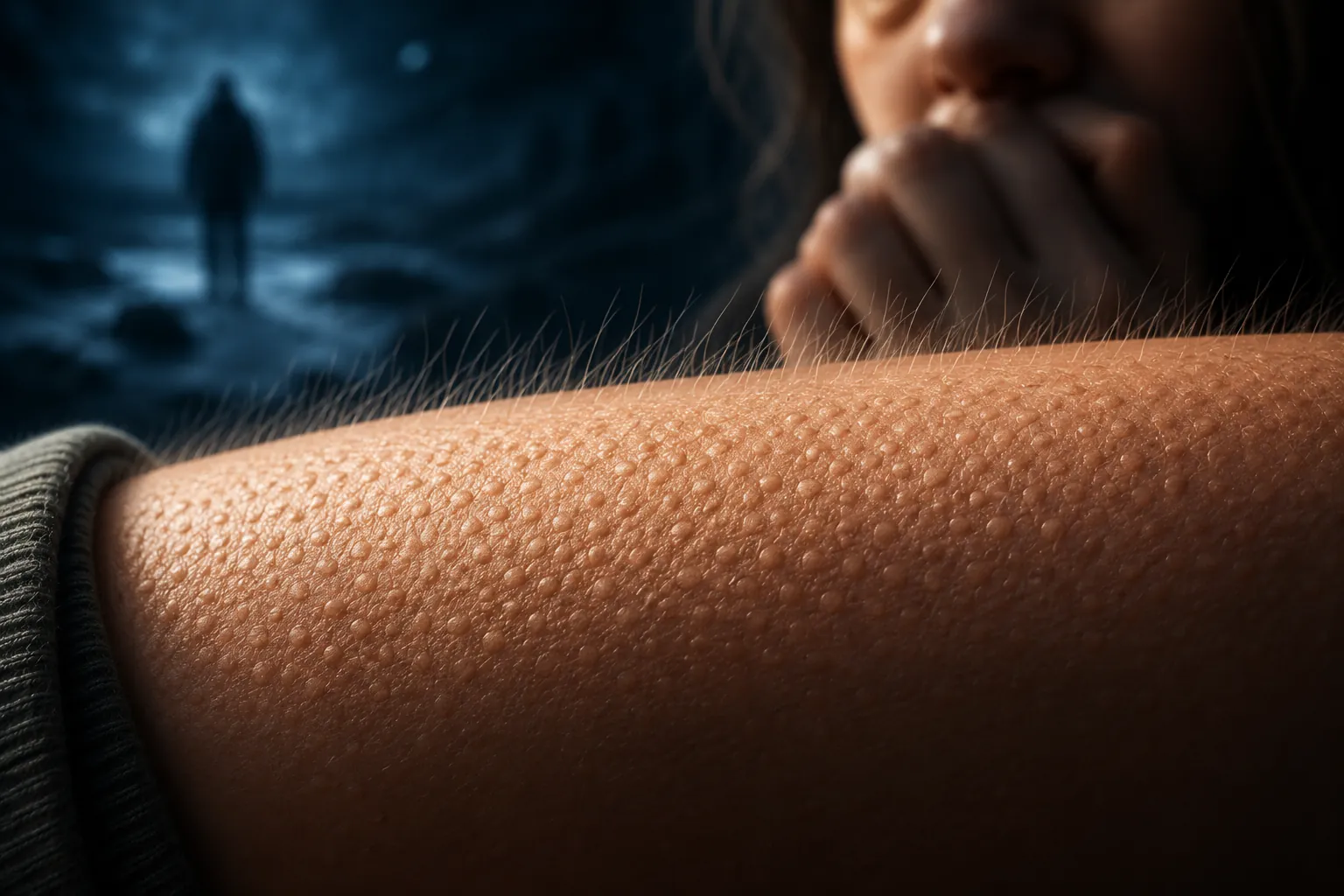
You step outside on a cold winter morning and within seconds your arms are covered in small raised bumps. You hear a piece of music that you love and a wave of tingling shivers runs up your spine and across your scalp. You watch a frightening moment in a film and your skin prickles all over. These are all the same phenomenon, known scientifically as cutis anserina, and informally as goosebumps, goose pimples, or in some parts of the world, chicken skin.
The name comes from the visual resemblance of bumpy human skin to the skin of a plucked goose or chicken. The question is: what is actually happening, and why does the human body do this?
The Mechanism: Tiny Muscles You Never Think About
Every hair on your body, whether visible or nearly invisible, sits in a small tube in the skin called a hair follicle. Attached to each hair follicle is a tiny muscle called the arrector pili (from the Latin for "hair erector"). When this muscle contracts, it pulls the hair follicle upright, making the hair stand on end. Because the hair follicle is anchored in the skin at an angle, this muscular contraction also causes a small dimple or bump to appear on the skin surface around the base of the hair. Millions of these tiny contractions happening simultaneously across a large area of skin produce the distinctive goosebump appearance.
The arrector pili muscles are controlled by the sympathetic nervous system, the same branch of the autonomic nervous system that governs the "fight or flight" response. When the sympathetic nervous system is activated, whether by cold, fear, or strong emotion, it releases adrenaline (epinephrine) and other hormones. These signals travel to the arrector pili muscles, triggering contraction. This is why goosebumps accompany the same situations: cold temperatures, fear, and intense emotional arousal all activate the sympathetic nervous system.
Why Did This Evolve? The Cold Response
The original evolutionary function of goosebumps becomes clearer when you look at how the same mechanism works in other mammals. When a dog, cat, or other furry mammal gets cold or frightened, the hairs across their body (and particularly along the spine) stand on end, a response called piloerection. In cold conditions, erected fur traps a layer of insulating air close to the skin, improving the animal's ability to retain body heat. This is the same principle used by down jackets and duvets, trapping air is one of the most effective forms of insulation available.
For our distant ancestors who had much more body hair than modern humans, this mechanism provided a meaningful thermal benefit. When cold, the arrector pili muscles raised the body hair to create an insulating layer, helping to maintain core body temperature without burning extra energy.
Modern humans have largely lost the dense body hair that made this mechanism useful for warmth. Our arrector pili muscles still function and still contract in response to cold, but the result (tiny bumps on mostly smooth skin) provides essentially no thermal benefit. It is a vestigial response: the mechanism is intact, but the physical feature it was designed to operate (thick body hair) is mostly gone.
The Fear Response: Looking Bigger
The second major trigger for goosebumps, fear or threat perception, also has a clear evolutionary explanation, and again, it is more obvious when you observe it in other animals.
When a cat is frightened or feels threatened, the hair along its spine and tail stands dramatically on end. This piloerection makes the cat look significantly larger than it actually is, a visual strategy for intimidating a potential predator or rival. Chimpanzees and other great apes do the same. A chimpanzee displaying aggression will puff up its fur to appear larger and more formidable.
For hairy ancestral humans, the same mechanism would have served the same purpose. A human ancestor covered in body hair who was confronted by a predator would have benefited from appearing larger and more threatening as part of a fear response. The hair standing on end was part of the body's full threat-response package, alongside increased heart rate, tensed muscles, and sharpened senses.
Again, modern humans retain the nervous system circuitry that triggers this response, but without the dense body hair, the visual intimidation effect is entirely absent. What remains is the bump pattern on smooth skin, a ghost of the original function.
Why Does Music Give You Goosebumps?
This is where the phenomenon gets genuinely interesting, and scientifically more complex. Many people experience goosebumps in response to emotionally powerful music, a specific film scene, an act of great courage or beauty, or a sudden rush of nostalgia. This response is sometimes called "frisson" (from the French word for shiver), and it is distinct from the cold or fear responses.
Frisson involves the same physical mechanism (arrector pili contraction) but is triggered by a different pathway. Research published in the journal Social Cognitive and Affective Neuroscience in 2017, led by Matthew Sachs at the University of Southern California, found that people who experience frisson in response to music have structural differences in their brains compared to those who do not. Specifically, they appear to have denser connections between their auditory cortex (the region that processes sound) and areas involved in emotional processing and the brain's reward system.
Brain imaging studies have shown that frisson activates the same dopamine-reward pathways that respond to food, sex, and other biological rewards. In other words, the brain treats intensely moving music or other aesthetic experiences as rewarding in a way that is neurologically similar to fundamental survival rewards.
Why this pathway is connected to the sympathetic nervous system and thus to arrector pili contraction is not fully explained, but the leading hypothesis is that intense emotional arousal, whether from a genuine threat or from aesthetic experience, activates the sympathetic system broadly. The same "fight or flight" circuitry that raises body hair in fear also fires in response to powerful emotions, producing the same physical effect for a very different reason.
Research consistently finds that not everyone experiences musical frisson. Estimates from multiple studies suggest that roughly 50 to 55% of people experience it at least occasionally. The experience tends to be correlated with personality traits like openness to experience and emotional sensitivity, suggesting there is a genuine individual variation in this response.
The 2022 Discovery: A Completely New Function
In 2022, researchers at Harvard University published a study in the journal Cell that revealed a previously unknown function of the arrector pili muscle and its associated structures. The study, led by Ya-Chieh Hsu, found that the sympathetic nerve endings that stimulate the arrector pili muscle also play a direct role in stimulating hair follicle stem cells.
The finding was unexpected: the same neural circuitry that triggers goosebumps during cold or stress also activates the regenerative stem cells in hair follicles that are responsible for hair growth. The arrector pili muscle sits in direct physical contact with both its sympathetic nerve connection and the hair follicle stem cell niche. During cold exposure, the sympathetic nerves release noradrenaline, which stimulates hair follicle stem cell proliferation, promoting hair growth.
This suggests that the goosebump mechanism serves a function that was not previously recognised: connecting the body's stress-response system directly to tissue maintenance and regeneration in the skin. Under conditions of chronic stress, this same pathway is dysregulated, which may help explain why chronic stress is associated with hair loss. The research opens a new area of investigation into stress-related skin and hair conditions.
Different Names Around the World
The phenomenon of goosebumps is universal across humans, but the names used for it reflect different cultural associations. In English, the comparison is to a plucked goose. In French, "chair de poule" means chicken flesh. In German, "Gänsehaut" means goose skin. In Dutch, "kippenvel" is chicken skin. In Spanish, "piel de gallina" is again chicken skin. In Japanese, "鳥肌 (toridahada)" means bird skin. The widespread comparison to plucked poultry skin reflects how universally recognisable the texture and appearance is.
The Bigger Picture
Goosebumps are a small but instructive example of how the human body carries the history of its evolution. The mechanism that produces them was genuinely useful for our fur-covered ancestors: it kept them warm in cold conditions and made them look bigger to predators. Modern humans have retained the entire neural and muscular machinery for this response despite losing most of the body hair that made it functionally effective.
The fact that the same pathway has also been co-opted over evolutionary time to produce an emotional response to music and beauty, a response that has no obvious survival function but is clearly real and consistently reported, suggests that the sympathetic nervous system and emotional experience are more deeply intertwined than a simple reading of biology might suggest. A mechanism that evolved to raise fur against the cold has, in the strange way that evolution repurposes existing structures, become part of how we experience beauty.
This article is for general information only and is not medical advice. Talk to a qualified health professional about your own situation.
Related Posts

Why Do We Dream? What Science Actually Knows
We spend roughly six years of our lives dreaming. Scientists have been studying the question for over a century. Here is what they have actually found.

Cancer Breakthroughs in 2026: What the Science Actually Shows
mRNA vaccines that shrink tumours. Immune cells engineered to hunt cancer. A clear-eyed look at the most important advances, and what they mean for patients right now.
Comments
Loading comments…