
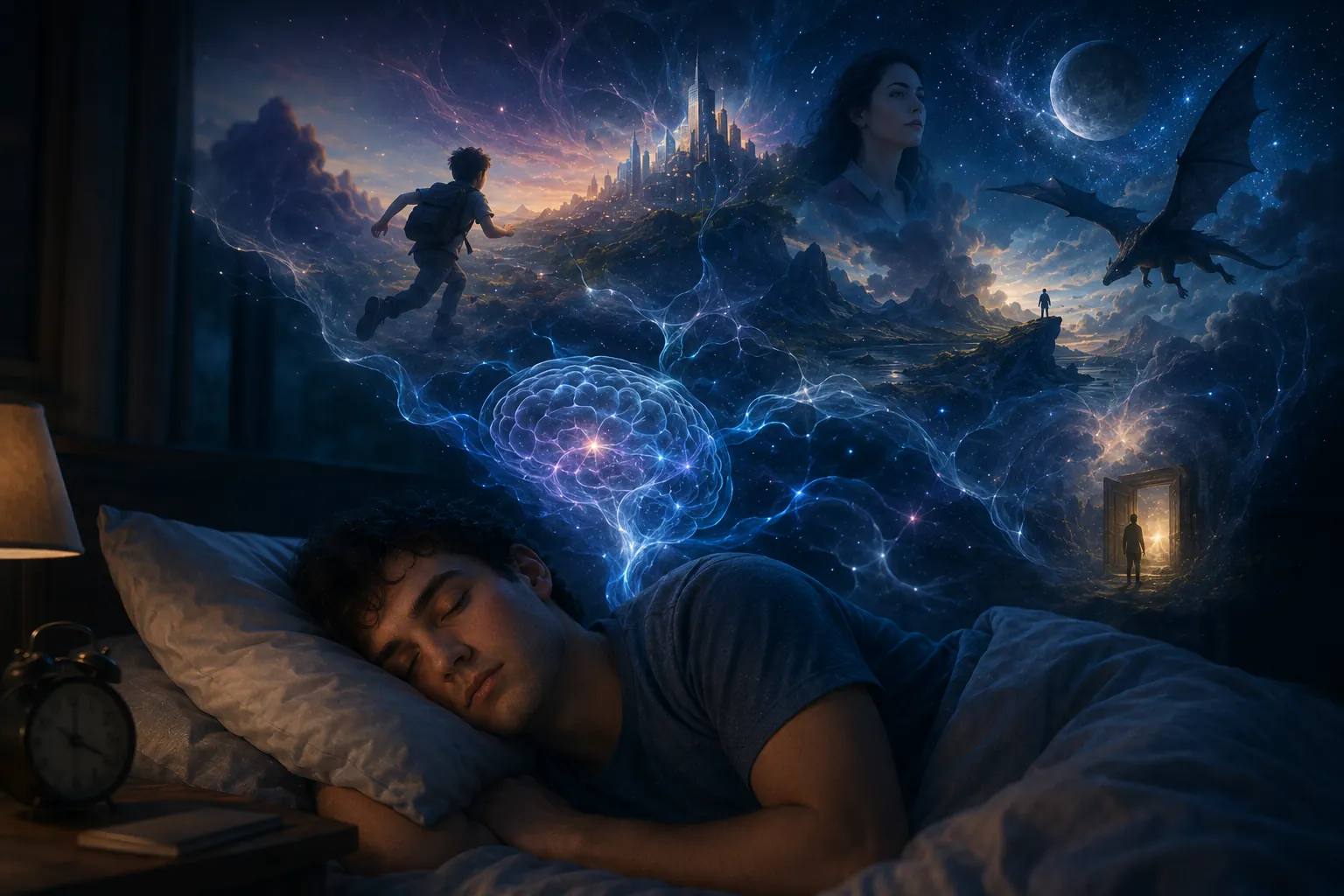
Every night, while your body lies still and your muscles are temporarily paralysed, your brain runs what amounts to a private cinema. You fly over cities you have never visited. You sit in exams for subjects you never studied. You have conversations with people who died years ago. You feel emotions as vivid as anything you experience while awake.
Then you wake up, and within about five minutes, more than half of the dream is gone. Within ten minutes, nearly all of it has vanished. This strange, nightly experience is shared by every human being on the planet, and by most other mammals too. And yet, despite over a century of scientific investigation, a complete answer to the question of why we dream remains one of the genuine mysteries of neuroscience.
Here is what researchers have actually established, and where the uncertainty still lies.
The Basics: When Do We Dream?
Human sleep is not a single uniform state. It cycles through several distinct stages throughout the night, roughly every 90 minutes. These stages fall into two broad categories: non-REM sleep (which itself has three sub-stages, from light sleep to deep slow-wave sleep) and REM sleep.
REM stands for Rapid Eye Movement, a name derived from the observable fact that during this stage, the eyes move quickly back and forth beneath closed eyelids. REM sleep was first formally described and named in 1953 by University of Chicago researchers Nathaniel Kleitman and his student Eugene Aserinsky, a discovery that revolutionised sleep science. When they woke sleepers during REM sleep, nearly 80% reported vivid dreaming. When sleepers were woken from non-REM sleep, far fewer reported dreams, and those that were reported tended to be vaguer and less story-like.
A typical adult has four to six REM cycles per night. The first REM period, early in the night, is short, often just five to ten minutes. Later REM periods grow progressively longer, with the final one potentially lasting 20 to 30 minutes or more. This is why vivid, memorable dreams often occur in the hours just before waking up, when REM sleep is most concentrated.
According to the National Sleep Foundation, the average person spends about two hours dreaming every night. Over a lifetime of roughly 80 years, that adds up to approximately six years spent in the dream state.
The Main Scientific Theories of Why We Dream
Researchers have proposed several competing theories to explain the function of dreaming. None has been definitively proven, but the evidence behind some is considerably stronger than for others.
Theory 1: Memory Consolidation
One of the most widely supported theories in modern neuroscience is that dreaming plays a role in memory consolidation, the process by which newly learned information is stabilised and stored in long-term memory.
During sleep, and particularly during REM sleep, the brain replays and reprocesses experiences from the day. Research from Harvard Medical School has shown that people who sleep after learning a new skill or task perform significantly better on that task the following day than people who stay awake. Studies using brain imaging have shown that areas of the hippocampus (the brain region most involved in forming new memories) are highly active during REM sleep and appear to communicate with the cortex in ways that strengthen memory traces.
This theory suggests that dreams are not necessarily the purpose of REM sleep, but rather a byproduct of the brain's memory-sorting activity. The strange narratives of dreams may result from the brain weaving together memories, emotions, and associations in ways that are not fully filtered by the rational, waking mind.
Theory 2: Emotional Processing
A closely related theory, developed significantly by neuroscientist Matthew Walker at the University of California, Berkeley, and described in detail in his 2017 book "Why We Sleep," proposes that REM sleep functions as a kind of overnight emotional therapy.
According to this theory, the brain uses dreaming to reprocess emotionally charged memories in a neurochemical environment that is fundamentally different from waking consciousness. During REM sleep, levels of noradrenaline (a stress-related neurochemical) are at their lowest point of the 24-hour cycle. Walker and his colleagues suggest that this allows the brain to replay emotionally difficult experiences in a calmer neurochemical state, effectively "stripping" the emotional charge from the memory while preserving the factual content.
Supporting this, people who are deprived of REM sleep specifically (rather than all sleep) show significantly increased emotional reactivity and difficulty regulating their responses to upsetting situations. People with PTSD, a condition in which traumatic memories are not properly processed, often show disrupted REM sleep patterns.
Theory 3: Threat Simulation
Finnish neuroscientist Antti Revonsuo proposed in 2000 what he called the Threat Simulation Theory of dreaming. His argument is evolutionary: dreams, particularly anxiety-inducing dreams and nightmares, function as a kind of safe simulation environment in which the brain rehearses responses to threatening situations.
Data supports the observation that threatening events are disproportionately common in dreams compared to everyday waking life. Studies of dream content across multiple cultures have found that dreams involving threats, pursuit, aggression, or danger are far more common than dreams involving pleasant social interactions. Revonsuo argues this is not random. The brain is using the dreaming state to rehearse survival-related behaviours in a low-risk environment, essentially running threat-response drills while the body sleeps.
Theory 4: Creativity and Problem Solving
There is well-documented anecdotal and scientific evidence that dreams can facilitate creative insight. Chemist August Kekulé famously reported that the circular structure of the benzene molecule came to him in a dream involving a snake biting its own tail. Paul McCartney has said the melody of "Yesterday" came to him fully formed in a dream. Dmitri Mendeleev claimed the arrangement of the periodic table appeared to him while sleeping.
Laboratory research has backed up the anecdotes. A study published in the journal Nature in 2004 by Ullrich Wagner and colleagues at the University of Lübeck showed that people were more than twice as likely to discover a hidden mathematical shortcut in a task after sleeping on it compared to those who remained awake. The researchers specifically linked the insight gains to REM sleep.
The likely mechanism is that during REM sleep, the brain makes connections between memories and ideas that are not constrained by the linear, logical thinking of the waking mind. Distant associations are more easily formed, which can produce novel combinations of ideas that feel like sudden insights upon waking.
Why Do We Forget Dreams So Quickly?
Most dreams are forgotten within minutes of waking, and the reason appears to be neurochemical. During REM sleep, levels of acetylcholine (a neurochemical that promotes memory formation) are high, while levels of noradrenaline and serotonin are low. This combination promotes dreaming itself but is not ideal for encoding those experiences into lasting memory.
Additionally, the hippocampus, which plays the key role in transferring short-term experiences into long-term memory, appears to be less involved in recording dream content than in recording waking experiences. Dreams seem to be processed differently from waking memories, using a system that is efficient for its own purposes but not designed to leave permanent records.
The moment of waking involves a rapid shift in neurochemistry. If you lie still and focus on your dream immediately upon waking, before engaging with anything else, you can often retain more of it. Writing it down within the first few minutes captures the content before it dissolves.
Why Do Some Dreams Feel So Real?
During REM sleep, the brain's visual cortex, emotional centres (including the amygdala), and motor planning areas are all highly active. The prefrontal cortex, the region responsible for rational analysis, reality testing, and critical thinking, is significantly less active. This neurological pattern explains a great deal about the experience of dreaming.
Because the emotional and sensory regions are running at near-waking levels while the rational filter is offline, the brain cannot easily distinguish the dream from reality. Emotions feel genuine. Visual scenes feel real. Impossible events, flying, breathing underwater, talking to the long dead, are accepted without question because the brain has no functioning critical voice to challenge them.
This also explains why waking from a vivid nightmare leaves a physical residue of fear even after you are fully conscious. The amygdala processed a genuine threat response during the dream, and the body responded accordingly, with elevated heart rate, sweat, and alertness.
Do Animals Dream?
The evidence strongly suggests that many animals do. All mammals that have been studied show REM sleep, and during REM sleep, their brains show activity patterns that closely mirror waking brain activity for species-typical behaviours. Dogs show leg movements and vocalisation during REM sleep that appears consistent with running or playing. Rats, studied extensively in the laboratory, show hippocampal replay of their daytime maze-running routes during REM sleep, suggesting active memory consolidation is occurring.
In a landmark 2001 study from MIT, Matthew Wilson and Kenway Louie showed that the specific pattern of hippocampal activity recorded in rats while they ran a maze was replayed in detail while the rats slept. The replay was so precise that the researchers could identify which parts of the maze the rat appeared to be "running through" in its sleep.
Whether animals experience a subjective, narrative dream the way humans do is impossible to determine from outside the animal's mind. But the neurological machinery of REM sleep and something resembling memory replay appears to be widespread among mammals.
What About Lucid Dreaming?
Lucid dreaming is the state in which a dreamer becomes aware that they are dreaming, sometimes gaining the ability to consciously direct the dream's content. It was long considered a curiosity or a folk claim, but scientific evidence for its reality was firmly established by psychophysiologist Keith Hearne in 1975 and independently by Stephen LaBerge at Stanford University in 1980. Both researchers asked lucid dreamers to signal their awareness to the outside world by moving their eyes in a prearranged pattern while still in REM sleep. The eye movement signals, visible on polysomnography equipment, confirmed the reports.
Research suggests that during lucid dreaming, the prefrontal cortex, usually dampened during REM sleep, shows increased activity. The dreamer has, in effect, partially reactivated their rational self-awareness without fully waking up. This is a fascinating intersection of the sleeping and waking brain states.
The Honest Answer
Science has made enormous progress in understanding the neuroscience of sleep and dreaming over the past 70 years. The evidence strongly points toward REM sleep and dreaming playing important roles in memory consolidation, emotional processing, and possibly creative insight and threat rehearsal. These functions are not mutually exclusive; dreaming likely serves multiple overlapping purposes simultaneously.
But the full answer to why we dream, why the brain generates this particular subjective experience of vivid narrative imagery rather than processing memories in some other, less theatrical way, remains genuinely open. It is one of the last great frontiers of neuroscience, sitting at the intersection of biology, psychology, and the deep question of consciousness itself.
What we can say with confidence is this: dreaming is not random noise. It is not meaningless. It is an active, purposeful state of the brain that serves real biological functions. The six years you will spend dreaming over your lifetime are not wasted. They are, in ways we are only beginning to understand, some of the most productive hours your brain will ever spend.
This article is for general information only and is not medical advice. Talk to a qualified health professional about your own situation.
Related Posts

Why Do We Get Goosebumps? The Science Behind It
Goosebumps happen when you are cold, scared, or moved by music. The answer reaches back millions of years into our evolutionary past, with a surprising recent discovery.


Cancer Breakthroughs in 2026: What the Science Actually Shows
mRNA vaccines that shrink tumours. Immune cells engineered to hunt cancer. A clear-eyed look at the most important advances, and what they mean for patients right now.
Comments
Loading comments…