
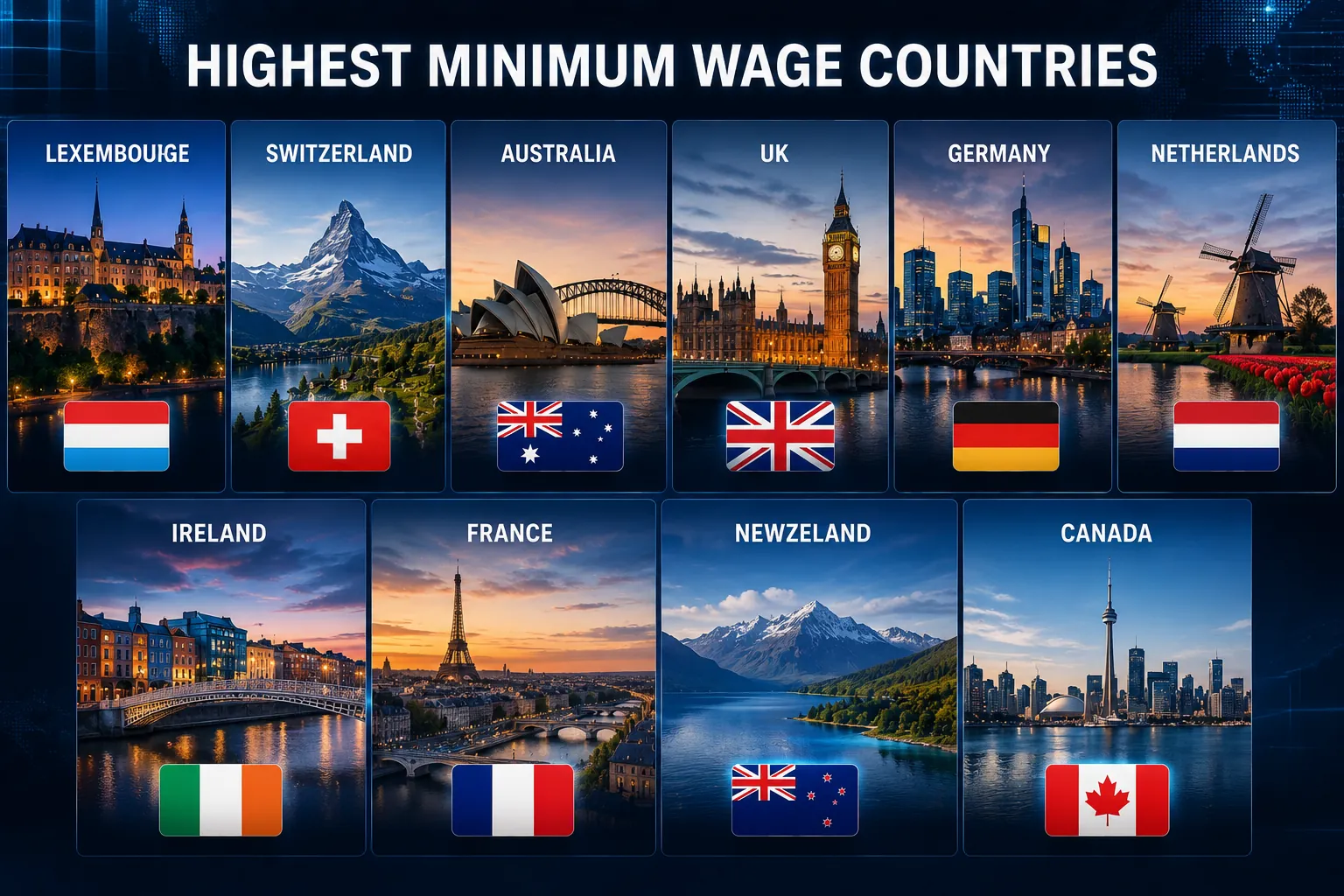
Minimum wage is one of the most direct measures of how a country values its workers. It sets the floor, the absolute least that an employer can legally pay. And across the world, that floor varies so dramatically that a minimum wage worker in Luxembourg earns in a single day what a minimum wage worker in some developing countries earns in a month.
The figures below are based on verified 2026 data converted to US dollars at current exchange rates. Where countries have regional variations, we use the most widely applicable national figure. All amounts are gross monthly earnings before tax unless otherwise stated.
1. Luxembourg, Approximately $3,670 per month
Luxembourg consistently tops global minimum wage rankings and 2026 is no exception. The Grand Duchy sets its minimum wage for unskilled workers over 18 at around €3,085 per month, which converts to approximately $3,670 USD, the highest statutory national minimum wage in the world.
Luxembourg's wealth is driven by its position as Europe's premier financial centre, hosting major investment funds and European institutions. The cost of living is high, housing in Luxembourg City is among the most expensive in Europe, but the minimum wage still provides a meaningful standard of living. Workers receive 13 months of pay per year in many sectors, which pushes effective annual earnings even higher.
2. Switzerland, Approximately $3,940 per month (Geneva)
Switzerland does not have a single national minimum wage, but several cantons have introduced their own. Geneva's cantonal minimum wage of CHF 24.59 per hour is the highest in the country and among the highest in the world, translating to approximately $3,940 USD per month for a full-time worker. Zurich and Basel have similar or slightly lower floors.
Switzerland's high wages reflect its extraordinary cost of living. A coffee costs around $5, a monthly public transport pass in Zurich runs over $100, and a one-bedroom apartment in Geneva typically costs $2,500 or more per month. Still, minimum wage workers in Switzerland have purchasing power that workers in most other countries cannot match.
3. Australia, Approximately $2,450 per month
Australia's national minimum wage is set annually by the Fair Work Commission. In 2026, it stands at AUD $24.10 per hour, which translates to approximately $2,450 USD per month for a standard 38-hour working week. Australia also mandates employer-paid superannuation (pension contributions) of 11.5% on top of wages, which significantly increases total compensation beyond the base figure.
Australia's minimum wage is among the highest in the Asia-Pacific region by a wide margin. The system is reviewed every year and has consistently increased above inflation over the past decade. Casual workers receive an additional 25% loading on top of the base rate, which makes part-time and seasonal work more financially viable than in many comparable countries.
4. United Kingdom, Approximately $2,915 per month
The UK's National Living Wage for workers aged 21 and over increased in April 2026 to £12.71 per hour, equivalent to approximately $2,915 USD per month based on current exchange rates. Workers aged 18 to 20 receive a lower rate of £10.18 per hour, and apprentices have their own rate.
The UK minimum wage has risen substantially in recent years as part of a government commitment to reach two-thirds of median earnings. London has its own voluntary Living Wage set by the Living Wage Foundation at a higher rate, which many large employers now use, but this is not legally mandated. Outside London, the national rate applies uniformly across England, Scotland, Wales, and Northern Ireland.
5. Germany, Approximately $2,576 per month
Germany introduced a statutory national minimum wage only in 2015, but it has risen quickly since then. In 2026, the rate stands at €12.82 per hour, translating to approximately $2,576 USD per month for full-time work. The Minimum Wage Commission reviews the rate every two years and has recommended continued increases in line with collective bargaining trends.
Germany's system is notable for its strong union presence in many sectors, where collectively bargained wages often sit significantly above the statutory minimum. Industries like construction, electrical trades, and cleaning have their own sector-specific minimum rates that exceed the national floor. The actual average wage in Germany is considerably higher than the minimum, which is used primarily as a floor for lower-skilled service sector jobs.
6. Netherlands, Approximately $2,580 per month
The Netherlands links its statutory minimum wage to the Dutch Social Minimum and adjusts it twice a year, in January and July, in line with average wage growth. In 2026, the rate stands at €14.40 per hour for workers aged 21 and over, or approximately $2,580 USD per month. The Netherlands also provides a mandatory holiday allowance of 8% of annual gross salary on top of the base wage.
The Netherlands abolished age-related minimum wage tiers below 21 in recent years, meaning younger workers now receive the same statutory minimum as adult workers, a significant change that increased earnings for many young people in retail, hospitality, and agriculture.
7. Ireland, Approximately $2,560 per month
Ireland raised its national minimum wage in January 2026 as part of a multi-year plan to reach a Living Wage standard. The current rate is €13.50 per hour for adult workers, translating to approximately $2,560 USD per month. Ireland is on a roadmap to reach 60% of median wages, and further increases are expected in the coming years.
Ireland's strong economy, driven largely by multinational technology and pharmaceutical companies based in Dublin, has created significant upward pressure on wages generally. The gap between the minimum wage and actual average wages is wide in Dublin, where tech sector salaries dominate. Outside Dublin, the minimum wage represents a more meaningful proportion of typical earnings.
8. France, Approximately $2,020 per month
France's SMIC (Salaire Minimum Interprofessionnel de Croissance) is updated annually and tied to inflation plus a share of real wage growth. In 2026, it stands at approximately €11.88 per hour, or around $2,020 USD per month gross. France mandates the 35-hour working week for full-time employees, which means the monthly minimum wage is calculated on fewer hours than in most other countries, making the hourly rate more comparable than the monthly figure suggests.
France's minimum wage system also links to a range of social benefits. Workers at or near the SMIC threshold receive reduced social contributions under the Fillon reductions scheme, which effectively increases their take-home pay relative to higher earners. About 17% of French workers earn the SMIC, making it one of the most widely applied minimum wages in any major economy.
9. New Zealand, Approximately $2,190 per month
New Zealand's minimum wage is set by the government and reviewed each year. In 2026, the adult minimum wage stands at NZD $23.15 per hour, converting to approximately $2,190 USD per month. New Zealand abolished youth and training minimum wages in 2021, so all adult workers receive the same floor regardless of age or industry.
New Zealand's labour market is tight, and many employers in hospitality, retail, and agriculture pay above the minimum wage simply to attract staff. The country also mandates four weeks of paid annual leave for all employees, which adds meaningful value beyond the base hourly rate when calculating total compensation.
10. Canada, Approximately $1,900 per month (national average)
Canada sets minimum wages at the provincial level rather than nationally. In 2026, rates range from around $15.60 CAD per hour in some provinces to $17.40 CAD in British Columbia, the highest provincial rate. The national average across all provinces and territories sits at approximately $16.50 CAD per hour, converting to around $1,900 USD per month. Ontario, Alberta, and British Columbia, home to Canada's largest cities, all have rates above the national average.
The federal minimum wage of $17.30 CAD per hour applies to federally regulated industries such as banking, telecommunications, and interprovincial transport. Several provinces have committed to further increases tied to inflation in coming years, which will push the national average higher.
Why Minimum Wage Figures Can Be Misleading
The raw monthly figures above tell only part of the story. A worker earning $2,900 per month in London takes home significantly less after income tax and National Insurance than the gross figure suggests, while a worker earning $3,670 in Luxembourg keeps more of it than you might expect, because Luxembourg's tax system is relatively favourable for lower earners.
Purchasing power matters more than the nominal figure. Switzerland's $3,940 minimum wage sounds enormous until you account for the fact that a basic grocery run costs twice what it does in France or Germany. Australia's $2,450 goes considerably further in Melbourne than Luxembourg's $3,670 does in Luxembourg City for many categories of spending.
Social benefits also vary enormously. Countries like France, Germany, and the Netherlands provide universal healthcare, heavily subsidised childcare, and generous unemployment benefits, which effectively increase the real value of low wages compared to countries where workers must fund these needs privately.
Finally, the gap between minimum wage and average wage matters. In countries where the minimum wage is close to the median wage, it has a much larger effect on the overall economy and income distribution than in countries where it is a distant floor that few workers actually earn.
The Bottom Line
Luxembourg, Switzerland, and Australia lead the world on minimum wage in absolute terms. But the most meaningful measure is what that wage actually buys in the country where it is earned, and by that measure, the rankings look somewhat different. Workers in New Zealand and Australia arguably get among the best deals in the world when minimum wage, purchasing power, and social benefits are considered together. For workers around the world watching these figures, the direction of travel is clear: most high-income countries are committed to raising their floors further over the next several years.
Related Posts

Why is there liquid inside a coconut? The answer is stranger than you think
You crack open a coconut and liquid pours out. The real answer involves biology, evolution, and a survival trick millions of years in the making.

Blue Moon vs Red Moon Explained: What They Actually Are
What is a blue moon, and does it actually look blue? What makes a moon turn red? A clear, science-based explanation of two of the most misunderstood events in the night sky.

The space economy: how space is about to affect your daily life
Satellites, asteroid mining, and orbital manufacturing are no longer science fiction. They are business plans.
Comments
Loading comments…