
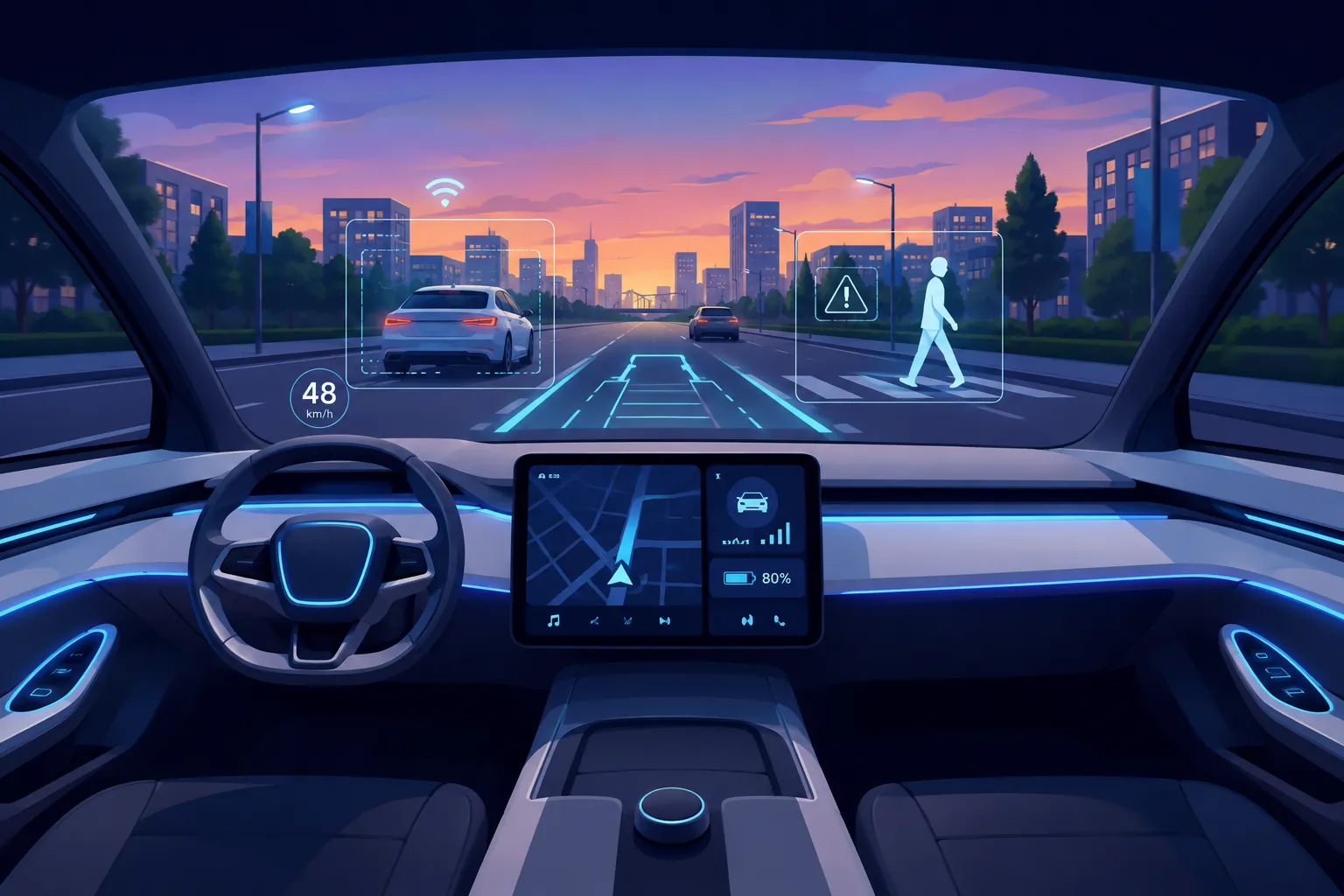
The story of self-driving cars is, so far, primarily a story of a gap between ambition and reality. In 2016, Elon Musk said a Tesla would drive itself from Los Angeles to New York by the end of 2017. In 2018, Uber's chief scientist predicted fully autonomous vehicles within eighteen months. Ford announced plans for a self-driving commercial vehicle by 2021, with no steering wheel. None of these predictions came true.
But here is what did happen: genuinely driverless vehicles are now operating commercially in several cities, accumulating millions of miles of data, and the gap between current performance and the level required for safe, widespread deployment is narrowing in measurable ways. The story has become less about "when will this happen" and more about "where, in which conditions, and on what timeline."
Where it is actually working: the United States
Waymo, the autonomous vehicle division of Alphabet (Google's parent company), is the most advanced commercially deployed system in the world. Its robotaxis operate without any safety driver in Phoenix, San Francisco, Austin, and Los Angeles, completing over 150,000 paid trips per week as of early 2026. The service has a safety record that compares favourably with human drivers in the same cities.
The critical caveat is geography. Waymo's vehicles operate only in mapped areas where the company has conducted extensive prior data collection. They do not operate in unfamiliar territory, in extreme weather, or on roads with highly unpredictable human behaviour. This is not a flaw, it is an intelligent engineering decision, but it means the transition to a world where you can hail a driverless car anywhere is still some way off.
Tesla's Full Self-Driving (FSD) system, despite the name, still requires human supervision. It is a Level 2 driver assistance system, impressive, but not autonomous. Tesla has been promising Level 4 autonomy (no human needed in defined conditions) for years without delivering it. The company's approach, which relies on camera-only systems without radar or lidar, is controversial among researchers who believe additional sensor inputs are necessary for full safety.
"The problem is not the 99% of normal driving. It is the 1%, the unpredictable scenario that every algorithm must handle correctly the very first time it encounters it."
China: a different approach, surprising results
China has taken a fundamentally different approach to autonomous vehicles, treating it as a national strategic priority, investing heavily in both the technology and the infrastructure needed to support it. Smart road infrastructure that communicates with vehicles, extensive regulatory fast-tracking for testing, and massive state investment have created a unique environment.
Apollo Go, Baidu's robotaxi service, has completed over seven million trips in China as of 2026 and operates in 11 cities. WeRide and AutoX have also deployed commercial services. The Chinese approach, building roads that help cars navigate rather than building cars that can navigate any road, may prove faster to widespread deployment than the Western approach, at the cost of requiring infrastructure investment that not all countries can make.
Europe: regulation before deployment
Europe's autonomous vehicle story is primarily a regulatory story. The EU has been working on a harmonised legal framework for autonomous vehicles since 2019, and this process has been thorough, arguably too thorough for an industry moving at technology speed. Germany was the first country in the world to pass a law explicitly permitting fully driverless vehicles on public roads (2021), but commercial services remain limited. Mercedes-Benz received approval for Level 3 autonomous driving on German motorways in 2023, the first such approval anywhere in the world.
The UK, post-Brexit, has taken a more permissive regulatory stance and is positioning itself as a testing ground for autonomous technology, with commercial deployments expected to expand significantly from 2027 onwards.
The realistic global timeline
Autonomous robotaxis in geofenced urban areas in major US and Chinese cities: happening now, expanding through 2028. Autonomous freight on dedicated highway routes in the US, China, and Europe: commercially operational by 2028 to 2030. Private autonomous vehicles that require no human input in most conditions: 2030 to 2035 in early-adopter markets. Fully autonomous vehicles operating anywhere, in any weather, without prior mapping: beyond 2035, and possibly much further.
The technology will not arrive uniformly. As with most big technologies, it will arrive first in the places with the most permissive regulation, the best infrastructure, and the greatest investment. The gap between early-adopter countries and the rest of the world may persist for a decade or more after the technology reaches mass-market maturity.
Japan and South Korea: careful and methodical
Japan has a specific motivation for pursuing autonomous vehicles beyond convenience: an ageing population and a severe shortage of rural transport options. Many older Japanese citizens live in areas where public transport is sparse and driving becomes impossible as they age. The Japanese government has designated autonomous vehicles as a national social priority and approved public road trials in several prefectures. Honda received the first Level 3 autonomous vehicle approval in Japan in 2021 and has deployed a limited commercial service in Tokyo.
South Korea has taken a similar approach, investing heavily in both the technology and the legal framework to support it. Hyundai and Kia have both deployed test fleets in Seoul, and the government has been testing a fully driverless bus service in the city of Sejong. Commercial expansion is expected through 2027 and 2028.
The safety question
Every conversation about autonomous vehicles eventually comes back to safety. The data from Waymo, the most mature commercial deployment, suggests that its vehicles are involved in significantly fewer serious accidents per kilometre driven than human drivers in the same areas. But critics point out that Waymo operates in optimal conditions: well-mapped cities, mostly clear weather, and at relatively low speeds. The harder question is how the systems will perform in the full range of conditions that human drivers handle every day.
There have also been high-profile failures. In 2018, an Uber self-driving vehicle killed a pedestrian in Tempe, Arizona, in the first fatal autonomous vehicle accident. Tesla's FSD system has been involved in a number of accidents, some fatal, which are being investigated by the US National Highway Traffic Safety Administration. These incidents have shaped regulation, slowed certain approvals, and reminded both engineers and the public that the gap between "impressive in testing" and "safe in every real-world condition" remains significant.
What this means for ordinary people
For people living in major cities in the United States or China, driverless robotaxi services are already available and expanding. For everyone else, the practical impact on daily life is still some years away. The most likely near-term change for most people will be in freight: autonomous trucks on motorways will become common before driverless personal vehicles do, because the conditions are more controlled and the economic incentive is enormous.
Insurance, urban planning, parking infrastructure, and public transport will all be disrupted when autonomous vehicles become mainstream. Cities designed around parking lots and roads wide enough for human error will not be the cities of 2040. The change is coming. The honest answer is simply that nobody knows exactly when, or how fast.
Related Posts

Why is there liquid inside a coconut? The answer is stranger than you think
You crack open a coconut and liquid pours out. The real answer involves biology, evolution, and a survival trick millions of years in the making.

Blue Moon vs Red Moon Explained: What They Actually Are
What is a blue moon, and does it actually look blue? What makes a moon turn red? A clear, science-based explanation of two of the most misunderstood events in the night sky.
The space economy: how space is about to affect your daily life
Satellites, asteroid mining, and orbital manufacturing are no longer science fiction. They are business plans.
Comments
Loading comments…