
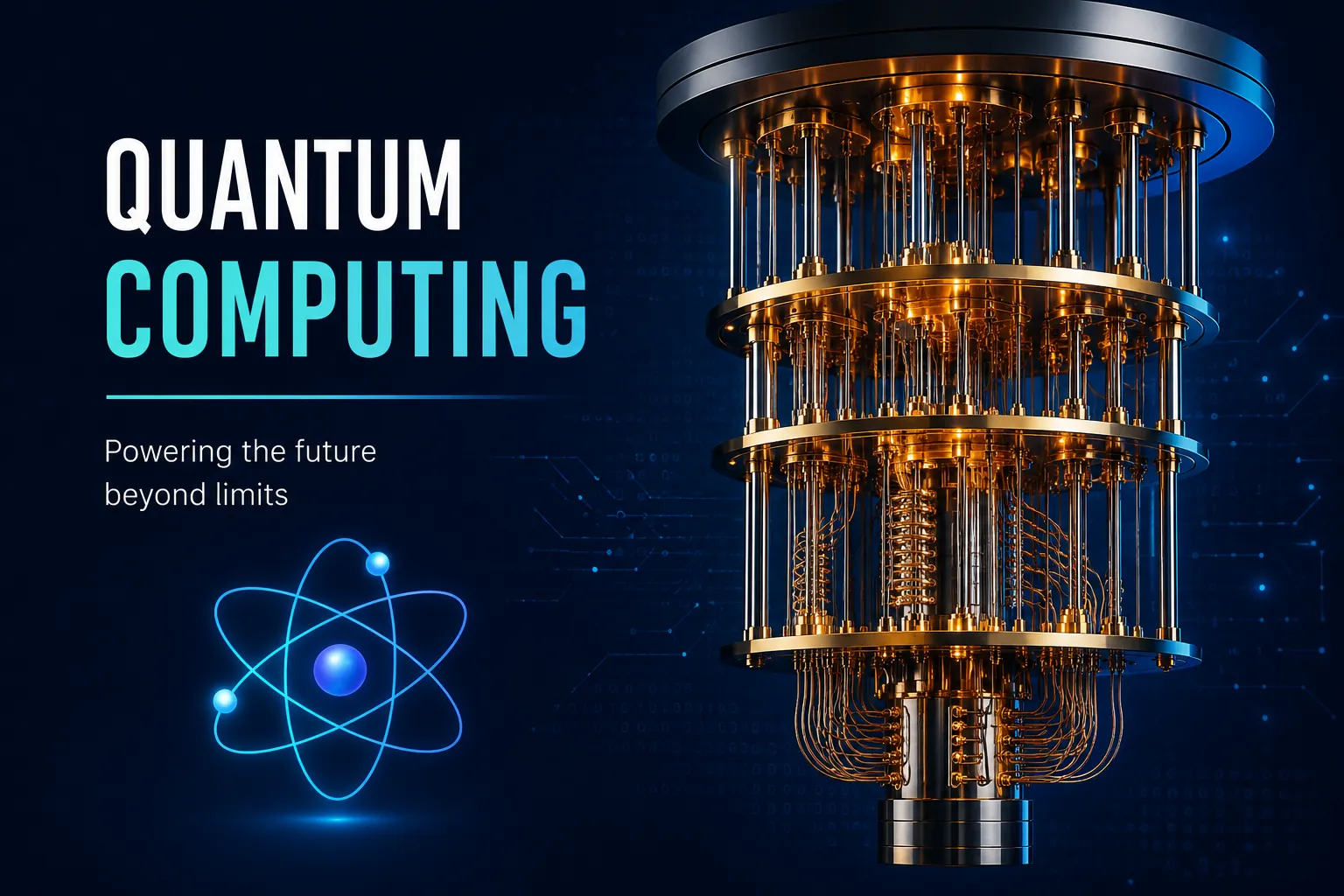
Start with what a regular computer actually does. Every piece of information in a conventional computer is stored as a bit, a switch that is either off (0) or on (1). Everything you have ever done on a computer, every email, every video, every calculation, is ultimately a very long sequence of zeros and ones being manipulated at enormous speed. The architecture is elegant and has proven extraordinarily capable, but it has a fundamental limit: a bit can only be zero or one at any given moment.
A quantum computer uses quantum bits, qubits, and qubits behave differently. Thanks to a property of quantum physics called superposition, a qubit can exist as zero, one, or, crucially, both simultaneously until you measure it. Entangle multiple qubits together, and you get a system that can represent and process an exponentially larger number of states at once than a classical computer of equivalent size. For certain categories of problem, this represents a difference not of degree but of kind.
What it is good at: and what it is not
Quantum computing is not a faster version of ordinary computing. For most tasks, browsing the internet, running a spreadsheet, playing a video game, it offers no advantage at all. What it is genuinely superior at is a specific class of problems involving enormous numbers of variables and combinations: simulating molecular interactions, optimising complex logistics networks, breaking certain types of encryption, and searching vast datasets in ways that classical computers cannot efficiently do.
Drug discovery is the most immediately consequential application. Designing a new drug molecule requires simulating how it will interact with proteins in the human body, a calculation so complex that even the most powerful classical supercomputers can only approximate it. A sufficiently capable quantum computer can simulate these interactions exactly. This would compress the drug discovery timeline from the current average of 12 years to potentially 2 to 3 years, and dramatically reduce the cost. For diseases where no effective treatment currently exists, this is not a technical curiosity. It is potentially life-saving at scale.
"Quantum computing will not replace your laptop. It will solve the problems your laptop cannot even attempt."
Where the technology stands today
IBM, Google, Microsoft, and several well-funded startups including IonQ and Quantinuum are all racing to build quantum computers capable of solving real-world problems better than classical machines, a threshold researchers call "quantum advantage." Google claimed quantum supremacy in 2019 with a calculation that it said would take a classical supercomputer 10,000 years but took its 53-qubit processor 200 seconds. IBM disputed the comparison. The field is advancing rapidly, but also generating hype that outpaces reality.
The honest current state: quantum computers with hundreds to thousands of qubits exist and are being tested by major corporations and research institutions. They are not yet reliably error-corrected enough to run the complex algorithms that would demonstrate real-world quantum advantage at scale. The consensus among researchers is that fault-tolerant quantum computers, capable of running long, complex algorithms without errors accumulating, are 5 to 15 years away.
The encryption problem everyone needs to know about
The most urgent near-term implication of quantum computing has nothing to do with drug discovery or optimisation. It is about encryption. Most of the security infrastructure of the internet, the technology that protects your banking, your messages, your medical records, relies on mathematical problems that classical computers cannot solve in any reasonable timeframe. A sufficiently powerful quantum computer could solve these problems quickly, rendering current encryption obsolete.
This is not a hypothetical future concern. Adversarial actors are already harvesting encrypted data today with the intention of decrypting it once quantum computers are capable enough, a strategy known as "harvest now, decrypt later." Governments, banks, and technology companies are actively transitioning to quantum-resistant encryption standards. In 2024, the US National Institute of Standards and Technology published the first set of post-quantum cryptographic standards. The transition is underway, but it will take years to complete across all systems.
What it means for you, practically
In the short term, almost nothing changes for the average person's daily life. In the medium term, the next decade, the effects will be felt primarily through better medicines, faster materials discovery for batteries and solar panels, and more secure (post-quantum) encryption protecting your data. In the longer term, quantum computing combined with AI will likely accelerate scientific discovery across every field of medicine, materials science, and climate modelling in ways that are genuinely difficult to predict.
The technology is real, the progress is real, and the implications are large. The timeline is measured in years to decades, not months. For now, the most useful thing most people can do is stay informed, and note when a bank or service provider updates its security protocols. That update, boring as it sounds, will be one of the most consequential changes in the history of internet security.
Climate and energy: an underrated application
One of the least-discussed but potentially most important applications of quantum computing is in materials science and energy. Designing better solar panels, more efficient batteries, and new materials for clean energy generation all require simulating molecular behaviour at a level of complexity that classical computers struggle with. A quantum computer capable of accurately modelling nitrogen fixation, the chemical process that produces fertiliser, could help design processes that consume a fraction of the energy current methods require. Nitrogen fixation currently accounts for roughly 1% of global energy consumption.
Climate modelling is another area where quantum computing could have outsized impact. The atmosphere is an extraordinarily complex system with a vast number of interacting variables. More accurate climate models would improve weather forecasting, disaster prediction, and long-term policy planning in ways that directly affect millions of lives.
The companies and countries racing to get there first
Quantum computing has become a geopolitical competition as much as a scientific one. The United States, China, the European Union, and the United Kingdom have all made it a national strategic priority, committing billions in public funding. The concern is that the first country to achieve reliable, fault-tolerant quantum computing will have an enormous advantage in both economic and security terms.
In the private sector, IBM has been the most transparent about its progress, publishing a public quantum roadmap and giving researchers cloud access to its quantum hardware through IBM Quantum. Google's quantum division, led by researchers from some of the world's top universities, has claimed several milestones. Microsoft has taken a different technical approach, pursuing what it calls topological qubits, which are theoretically more stable and easier to error-correct, though harder to build. Startups like IonQ, Quantinuum, and PsiQuantum are pursuing different hardware approaches and attracting significant venture capital.
China has invested heavily and quietly. Its publicly known quantum computing programme includes the Jiuzhang photonic quantum computer, which in 2020 claimed to perform a specific calculation 100 trillion times faster than the world's fastest classical supercomputer. Independent verification of such claims is difficult, but the scale of China's investment in the field is not in doubt.
How to think about quantum computing without the hype
The history of quantum computing coverage is littered with premature announcements and overstated milestones. "Quantum supremacy," the point at which a quantum computer does something faster than any classical computer, has been claimed multiple times by multiple companies, and disputed almost as often. The reason is that demonstrating supremacy on a carefully chosen, narrow problem is very different from demonstrating genuine practical advantage on real-world problems that matter.
A useful analogy: the Wright brothers' first flight at Kitty Hawk in 1903 was genuine, historic, and technically extraordinary. It was also a 12-second hop across a beach that was useless for transporting people or goods. The gap between that first flight and commercially viable aviation was 25 years. Quantum computing is somewhere between the first flight and the first commercial airline. The physics works. The engineering challenges that remain are enormous. The payoff, when it arrives, will be transformative.
Related Posts

Why is there liquid inside a coconut? The answer is stranger than you think
You crack open a coconut and liquid pours out. The real answer involves biology, evolution, and a survival trick millions of years in the making.

Blue Moon vs Red Moon Explained: What They Actually Are
What is a blue moon, and does it actually look blue? What makes a moon turn red? A clear, science-based explanation of two of the most misunderstood events in the night sky.
The space economy: how space is about to affect your daily life
Satellites, asteroid mining, and orbital manufacturing are no longer science fiction. They are business plans.
Comments
Loading comments…