
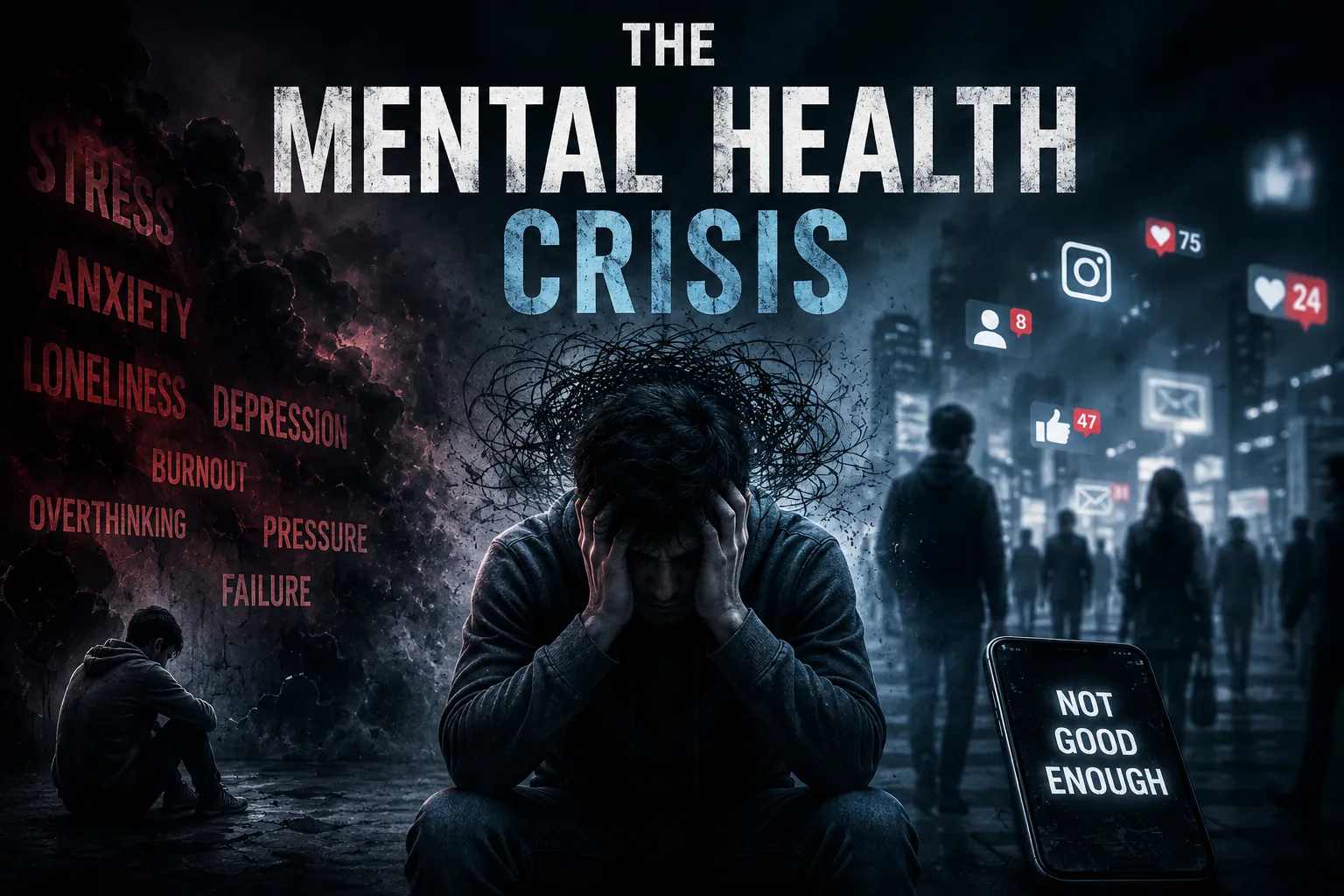
Every year, governments around the world release statistics on cancer rates, cardiovascular disease, diabetes, and infectious disease. Enormous budgets are allocated, national strategies are drawn up, and awareness campaigns run in every language. Mental health receives none of this at scale, despite the fact that it affects more people than most of those conditions combined.
According to the World Health Organization, approximately one billion people, roughly one in eight people alive today, currently live with a mental or neurological disorder. Depression is the leading cause of disability worldwide. Anxiety disorders affect over 300 million people. Schizophrenia, bipolar disorder, and eating disorders affect hundreds of millions more. And yet the global response, measured in funding, trained professionals, and access to treatment, remains catastrophically inadequate.
The treatment gap: a problem without parallel in medicine
In high-income countries, around 70% of people with a serious mental health condition receive no treatment. In low- and middle-income countries, that figure rises to over 90%. There is no comparable gap anywhere else in medicine. A person who develops tuberculosis in a low-income country has a reasonable chance of receiving treatment. A person who develops severe depression in the same country almost certainly will not.
The reasons are structural. Mental health was, for much of the twentieth century, handled through institutionalisation, a model that has largely been abandoned, but never adequately replaced. Community-based care systems were promised in its wake. In most countries, they were never properly built. The result is a vacuum: the hospitals are gone, the community services are inadequate, and the people who need help have nowhere to go.
"We have the knowledge to treat most mental health conditions effectively. The problem is that almost no one who needs that knowledge can access it."
What countries actually spend
The median global spending on mental health is less than 2% of national health budgets. In low-income countries, the median is under 1%. To put this in context: mental, neurological, and substance use disorders account for approximately 13% of the global burden of disease. They receive 1% of the funding. The mismatch is so severe that health economists refer to it simply as "the mental health financing gap."
Even within the spending that does exist, most goes to psychiatric hospitals rather than community-based treatment. WHO data shows that over 80% of mental health spending in low- and middle-income countries goes to inpatient facilities, institutions that serve relatively small numbers of the most severely ill patients, while the vast majority with treatable conditions go without any support at all.
The economic cost the world ignores
Mental health conditions cost the global economy an estimated $1 trillion per year in lost productivity. Depression and anxiety alone account for approximately 12 billion lost working days annually. Studies consistently show that every dollar invested in scaling up mental health treatment returns four dollars in improved health and productivity. By the conventional logic of cost-benefit analysis, expanding mental health care is one of the highest-return investments any government can make.
The argument is rarely made effectively because mental health sits in an awkward institutional space, it is not clearly owned by any single government department, its outcomes are harder to measure than, say, cancer survival rates, and it carries a stigma that makes it politically difficult to champion. It is, in a precise technical sense, a neglected disease area, one where the burden is enormous and the response is minimal, not because of ignorance but because of structural inertia.
What is actually working
Despite the scale of the problem, there are models that work. Task-sharing programmes, which train community health workers, nurses, and primary care doctors to deliver evidence-based psychological treatments, have shown remarkable results in countries ranging from Ethiopia to India to Pakistan. The Friendship Bench programme in Zimbabwe, which trained grandmothers to deliver problem-solving therapy on park benches, reduced depression symptoms in participants by over 50% in randomised trials. It has since been replicated in multiple countries.
Digital mental health is emerging as another scalable solution. Apps delivering cognitive behavioural therapy have shown clinical efficacy in multiple trials, and the smartphone penetration needed to reach large populations at low cost already exists across much of the world. The challenge is not the technology but quality control, regulation, and reaching populations that most need help and are least likely to seek it.
The post-pandemic shift
COVID-19 produced a global surge in anxiety and depression that was well documented and widely reported. What received less attention was the effect on policymakers. In many countries, the pandemic represented the first time senior officials personally knew large numbers of people experiencing mental health difficulties, and it generated a political attention that the field had never previously enjoyed.
Several governments have since increased mental health budgets meaningfully. Australia, the UK, and Canada have all expanded community mental health infrastructure. In 2025, the WHO launched a new global action plan that, for the first time, set binding targets for member states around mental health service coverage. These are not sufficient responses to the scale of the crisis, but they represent a shift in seriousness that the field has long needed.
The scale of what remains undone is immense. But the trajectory, for the first time in generations, is in the right direction.
This article is for general information only and is not medical advice. Talk to a qualified health professional about your own situation.
Related Posts


Japan is testing a drug that grows back your teeth. Human trials started in 2026
A Japanese biotech company has started human trials for a drug that can grow back lost teeth from the root up.

Scientists in Germany just created a gel that grows back your joint cartilage, and no surgery is needed
Millions of people live with painful, damaged joints and are told there is no fix. German scientists just proved that wrong with a gel that restores cartilage naturally.
Comments
Loading comments…