
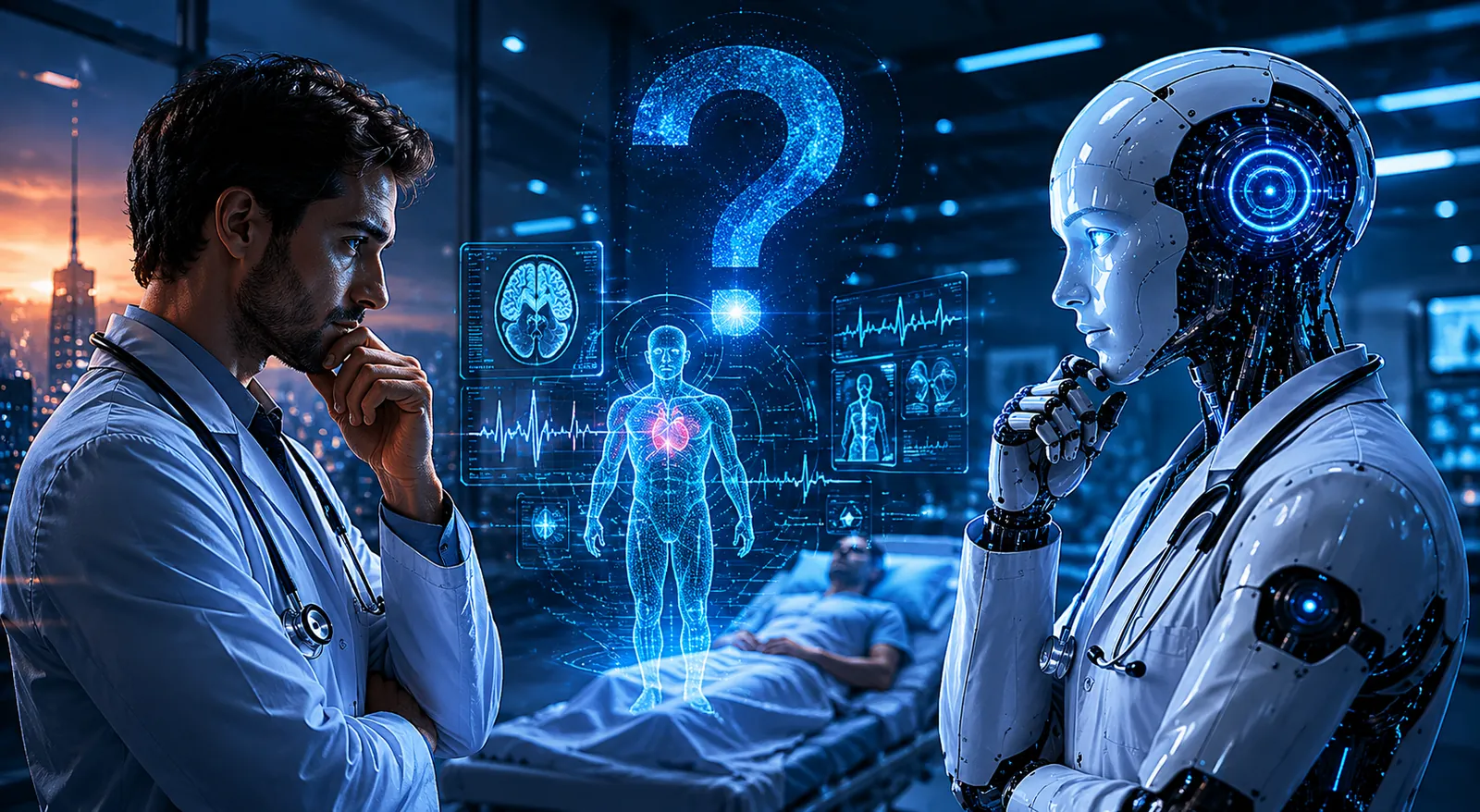
In a hospital in London, an AI system examined 10,000 mammograms and caught 11% more cancers than human radiologists, while also reducing false positives by nearly 6%. In South Korea, a machine learning model predicted which ICU patients would go into cardiac arrest four hours before it happened, with 80% accuracy. In the United States, a dermatology AI outperformed board-certified dermatologists at identifying melanoma from photographs.
The question is no longer whether artificial intelligence can perform medical tasks at a high level. It clearly can. The real question, the one researchers, hospital administrators, and medical students are wrestling with right now, is what happens to doctors when it can do so reliably, cheaply, and at scale.
What AI already does better than humans
The tasks where AI has proven itself superior share a common feature: pattern recognition across enormous datasets. Radiology, pathology, and dermatology, specialties built on identifying subtle visual differences, are the furthest along.
Google's DeepMind has developed systems that detect over 50 eye diseases from retinal scans with accuracy matching world-leading experts. Other systems can process a patient's entire medical history, thousands of research papers, and treatment outcomes from millions of similar cases in under a minute, a task that would take any human clinician weeks.
"AI won't replace doctors. But doctors who use AI will replace doctors who don't."
This phrase has become something of a mantra in medical schools worldwide. It captures the prevailing consensus among most healthcare AI researchers: the technology is an extraordinarily capable tool, not an autonomous replacement.
Where humans still have the clear advantage
Medicine is not only pattern recognition. It involves communication, judgment under deep uncertainty, ethical reasoning, and the human relationship between a sick person and someone genuinely trying to help them.
Complex cases involving multiple interacting conditions, rare diseases with limited training data, and patients from under-represented populations all represent areas where current AI systems perform poorly or fail outright. The more unusual the patient, the worse the algorithm tends to do.
"A patient who has just been told they have cancer doesn't need an algorithm to explain their options," says one cardiologist at a major London hospital. "They need someone who has sat with other patients who felt exactly what they're feeling right now. That presence, that's not in any dataset."
The realistic 10-year picture
Most researchers believe that by 2035, AI will have fundamentally changed what doctors do day-to-day, but will not have eliminated the profession. The more nuanced prediction: a significant reduction in certain specialties (particularly radiologists and pathologists), while other roles expand considerably.
Primary care doctors are expected to use AI to handle routine diagnoses and administrative work, freeing them for complex cases and patient relationships. Surgeons may work alongside robotic systems that handle precision tasks beyond human capability. Psychiatrists and general practitioners, roles built heavily on human connection, are considered the least at risk.
What this means for you
If you are a patient, the likely outcome is better healthcare at lower cost. AI-powered screening will catch diseases earlier, more accurate diagnoses will reduce unnecessary procedures, and specialist-level care will become accessible in parts of the world that currently have very few specialists.
If you are a medical student, the advice from most educators is consistent: lean into skills that AI cannot easily replicate, complex reasoning, patient communication, procedural skill, and the ability to handle ambiguity when there is no clear answer. The physicians who will thrive are those who treat AI as a remarkably capable colleague.
The countries where AI medicine is moving fastest
The adoption of AI in healthcare is not happening evenly around the world. The United States, China, the United Kingdom, and South Korea are leading deployment of clinical AI tools, driven by large health datasets, significant investment, and regulatory frameworks beginning to accommodate the technology.
China's national AI strategy explicitly includes healthcare, and the country has fast-tracked regulatory approvals for AI diagnostic tools. Over 70 AI-powered medical products have received regulatory clearance in China, more than any other country. The UK's National Health Service has run several large-scale AI trials, including the mammography study mentioned above, and is committed to rolling out AI diagnostic tools across all NHS trusts.
In lower-income countries, there is genuine hope that AI could address the severe shortage of trained specialists in sub-Saharan Africa, South Asia, and parts of Latin America. An AI system that can read a chest X-ray at a specialist level, running on a tablet in a rural clinic, could save lives where no radiologist exists within hundreds of kilometres. Google has already run pilot programmes for diabetic retinopathy screening in Uganda and Thailand.
The ethical questions that still have no easy answers
The rapid deployment of AI in medicine raises serious ethical questions. The first is bias. Most AI medical systems are trained on data that overrepresents white, male, and Western patients. Studies show that AI diagnostic systems perform significantly worse on darker skin tones, on women's heart conditions, and on populations with different genetic profiles from the training data. Deploying a biased system at scale could worsen healthcare for already disadvantaged populations.
The second is accountability. When an AI system makes a wrong diagnosis and a patient is harmed, who is responsible? The doctor who accepted its recommendation? The company that built it? The hospital that deployed it? Legal frameworks have not caught up with the technology, and in most jurisdictions the answer is genuinely unclear.
The third is data privacy. AI medical systems require enormous amounts of patient data to train and improve. This is among the most sensitive information a person can share. How it is collected, stored, used, and protected by commercial companies is a question patients, regulators, and ethicists are still working through.
The bottom line
AI will not replace doctors by 2035. What it will do is fundamentally change what doctors spend their time on, make certain diagnostic specialties significantly smaller, and bring high-quality medical assessment to billions of people who currently have no access to it. The best doctors will use AI to become dramatically more effective. Healthcare systems that integrate it thoughtfully will provide better outcomes at lower cost.
The profession is not disappearing. It is transforming. And the transformation, for patients, is likely to be a positive one.
Related Posts
How Elon Musk Sees the Future of AI
Musk believes AI could be humanity's greatest breakthrough, or its biggest threat. Here's how he thinks it will reshape the world.
Why every government is panicking about AI regulation right now
Every major country is rushing to write AI laws before it is too late. Here is why they are all terrified.

Comments
Loading comments…