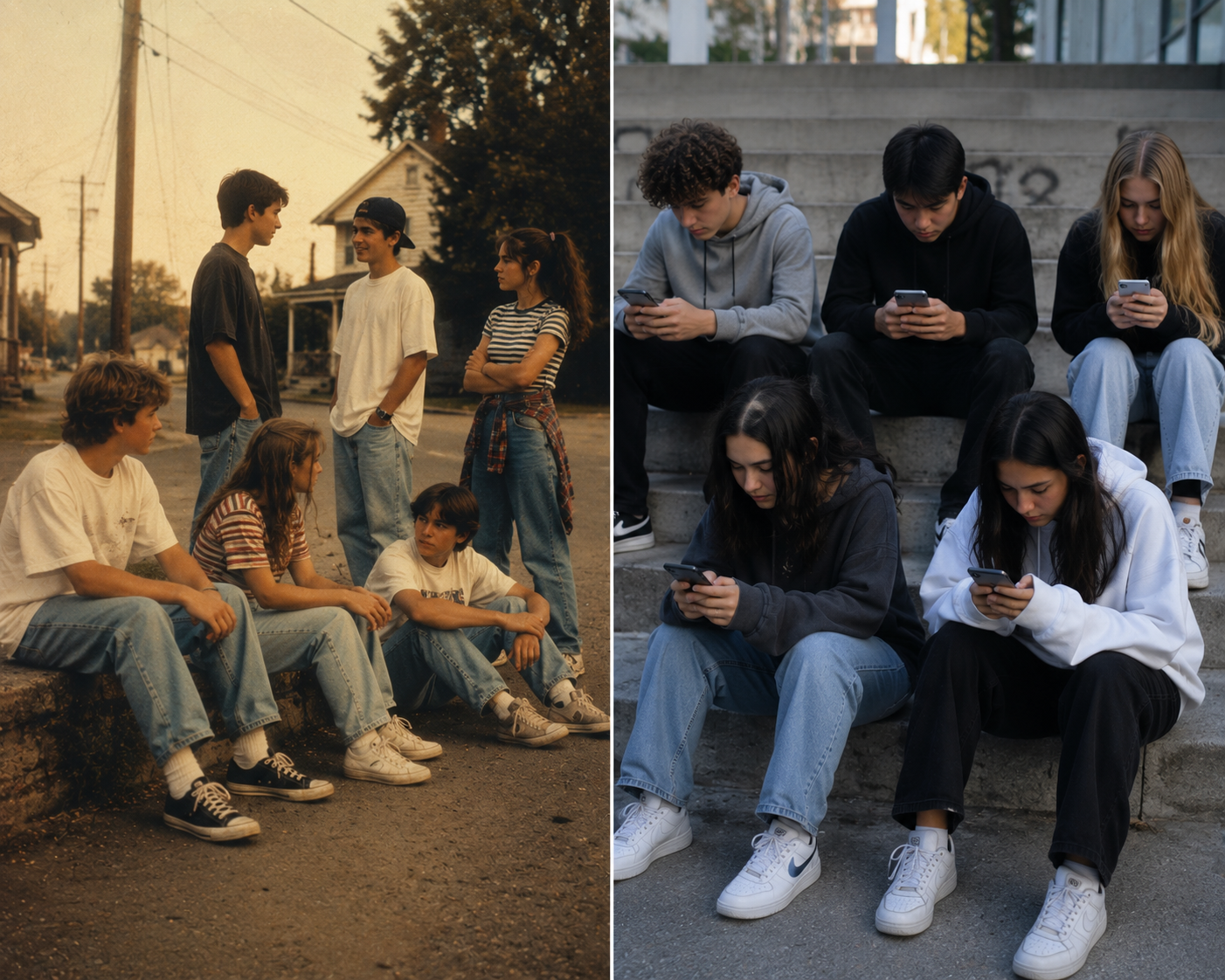
Ask anyone who grew up in the 1990s what teenage life was like, and they will describe a world that sounds almost alien to a teenager today. No smartphones. No social media. No streaming. If you wanted to call a friend, you called the house and hoped their parents picked up. If you wanted to listen to music, you sat by the radio waiting to hit record at exactly the right moment.
The gap between 1990s teenage life and teenage life in 2026 is not just a generation. It is a complete transformation of how young people communicate, learn, socialise, and understand themselves. This article walks through the real, specific differences, drawing on verifiable facts about technology adoption, media consumption, and social behaviour.
Waking Up: The Morning Routine Then and Now
A 1990s teenager woke up to an alarm clock, a radio, or a parent calling from downstairs. The first activity of the morning was not checking messages. There were no messages waiting. A typical morning involved watching whatever happened to be on television at that hour, or eating breakfast with the family before catching the school bus.
Today, research from the American Psychological Association and various media organisations consistently shows that the majority of teenagers check their smartphones within minutes of waking up. A 2023 Pew Research Center study found that 95% of American teenagers own a smartphone, and most report using it immediately upon waking. The first interaction of the day is no longer with family or the physical world. It is with a screen, often a social media feed, a notification, or a message thread that was active overnight.
This single shift changes the entire psychological starting point of the day. A 1990s teenager began the morning in the offline world. A 2026 teenager begins it inside a curated digital environment that has been active all night without them.
Communication: From Landlines to Instant Everything
In the 1990s, calling a friend meant calling their home number. There was no guarantee of privacy. A parent or sibling might answer. If your friend was not home, you left a message on an answering machine. If the line was busy, you waited and tried again. Long conversations were possible, but they tied up the household phone line and sometimes ran up the bill.
Pagers (also called beepers) became common among teenagers in the mid to late 1990s, particularly in the United States. A pager received numeric messages only. To respond, you had to find a phone. The entire system required patience and effort that is almost incomprehensible from today's perspective.
By contrast, a teenager today communicates through a layered ecosystem of platforms. WhatsApp and iMessage for direct text conversations. Instagram and Snapchat for visual sharing. TikTok for short-form video. Discord for group conversations and communities around shared interests. According to a 2024 survey by Common Sense Media, teenagers in the United States now spend an average of 4.8 hours per day on social media apps alone. Every message is instant. Every reply is expected quickly. The social pressure of being "seen" and expected to respond has no equivalent in 1990s teen life.
Music: Mixtapes vs Streaming 100 Million Songs
Music was a defining part of 1990s teenage identity, just as it is today, but the logistics were completely different. To listen to music, you needed physical formats: cassette tapes, compact discs, and later MiniDiscs for a brief window. A Walkman or a CD player (which skipped when you moved too fast) was the standard portable listening device.
Making a mixtape for a friend was a genuine act of effort and affection. You recorded songs in real time from the radio or other tapes, curating the order carefully. Copying an album meant physically dubbing it from one tape deck to another. Buying music required going to a record shop, and your entire collection was limited by what you could afford and physically store.
Today, Spotify alone hosts over 100 million tracks. Apple Music, YouTube Music, Tidal, and Amazon Music offer similar libraries. A teenager today has instant access to virtually all recorded music in human history, available offline or online, on any device, for a monthly fee that is less than the price of a single CD in 1995. Discovery is now algorithmic: platforms suggest new music based on listening history, and entire cultural moments around music (like a new album dropping) unfold in real time across social media.
The mixtape still exists conceptually as a playlist, but the labour and intimacy of the physical version is gone. What was once a meaningful creative effort is now a few taps on a screen.
Entertainment: Three Channels vs Infinite Choice
A teenager in the 1990s watched television on a schedule set by broadcasters. In many countries, there were only a handful of channels available. In the United States, the major networks were ABC, NBC, CBS, and Fox, along with a growing number of cable channels. Popular shows like Friends, Buffy the Vampire Slayer, and The Fresh Prince of Bel-Air were communal experiences because millions of people watched the same thing at the same time. Missing an episode was a real problem. There was no catch-up. The VCR existed, but programming it correctly was famously difficult.
Going to the video rental store on a Friday evening was a genuine social and logistical event. Blockbuster Video had over 9,000 stores worldwide at its peak in 2004. You browsed physical shelves, chose a tape or DVD, and hoped it was not already rented out. The movie was due back in two days.
Today, Netflix alone has over 300 million subscribers worldwide and offers thousands of titles on demand. Disney Plus, HBO Max, Prime Video, Apple TV Plus, and dozens of other platforms offer further libraries. There are no schedules, no rental fees, and no late penalties. A teenager today can watch any series from any country in any language, with subtitles, at any time, on any screen. The concept of waiting a week for the next episode still exists on some platforms, but binge watching, consuming an entire series in a weekend, has become the default behaviour for many viewers.
School and Homework: Encyclopaedias vs the Entire Internet
Researching a school project in the 1990s meant going to the library. Encyclopaedia Britannica was the gold standard for factual reference, either borrowed from the school library in its multi-volume print form or, from the mid-1990s onwards, available on CD-ROM. If your local library did not have the book you needed, you waited. Handwriting notes was standard. Typing assignments on a word processor or early computer was available but not universal.
The internet existed in the 1990s but was not yet a meaningful resource for most teenagers. In 1995, fewer than 1% of the world's population was online. By 1999, that figure had grown to around 4%. Dial-up connections were slow, expensive by the minute, and required the phone line, meaning no one could call the house while you were browsing.
Today, a teenager doing homework has instantaneous access to essentially all human knowledge. Wikipedia, Google Scholar, Khan Academy, YouTube tutorials, AI tools like Claude and ChatGPT, and millions of books digitised by Google Books and the Internet Archive are all reachable within seconds. Research that might have taken a full afternoon in a library in 1995 can now be completed in twenty minutes. The challenge has inverted: the problem is no longer finding information but evaluating whether the information found is accurate and reliable.
Social Life: Meeting Up vs Being Constantly Connected
In the 1990s, making plans with friends required direct communication, usually by phone or in person at school. Plans were made in advance and required commitment, because there was no easy way to cancel or change them at the last minute once someone had already left the house. If you said you would meet at the shopping centre at 2pm, you showed up at 2pm, because there was no way to send a quick message saying you were running late.
Hanging out in person was the default social activity. Shopping centres, parks, fast food restaurants, and each other's houses were the main gathering points. The social circle was largely defined by geography: the people you knew at school, in your neighbourhood, and through local clubs and activities.
Today, teenagers maintain hundreds or thousands of social connections simultaneously through platforms designed to keep engagement constant. The social circle is global. Online friendships with people in other countries, formed through shared gaming communities, fan communities, or social media, are treated as real and meaningful, and research increasingly confirms they can be. But the always-on nature of modern social connectivity brings its own pressures. A 2024 report from the US Surgeon General found that teenagers who spend more than three hours per day on social media face twice the risk of anxiety and depression symptoms compared to those who use it less.
Body Image and Self-Perception
Body image pressures existed for teenagers in the 1990s, driven by magazine culture, music videos, and film. But the exposure was intermittent. You saw idealised images in magazines or on television at specific times, then put the magazine down or turned the TV off.
Today, social media creates a continuous, immersive environment of visual comparison. Instagram, TikTok, and Snapchat all prioritise visual content, and much of it is filtered, edited, or professionally produced. Research from the London School of Economics and several major university psychology departments consistently links heavy social media use among teenagers, particularly girls, to body dissatisfaction and lower self-esteem. Meta's own internal research, revealed in a 2021 leak reported by the Wall Street Journal, found that Instagram was associated with body image issues in approximately 32% of teenage girls surveyed.
This is one of the most significant and measurable differences between 1990s and 2026 teenage life: the sheer scale and persistence of social comparison that digital platforms enable.
Shopping: The Mall vs Everything Delivered
The shopping mall was a central institution of 1990s teenage life, particularly in the United States, Australia, and parts of Europe. It was where you bought clothes, listened to music in a record store, hung out with friends, watched films, and ate fast food. Shopping required physical presence. You tried clothes on, browsed racks, and made purchasing decisions in the moment.
Today, a teenager can order from thousands of retailers without leaving their bedroom. Amazon, ASOS, Shein, Zara, and hundreds of other platforms offer next-day or even same-day delivery in major cities. TikTok Shop, launched in 2023, integrates purchasing directly into short video content. The mall has been in structural decline across the United States for over a decade, with hundreds of malls having closed or been repurposed since 2010.
The experience of browsing and discovery still exists, but it has moved online. Algorithmic recommendation engines suggest products based on browsing history, previous purchases, and social media activity, creating a personalised shopping environment that the physical mall could never replicate.
What Has Not Changed
For all the differences, the fundamental experience of adolescence has not changed as dramatically as the technology surrounding it. Teenagers in the 1990s and teenagers today both navigate identity formation, peer pressure, romantic relationships, anxiety about the future, and the complicated dynamics of family and friendship. The emotional landscape of being a teenager is recognisably the same.
Parents in every era have worried about new technology's effect on their children. In the 1990s, the concern was about violent video games and explicit music lyrics. Today, it is about social media and screen time. The specific concern changes; the parental anxiety does not.
What is genuinely different is the speed, scale, and permanence of the digital environment that today's teenagers inhabit. The mistakes of a 1990s teenager stayed local. A bad photograph stayed in a drawer. A rumour spread through one school. Today, a poorly judged post can spread globally within hours and remain searchable for years. The stakes of adolescence have not changed, but the visibility has.
The Bottom Line
The daily life of a teenager in the 1990s and a teenager in 2026 share the same emotional core and social needs, but the tools, pace, and environment are entirely different. One generation had to be patient, physically present, and geographically limited. The next has access to infinite information, global connection, and entertainment on demand, but also faces new forms of pressure, comparison, and distraction that their parents could not have imagined.
Neither era was simpler than the other. Both had real challenges. But the transformation from one to the other, accomplished in barely 25 years, is one of the most remarkable shifts in everyday human experience in modern history.