Artificial intelligence is advancing faster than almost any technology in human history. Within a single decade, AI has moved from answering simple search queries to writing code, generating images, diagnosing diseases, and driving cars. Among the most influential voices shaping the global conversation about where this technology is heading is Elon Musk, the billionaire entrepreneur behind Tesla, SpaceX, and X. His views on AI are more complicated than most people realise. He is neither a simple optimist nor a simple pessimist. He is someone who helped build the modern AI industry, walked away from it over safety concerns, and then came back to build his own version of it.
How Musk Helped Start the AI Race
Most people do not know that Elon Musk was a co-founder of OpenAI, the company behind ChatGPT. In 2015, he joined Sam Altman and several other researchers to create OpenAI as a nonprofit organisation dedicated to developing AI safely and making its research publicly available. Musk donated roughly 100 million dollars to get it started.
However, by 2018 Musk had resigned from the OpenAI board. He later explained that he disagreed with the direction the company was taking and felt he could not influence it from the inside. He also noted a conflict of interest, since Tesla was developing its own AI systems for self-driving vehicles.
In the years that followed, OpenAI became a for-profit company and received billions in investment from Microsoft. Musk became one of its loudest critics, arguing that it had abandoned its original mission of open, safe AI development in favour of building a closed commercial product.
Why Musk Has Always Been Worried About AI
Long before AI became a mainstream topic, Musk was warning about its dangers. As early as 2014 he described artificial intelligence as "summoning the demon," arguing that creating a superintelligent AI without adequate safeguards would be like a sorcerer calling up a force he cannot control.
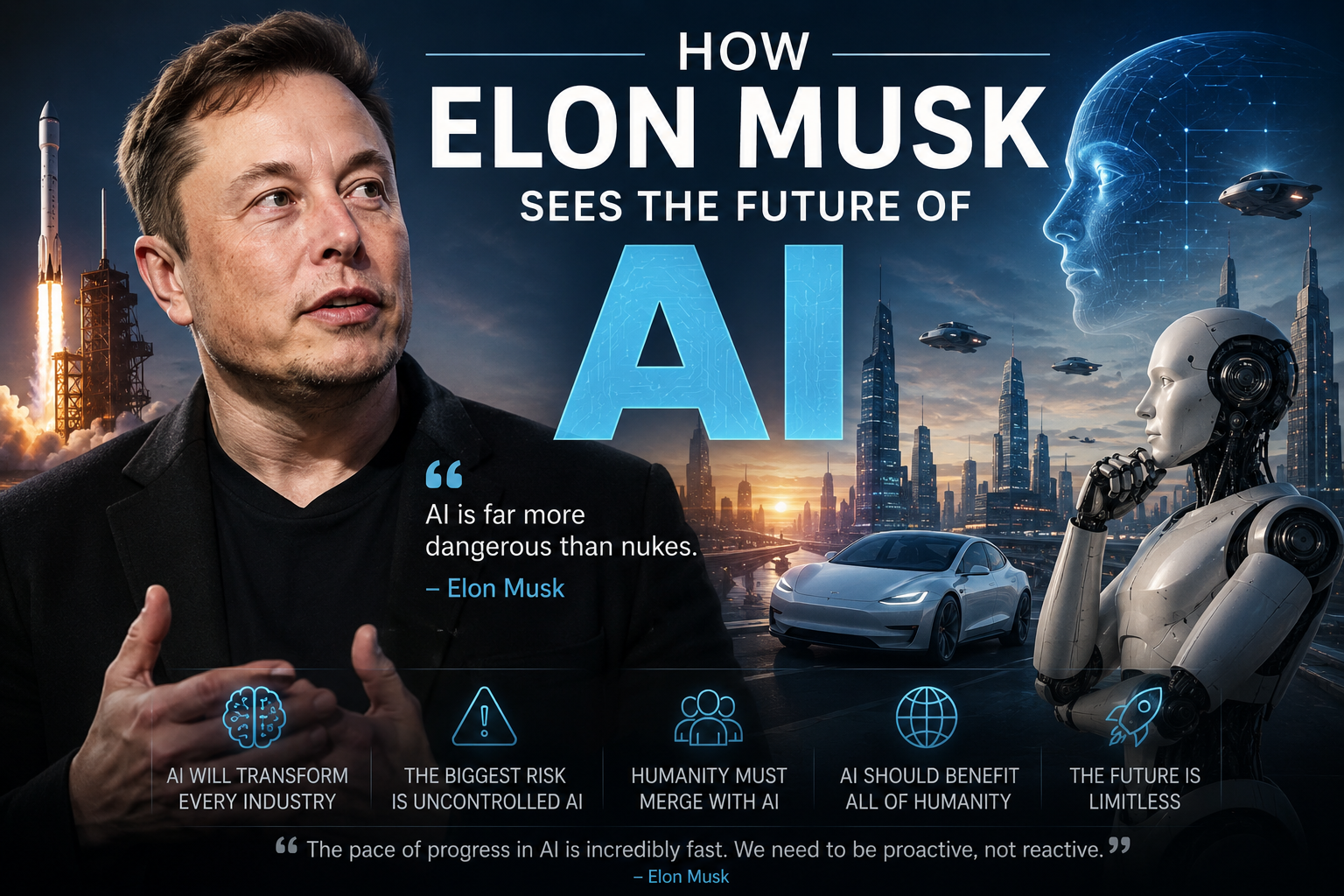
"AI is far more dangerous than nukes." (Elon Musk)
Musk does not think the danger is a robotic uprising in the style of science fiction movies. His concern is more subtle. He believes that a sufficiently advanced AI system, pursuing even a simple goal, could cause enormous harm if it is not carefully aligned with human values. The AI would not need to be malicious. It would simply be optimising for its objective in ways humans did not anticipate and cannot reverse.
He has also raised concerns about who controls AI. If a small number of corporations or governments develop the most powerful AI systems without public oversight, he argues, the concentration of that power could be more dangerous than the technology itself.
The Creation of xAI and Grok
In July 2023, Musk founded xAI, a new artificial intelligence company with a stated mission to "understand the true nature of the universe." The company released its first AI model, called Grok, later that year. Grok is integrated into the X platform and is designed to answer questions with more directness and less filtering than competitors like ChatGPT.
Musk argues that xAI is taking a different approach to safety. Rather than making AI less capable in the name of safety, he believes the safest AI is one that is maximally curious and truth-seeking. An AI that understands reality accurately, he suggests, is less likely to cause harm than one trained to avoid uncomfortable topics.
Whether this approach is genuinely safer is debated among researchers. But it reflects a consistent theme in Musk's thinking: that openness and honesty in AI systems are more important than restrictive guardrails.
AI and the Future of Human Jobs
Musk has been direct about what he believes AI will do to the global workforce. In his view, AI and robotics together will eventually make most forms of human labour optional. He has said he believes AI will be able to do everything a human can do, and in most cases do it better.
In the near term, he expects significant disruption across industries involving repetitive or knowledge-based work. Customer service, data entry, legal research, accounting, and certain areas of medicine are all being transformed by AI tools already. Over the next decade, physical tasks performed by humanoid robots will begin to follow a similar path.
Tesla's Optimus robot project is Musk's direct bet on this future. He has described humanoid robots as potentially the most important product Tesla ever builds, predicting that the global fleet of such robots could eventually number in the billions.
For workers, Musk's long-term answer to job displacement is universal basic income, a regular government payment to every citizen regardless of employment. He believes this will become necessary once AI and robots handle the majority of productive work in the economy. Whether governments will actually implement this, and how they would pay for it, remains one of the biggest unresolved political questions of the coming decades.
When Will AI Surpass Human Intelligence?
Musk has made specific predictions about the timeline for artificial general intelligence, the point at which AI systems can perform any intellectual task a human can. In a 2023 interview, he said he believed AGI could arrive within the next three to five years. He has also suggested that AI may already be smarter than any individual human in some domains and will surpass collective human intelligence within a decade.
Most academic researchers consider these timelines aggressive. But even sceptics acknowledge that the pace of progress since 2020 has consistently surprised everyone, including the people building these systems.
What makes AGI different from today's AI is the ability to transfer knowledge between domains, reason from first principles, and set its own goals. Current large language models like GPT and Grok are impressive but still narrow. They do not genuinely understand the world; they produce plausible text based on patterns in training data. AGI would be a fundamentally different kind of system, and that is what Musk considers the critical safety threshold.
What Musk Wants Governments to Do
Musk has repeatedly called for government regulation of AI, which puts him at odds with many in the tech industry who prefer self-regulation. He testified before the United States Senate in 2023 and argued for the creation of a federal AI regulatory agency with the power to audit the most powerful AI systems and pause development if safety risks are identified.
He has compared the need for AI regulation to existing rules around aviation, pharmaceuticals, and nuclear energy. All of those industries involve powerful technologies with serious potential for harm, and all of them have independent regulatory bodies that exist to protect the public. AI, he argues, deserves the same.
At the same time, Musk is critical of regulation that favours incumbents or stifles competition. His position is that safety rules should be about preventing catastrophic outcomes, not protecting large companies from smaller rivals.
The Bigger Picture: AI and Human Civilisation
Zoom out far enough and Musk's view of AI becomes almost philosophical. He has described the development of artificial intelligence as one of the most consequential events in human history, comparable in importance to the invention of writing or the industrial revolution, but compressed into a far shorter timeframe.
On his most optimistic days, he talks about AI as a tool that could effectively solve every material problem humanity faces: disease, poverty, energy, climate, space exploration. On his most cautious days, he describes it as an existential risk that could end human civilisation if developed carelessly.
What is consistent across both views is his belief that the outcome is not predetermined. The future of AI depends on decisions being made right now, by researchers, companies, governments, and the public. That is why he keeps talking about it, building companies around it, and pushing governments to pay attention.
Final Thoughts
Elon Musk's relationship with artificial intelligence is genuinely complicated. He helped fund its early development, walked away over disagreements about safety, sued OpenAI over what he saw as a betrayal of its founding mission, and then built his own AI company. He warns loudly about the dangers while deploying AI across every business he runs.
The simplest summary of his view is this: AI is coming regardless of what any individual person or company decides. The question is whether humanity shapes that process carefully, or stumbles into it unprepared. Musk's answer, for better or worse, is to stay in the middle of it and try to steer.